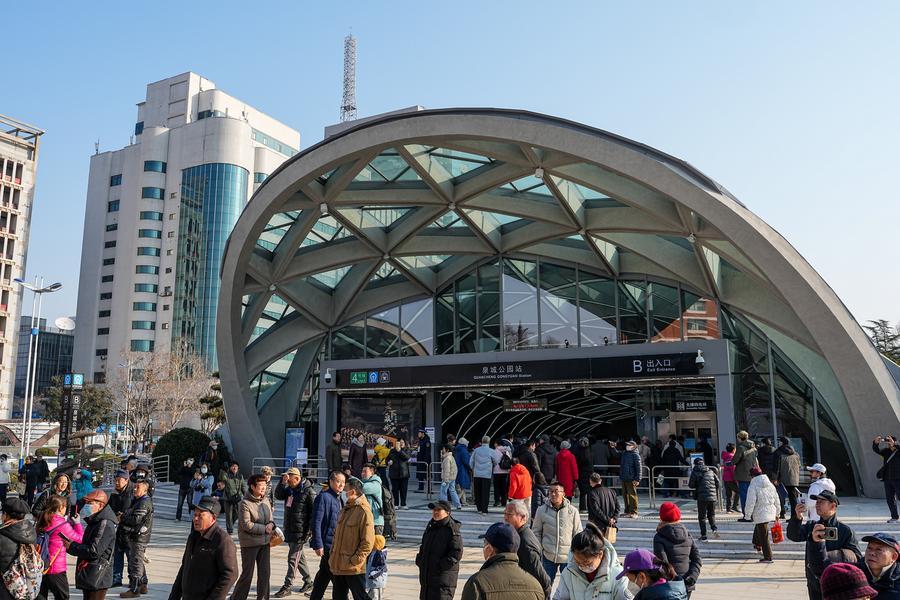
JINAN, Dec. 30 (Xinhua) -- Jinan, the capital of east China's Shandong Province, launched three new subway lines over the weekend, a milestone following decades of efforts to balance subway construction with the protection of its famed natural springs.
On Saturday, Line 4 and Line 8 of Jinan's subway system began operations, alongside a section of Line 6, expanding the city's rail transit network to a total length of 248 kilometers and, for the first time, bringing subway services to the city center where many of its famous springs are concentrated.
Line 4 is China's first subway line to pass through a karst spring area, one of the most fragile environments for underground construction.
The new lines are of significant value to the city, as its earlier lines mainly serve the urban fringe areas and suburbs, relatively far from its sensitive spring regions.
Line 4 runs beneath one of Jinan's busiest transport corridors, significantly reducing travel time and easing road congestion. Sun Wei, who lives in western Jinan but works in the eastern central business district, told Xinhua that his commute to work has been cut from as long as two hours to just 40 minutes.
"Beyond easing traffic, subway construction can optimize the city's spatial layout and cultivate new business models to spur economic growth," said Wang Jiantao, an official of Jinan Rail Transit Group Construction Investment Co., Ltd.
CONSTRUCTION DELAYS
Jinan is called the "City of Springs" for its roughly 1,000 natural artesian springs. Concerns over whether subway infrastructure could coexist with the city's sensitive spring environment delayed construction for years. Many feared that tunneling might disrupt groundwater flows from the southern mountains, which sustain the springs to the north.
An even greater challenge was the city's complex geology, characterized by karst caves, high-strength limestone and aquifers, resulting in the city opening its first subway line much later than many other Chinese cities, said Ba Xingzhi from the School of Qilu Transportation at Shandong University.
"As early as the 1980s, Jinan had thought to build a subway," said Liu Wei, who participated in the city's early metro planning and is the former head of the Jinan branch of Beijing Urban Construction Design & Development Group Co.
Local authorities once invited six academicians of the Chinese Academy of Sciences and the Chinese Academy of Engineering to assess subway construction with groundwater protection.
"The government said if even one expert objected, the plan would have to be reconsidered," Liu recalled. The limited technology available at the time ultimately kept the plan mired in prolonged assessment and planning.
However, mounting pressures from a rapidly growing population and severe traffic congestion prompted the city to revive its construction plan.
A turning point came in 2009, when professional studies concluded that subway construction was feasible if routes could avoid areas with dense spring distribution.
Jinan restarted subway planning in 2010, and construction of Line 1 began in 2015 on the western outskirts, far from key spring zones and densely populated regions.
"Western Jinan has relatively favorable geological conditions," Liu said. "Construction there helped gain experience and develop technology for future construction through downtown areas in tandem with the protection of the famous springs."
NEW TECHNOLOGIES
Breakthroughs in engineering and intelligent technologies have made it possible to expand the city's subway network without sacrificing its natural springs.
A team from the Shandong Provincial Bureau of Geology and Mineral Resources developed high-precision integrated geological survey technology to map groundwater channels.
"It's like giving the main karst groundwater channels a clear ultrasound scan," explained Zhao Zhiqiang, the team's chief engineer. "For the first time, we've identified and delineated these pathways in detail, laying the foundation for the protection of the spring water flow channels."
Planners designed subway tunnels to maintain buffer distances of 2 to 3 meters above the highest water levels of springs. Some stations were even built at shallower depths to avoid disrupting groundwater channels.
As Line 4 passes through the core spring area, with one part within 2 kilometers of the iconic Baotu Spring, engineers installed U-shaped groundwater diversion channels to maintain natural water flow.
To minimize impacts on water systems, planners also directed subway lines away from sensitive spring areas and kept them clear of underground aquifers.
The team also developed a smart groundwater monitoring platform covering 213 locations across the city. The system tracks groundwater flow directions, flow speeds and water quality in real time, enabling early warnings of even minor fluctuations in spring water levels.
Monitoring data shows that the water level of Baotu Spring reached 30.32 meters in mid October, the highest recorded since 1966.
"This demonstrates that our spring protection measures and innovative engineering approaches are scientifically effective," said Huang Yongliang, a senior engineer for spring protection from Jinan Rail Transit Group Co., Ltd. ■