TIANJIN, July 4 (Xinhua) -- Laura Maria Cinquini, an Italian PhD candidate in world history at the University of Turin, has returned to Tianjin, a municipality in northern China, to continue her research on Chinese glass painting.
Her latest visit brought her back to Zhang Chunlin, a representative inheritor of a Tianjin intangible cultural heritage item, involving glass painting techniques of dyeing, etching and grinding.
Cinquini's research focuses on modern and contemporary Chinese glass painting. "I have been studying this field for several years, trying to trace the overall historical thread of this painting tradition. While previous scholars have mostly concentrated on ancient glass paintings, I am more interested in its modern and contemporary development," she said.
Glassmaking dates back to ancient Egypt and later spread to Italy through the Roman Empire, with Italy having played a significant role in the history of glass painting.
This art form was introduced to China by missionaries and gradually merged with traditional Chinese painting techniques, forming a distinctive Chinese glass painting style.
In the 1920s and 1930s, glass paintings became a common sight in Chinese households, often presented as popular gifts for weddings and business openings. Tianjin's glass painting industry remained prosperous until the 1980s and was once an important category of Chinese export paintings, before later losing much of its export appeal.
Luo Shuwei, a Chinese cultural historian, noted that glass painting is a product of early cultural exchanges between China and the West.
"Tianjin was a key trading port in the Qing Dynasty (1644-1911). Early glass paintings were mainly used for interior decoration, but later incorporated elements beloved by Chinese people, such as auspicious patterns, folk tales and figures, making them fashionable gifts for weddings, birthdays, housewarmings and shop openings," Luo said, adding that Tianjin's glass paintings, characterized by their adoption of traditional Chinese ink painting techniques, carry a unique local flavor and represent the folk memory of a specific era.
Cinquini's fascination with Chinese glass painting began at the State Museum of Hanover in Germany, where she interned during her master's studies at the University of Bologna. She helped curate a private exhibition of Chinese glass paintings collected by a German couple, marking her first close encounter with this art form and sparking her academic pursuit.
While researching, Cinquini came across an online article about Zhang Chunlin and decided to travel to China to meet him in person. In August 2025, she made her first solo trip to Tianjin, determined to explore this intangible cultural heritage.
Zhang, a fourth-generation inheritor of the glass painting dyeing, etching and grinding techniques, grew up immersed in the craft. He began learning glass painting from his father when he was around six or seven. Over the past five decades, Zhang has become one of the few craftsmen to master all three techniques, and can, notably, integrate them in his creations.
"It moved me deeply that an Italian researcher is so passionate about Chinese glass painting that she would cross half the globe to find me. Her dedication and eagerness to learn are truly admirable," Zhang said.
"Glass painting came from the West but took root in China. The fusion of Chinese and Western elements, appealing to both refined and popular tastes, is a testament to the mutual exchange and influence of Eastern and Western arts," Zhang added.
After a few days of productive exchanges, Cinquini left with a promise to document what she had learned about Tianjin's glass painting heritage and to return with more questions.
The two have stayed in touch. "Cinquini shares her research progress with me. She is meticulous in her scholarship, often verifying a single point repeatedly. I am delighted that her research will help more people around the world learn about Tianjin's glass painting and its continuous innovation," Zhang said.
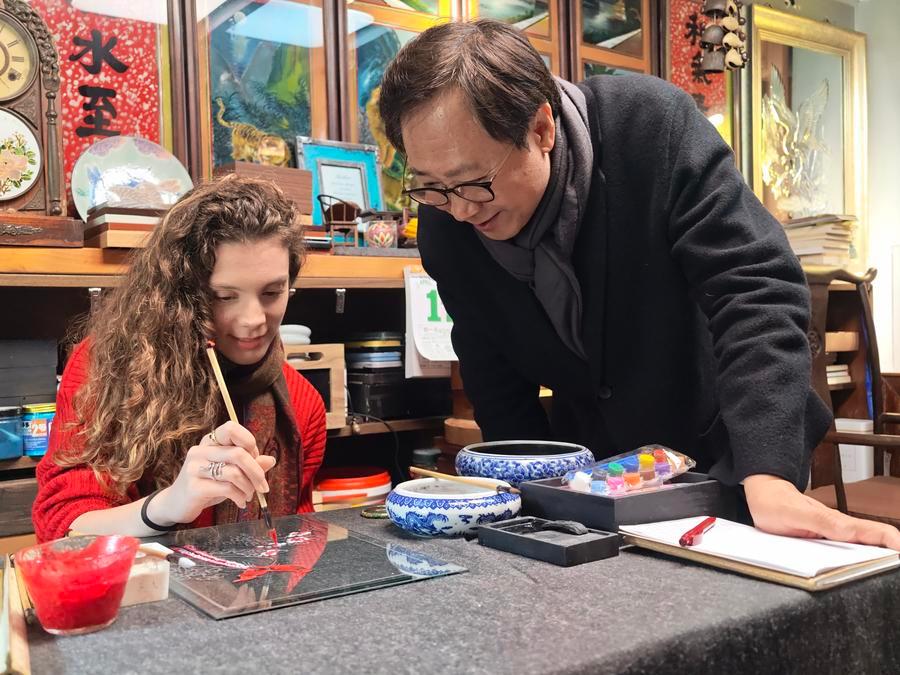
In April 2026, Cinquini returned to Tianjin with more research topics. This time, she not only observed but also tried her hand at glass painting.
In Zhang's studio, he sketched a design of two birds on a branch with a Chinese brush and guided her through the coloring process. Cinquini immediately recognized the motif as the traditional "double longevity" pattern commonly seen in glass painting. Though she had studied glass paintings for years, it was her first time to actually paint one.
"From Italy to China, I have visited many places and seen many glass paintings from different periods, but this is my first time creating one myself, which makes this trip unforgettable," she said after finishing her debut piece.
During her latest China tour, Cinquini also visited various places including Yibin, Yinchuan, Guilin, Guangzhou, Macao and Hong Kong, tracing the footprints of Chinese glass painting across the country.
"This skill, introduced from the West, has taken root in China and become a medium reflecting life and recording the times," she observed.
Via field investigations and conversations with inheritors, Cinquini has gained an in-depth understanding of the history, techniques and cultural significance of Chinese glass painting, amassing substantial material for her research.
Now an active researcher and promoter of the craft, Cinquini said: "I am in my second year of the PhD program, so I still have ample time for research. There are many more stories to uncover about Chinese glass painting and I will keep coming back to China."
She plans to compile her findings into a book and introduce Tianjin's glass painting to Europe, while building connections with scholars, collectors and museum experts from both China and the West to expose this unique intangible heritage to a broader audience.
"I hope to build a cultural bridge between the East and the West through glass painting," Cinquini said with conviction. ■