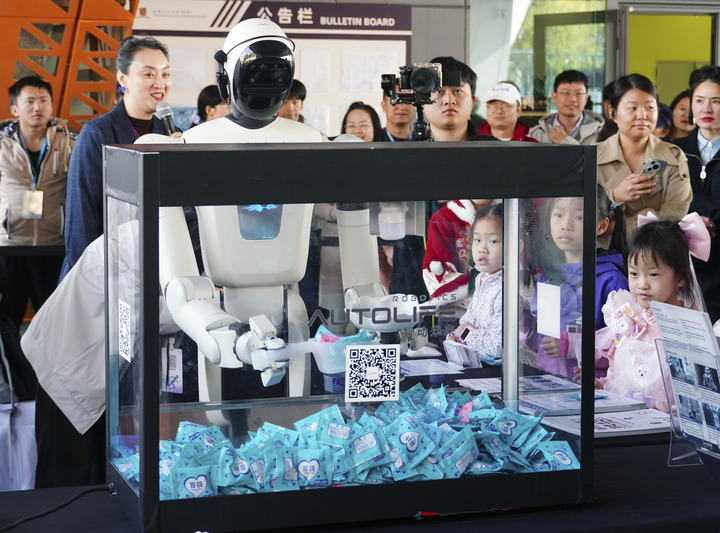
SHENZHEN, July 1 (Xinhua) -- Nestled within a 10-kilometer stretch flanked by the Tanglang and Yangtai mountains in Shenzhen's Nanshan District, China's "Robot Valley" has rapidly evolved into a global epicenter for robotics innovation, driven by an unparalleled supply chain and deep industry-academia integration.
Home to over 200 robotics firms and nearly a dozen universities, the valley is thriving with a seamless collaboration across the entire industry chain.
The year 2026 marks a new milestone for the sector, characterized by dual breakthroughs in technological prowess and capital markets. In April, "Flash," a humanoid robot developed by Shenzhen Honor Smart Technology Development Co., Ltd., swept the 2026 Beijing E-Town half-marathon. Securing the top six spots and shattering the human world record, the machine showcased leading advancements in power cores, liquid cooling, and motion control.
Capital markets have responded to this technological momentum. Leju Robotics' initial public offering (IPO) application was accepted by the Shenzhen Stock Exchange in May, with plans to raise 2.6 billion yuan (about 381 million U.S. dollars).
Manufacturing might is equally evident. In 2025, local collaborative robot pioneer DOBOT saw its shipments surpass 100,000 units, maintaining a leading position in worldwide exports for eight consecutive years. EngineAI Robotics inaugurated its Honghualing base within the Robot Valley in May, unveiling an assembly line capable of delivering a T800 humanoid robot every 15 minutes.
Fueled by these advancements, Shenzhen's robotics sector reached historic highs in 2025. Humanoid robot production surged 83.1 percent year on year to 343,400 units, while the total robotics industrial output value exceeded 240 billion yuan, up over 20 percent year on year.
This rapid ascent is rooted in Shenzhen's strategic focus on high-end innovation, such as embodied intelligence, while leveraging the broader manufacturing capabilities of the Guangdong-Hong Kong-Macao Greater Bay Area (GBA).
As NVIDIA CEO Jensen Huang noted, the GBA possesses a unique global advantage as the only region concurrently excelling in both mechatronics and artificial intelligence (AI). Within the Robot Valley, this synergy translates into unmatched supply chain efficiency.
Xu Jincheng, CEO of tactile sensing firm Paxini Tech, highlighted how circuit board iteration cycles have been slashed to just one or two weeks. Zhou Jian, founder of humanoid robot maker UBTECH, emphasized that Shenzhen boasts China's most complete AI and robotics supply chain, creating a closed-loop ecosystem that drastically accelerates product iteration.
This rapid commercialization is further fueled by a well-established industry-academia-research axis. "Here, a professor's research paper published in the morning can be validated on a neighboring company's production line by the afternoon," said Fan Jianping, president of Shenzhen University of Advanced Technology.
This seamless integration enables a relentless rhythm of "morning R&D, afternoon testing, and evening iteration," ensuring Shenzhen remains at the vanguard of global robotics innovation.
Shenzhen's trajectory is emblematic of a broader national strategy to cultivate cutting-edge industries. With embodied AI designated as a new engine for economic growth in China's 15th Five-year Plan (2026-2030), the nation is actively fostering development in key future sectors.
Backed by supportive policies and surging market demand, China has emerged as the world's largest producer of robots.
According to an industry research report, China is home to over 140 humanoid robot makers in 2025, with shipments reaching 14,400 units and accounting for 84.7 percent of the global market.
Experts noted that this dominance is underpinned by a comprehensive industrial ecosystem and a vast array of real-world application scenarios.
Shenzhen's pioneering efforts in robotics serve as a vivid microcosm of China's manufacturing upgrade to higher-end tiers.
Industry insiders also noted that it is China's innovation prowess that has propelled the rise of the city's Robot Valley. ■