XI'AN, July 2 (Xinhua) -- The place where U.S. journalist Edgar Snow trudged his way across the rugged revolutionary heartland in northwest China nine decades ago has been transformed with high-speed trains, upgraded orchards and improved ecological and living conditions.
After months of interviews in Yan'an of Shaanxi Province in the 1930s on the arid Loess Plateau, Snow turned his experiences into "Red Star Over China," a book that brought the remote yet resilient land to international attention and introduced the Communist Party of China (CPC) to the world in a full and honest light for the first time.
This highlighted place witnessed crucial twists in the history of the CPC and the country. It served as the headquarters of the CPC Central Committee in the 1930s and 1940s, and was where Mao Zedong and his comrades led the Chinese People's War of Resistance against Japanese Aggression and where the War of Liberation commenced against the reactionary Kuomintang regime, all before the founding of the People's Republic of China in 1949.
As the CPC marks its 105th anniversary, its endeavors have fundamentally transformed the future of the Chinese people. Under its leadership, China has become the world's second-largest economy, emerged as one of the world's fastest-rising innovators, and established the world's largest education, social security and healthcare systems.
Having led the country to eradicate absolute poverty, the CPC has mapped out a blueprint to basically realize modernization by 2035 and build China into a great modern socialist country in all respects by the middle of the century.
At the Yan'an Revolutionary Memorial Hall, an exhibition focused on the stories of Snow and other international friends in Yan'an is set to open to the public later this year, aiming to attract domestic and overseas visitors.
"With China's growing strength, the founding stories of the CPC take on even greater significance," said Liu Ni, the memorial hall's curator. "What took place in Yan'an has captured more attention from the international community."
Steeped in revolutionary history, Yan'an is now home to 445 revolutionary sites, 19 revolutionary memorial halls and 43,000 revolutionary cultural relics, a powerful draw for tourists seeking to connect with the past.
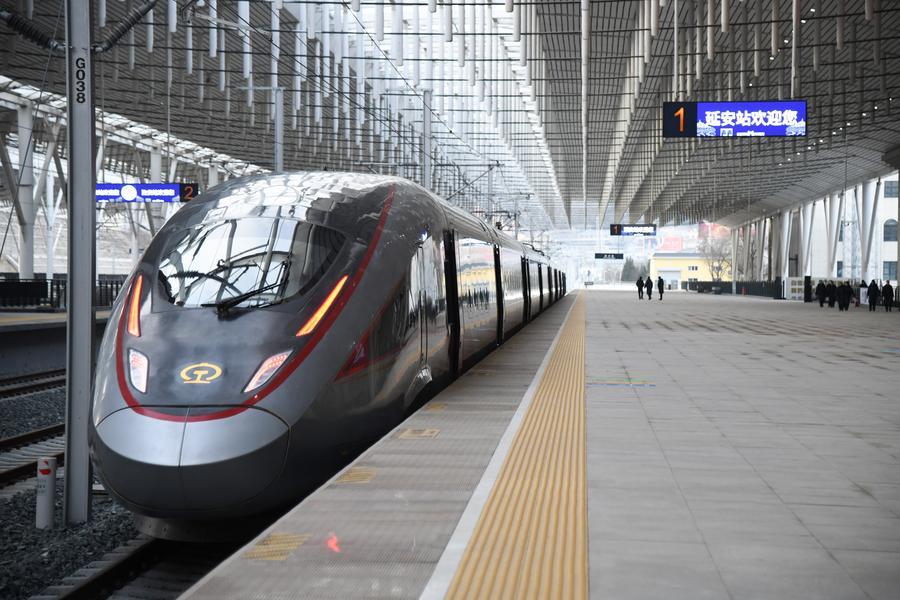
Fortunately, those who wish to visit Yan'an today no longer have to endure the arduous journey that Snow once undertook. In December 2025, the first high-speed rail line in Yan'an officially began operations, slashing the journey time between Yan'an and Xi'an, Shaanxi's capital, to around one hour, with the new route handling more than 1.2 million passenger trips within just three months.
Meanwhile, dedicated trains for study tours are available to students heading to Yan'an. Among the recent visitors was Ding Jiabao, a student from Xijing University in Shaanxi, who joined some 300 fellow members on a two-day program.
"All the revolutionary cultural relics, revolutionary sites and real stories of heroes have helped me understand the original aspiration and strength behind the Yan'an Spirit," Ding said.
Forged by revolutionaries and communists of the older generations, the Yan'an Spirit of maintaining the correct political direction, seeking truth from facts, serving the people wholeheartedly, and being diligent and enterprising remains a source of inspiration for the Party and a guiding force for the region's development.
Once depicted by Snow as one of China's poorest regions, Yan'an has capitalized on its natural endowments, including abundant sunshine and significant diurnal temperature variation, to develop its apple industry, making it a key driver of rural revitalization.
Song Wenquan, 67, has witnessed the industrial upgrading over his 30-plus years of cultivation efforts. Today, his orchard is fully managed by a professional service team, with meticulous, standardized care that yields quality fruit. "It saves time, labor and money, and the apples are bigger and fetch a better price," he said.
Song's experience epitomizes the revolutionary base's broader push to deliver tangible benefits to its rural residents. In recent years, Yan'an has upgraded large swathes of its aging orchards, making 80 percent of farm work mechanizable.
Last year, Yan'an produced 5.28 million tonnes of apple, with a total output value of 62 billion yuan (about 9.1 billion U.S. dollars), and the apple industry accounted for over 60 percent of local farmers' operational income. From 1999 to 2025, notably, the per capita disposable income of rural residents in Yan'an surged from 1,381 yuan to 18,759 yuan.
"Apple is not only a source of prosperity for local people, but also an excellent choice for greening the slopes of Yan'an," said Lu Shuguo, director of the city's fruit industry development center, adding that through large-scale apple cultivation, Yan'an has made remarkable progress in curbing soil erosion and improving ecological environment.
Data shows that Yan'an now boasts vegetation coverage of more than 80 percent, thanks to years of afforestation efforts in this ecologically fragile area. "In the past, when it rained, the water running off the slopes was thick with mud, but now it runs clear," said local apple grower Wang Junmin.
Alongside the environmental gains, local people's living conditions are steadily improving.
In an alley called Xingfu, meaning happiness in Chinese, residents used to be unhappy with the rundown conditions they faced. In response to their concerns, a systematic facelift has transformed the place, replacing weathered walls with vibrant murals.
"New streetlights have been installed, the guardrails repaired and the road repaved. All these renovations make me feel reassured," said Wang Zhiming, a local resident in this alley.
More detailed measures are also underway to meet the diverse needs of residents, ranging from adding more entertainment facilities for the elderly to screening high-quality films for children.
"They may seem like trivial matters, but we must handle them in a way that truly touches people's hearts," said Li Man, Party branch secretary of the Dangwanjie Community, which administers the alley. ■