BEIJING, May 22 (Xinhua) -- Behind every AI breakthrough lies raw computing power. And China, staying true to its characteristically pragmatic approach, is now racing to industrialize it.
Recent developments offer a striking glimpse of this trend. In Wuxi, a manufacturing city near Shanghai, electronics firm HON-Flex signed an agreement with the local government to build what they call a "token factory". Days later, China Telecom and China Mobile, the country's two telecom giants, began selling "token packages" directly to consumers, with entry-level plans starting at just 9.9 yuan (about 1.46 U.S. dollars) a month.
The ambition runs deeper than merely expanding data centers and stockpiling AI accelerators. China is methodically converting computing power into a measurable and priceable commodity -- much like water, electricity, or bandwidth. By leveraging the vast subscriber networks of traditional telecom operators that already reach billions of users, this push is poised to accelerate AI services into the marketplace.
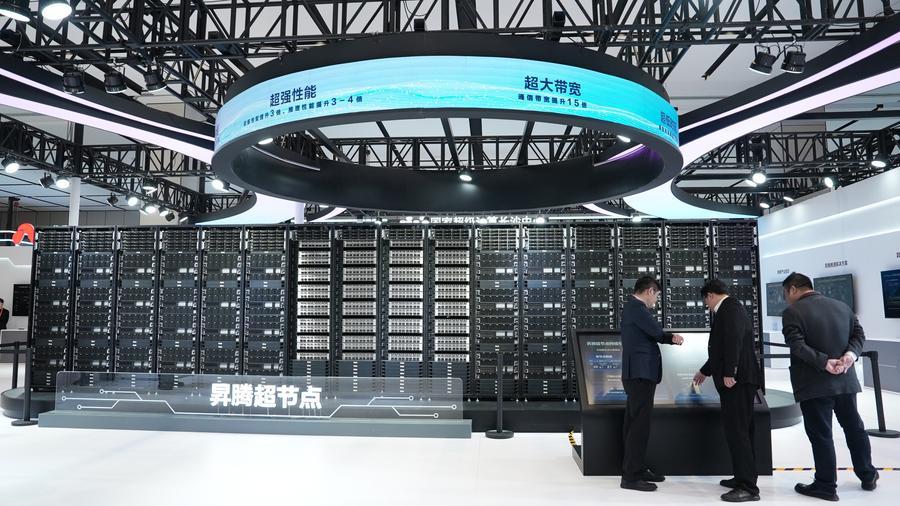
Wuxi is accommodating the physical anchor for this shift. HON-Flex has declared it will build a large-scale, high-performance supernode computing cluster here, powered by domestic chips and models.
This industrial-scale facility, which is built on AI accelerator clusters and combines power supply, liquid cooling systems, high-speed networks, and large model inference optimization technologies, is intended to mass-produce AI tokens, the fundamental units of large language model output.
The "token factory" will initially deploy four Huawei Ascend 384 supernode servers, each packing the computing power of 384 Ascend AI accelerator cards.
According to the Bureau of Science, Technology, Industry and Information Technology of Wuxi National High-tech District, the new "token factory" will directly provide low-cost and high-efficiency intelligent computing power services to AI enterprises in Wuxi and the broader Yangtze River Delta region. Meanwhile, it will drive the agglomeration of chip adaptation businesses, model optimization industries and industrial application sectors in Wuxi.
The project utilizes green power generated in northwest China's Qinghai Province, which is abundant in solar and wind power. Integrating basic clean energy-powered computing resources transmitted from the province with the supernode cluster in Wuxi, the project will convert raw "computing power" into standardized "tokens" that can be directly invoked by AI applications.
This approach makes full use of low-cost western green energy to reduce token production costs while ensuring consistent computing service provision.
According to the National Data Administration, China's average daily token calls have exceeded 140 trillion in March this year, which represents a surge of more than 1,000 times compared with 100 billion at the beginning of 2024, and an increase of over 40 percent compared with 100 trillion at the end of 2025.
While the emergence of the "token factory" is reshaping the supply side of AI infrastructure, the distribution side is now moving just as quickly.
China Telecom on May 17 launched a series of trial commercial token packages, becoming the first Chinese telecom operator to announce such packages at the group level. Following the move, China Mobile on Wednesday expanded the market with the launch of its own nationwide Token packages.
The actions taken by China's leading telecom carriers point to a broader strategic shift: from selling connectivity to retailing access to foundational AI computing resources for consumers and businesses alike.
China Telecom's token package system mainly targets three groups: individual and household users, developers and micro, small and medium-sized enterprises, and token ecosystem partners.
In addition to major telecom operators, companies such as Alibaba Cloud and Tencent Cloud have also launched token service products. The rollout of these new packages and services is expected to speed up the spread of AI applications among consumers and make token prices more affordable.
The move will not only open a new gateway to inclusive AI services for ordinary consumers, but also promote deeper integration among communications, computing power and AI, creating new opportunities and space for the digital economy, industry experts noted.
Zhou Guijun, editor-in-chief of telecom industry news portal C114, told 21st Century Business Herald that such products are expected to have greater market potential on the enterprise side. In his view, the real logic behind the telecom operators' push into the token economy is not tokens themselves, but the value chain behind them.
According to Li Fei, vice president of Guochuang Software, token packages will help remove the twin hurdles that have dogged smaller businesses -- high compute costs and technical barriers.
Micro, small and medium-sized enterprises no longer need to invest in their own servers or build models from scratch. By buying tokens as needed, they can quickly roll out AI applications like digital workers and content-generation tools, which will facilitate AI-driven upgrading for industries across the board, Li said. ■