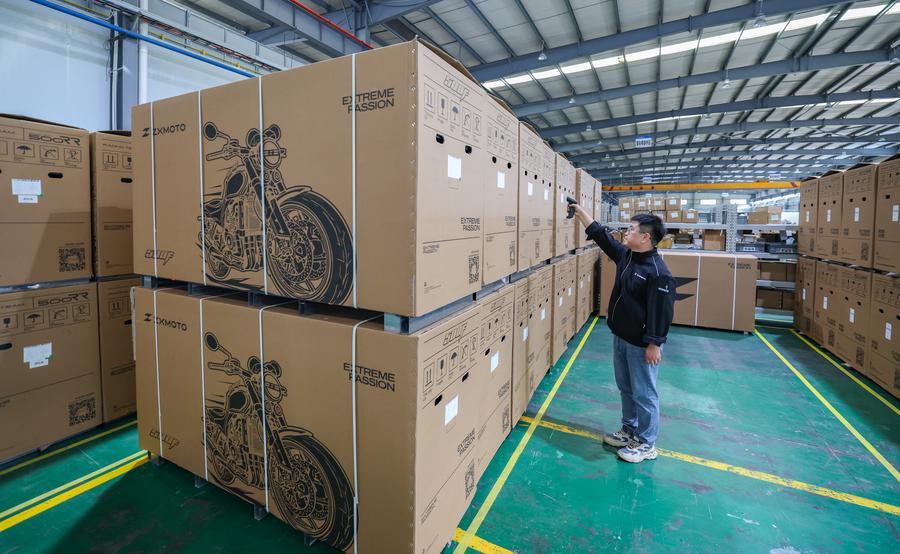
BEIJING, May 19 (Xinhua) -- China is ramping up targeted, systemic efforts to cultivate homegrown brands with global competitiveness, and advance holistic upgrades to product and service quality, noted policy analysts and industry observers.
Chinese authorities, including the Ministry of Industry and Information Technology (MIIT), unveiled an action plan for cultivation of excellent textile and apparel brands (2026-2028) last Monday, setting a clear goal of nurturing no fewer than 25 top-tier domestic brands in this sector by 2028.
As a traditional pillar industry, key livelihood-related sector and globally competitive export-oriented industry, China's textile and apparel industry regards brand development as a core driver of high-quality growth. It plays a vital role in spurring innovation, optimizing industrial structure, enhancing international competitiveness and spreading cultural value, an official with the MIIT's consumer goods industry department said.
The policy is being rolled out in a critical period of transformation and upgrading for China's textile industry, aiming to develop a batch of Chinese characteristic brands widely recognized by the global consumer market, and accelerate the transition from "Chinese products" to "Chinese brands".
In Tianmen, central China's Hubei Province, historically known as a "cotton township," the adoption of a digital quality inspection system has cut garment testing time from 3 minutes per piece down to just 3 seconds, driving the local apparel e-commerce transaction value to surge from 7 billion yuan (about 1.02 billion U.S. dollars) in 2021 to over 70 billion yuan in 2025.
Pursuing high-quality development in the textile industry is a microcosm of China's all-around efforts in "building up national strengths" across various sectors, a key goal outlined in the country's 15th Five-Year Plan (2026-2030).
China has yielded solid results in improving quality governance and brand-building capabilities. Official data shows that China has resolved 25,000 quality bottlenecks across industrial chains, with the quality of a host of major types of technical equipment, key engineering projects, consumer goods and high-tech products in emerging sectors reaching world-advanced standards.
Quality improvement, notably, has been fully integrated into all links of industrial development and people's daily lives. The Baihetan hydropower station in southwest China, the world's second-largest hydropower project, has put in place a full-process intelligent quality control system, assigning unique "digital ID cards" for every construction link to upgrade quality responsibility management from "lifelong accountability" to "full traceability."
For the consumer sector, a full-process traceability system has kept the dairy product sampling pass rate of Xiqiang Group in east China's Anhui Province at 100 percent for three consecutive years, while a "prior inspection before house acceptance" system for residential projects has guaranteed housing quality for more than 110 million residents benefiting from old urban community renovation during the 14th Five-Year Plan period (2021-2025).
Gu Shaoping, an official with the State Administration for Market Regulation (SAMR), noted that "up to now, the total number of national standards in China has reached 48,000," cementing a solid institutional foundation for all-round quality upgrading.
So far, a total of 320,000 Chinese enterprises have appointed chief quality officers, while over 2 million enterprises have received quality training, according to SAMR data.
Going forward, China will further advance quality upgrading at enterprise, industrial chain and county levels, and build quality infrastructure innovation hubs to steadily elevate the country's overall quality strength, the SAMR said.
With services now forming the bedrock of the Chinese economy, the country has also elevated the sector's strategic importance to new heights. China has called for "breaking new ground" in the high-quality development of the service sector at a conference last month, the first of its kind at the national level.
China has rolled out new measures to boost the service sector. The Ministry of Commerce and several other departments recently jointly issued the 2026 work plan for enhancing the quality and accessibility of service consumption, focusing on upgrading service consumption infrastructure while addressing key livelihood concerns like care for the elderly and young children.
Official data revealed that China's service sector had surpassed 80 trillion yuan in added value last year, making up 57.7 percent of the country's GDP. It also contributed 61.4 percent to national economic growth, an increase of 3.7 percentage points from the 2024 level, and accounted for around half of total employment.
Industry observers noted that as China steadily pushes forward its transition from "made in China" to "created in China," from "China speed" to "China quality," and from "Chinese products" to "Chinese brands," more competitive high-quality products and services will emerge as new calling cards of the country, injecting strong impetus into its high-quality development while delivering more benefits to global consumers. ■