* China on Friday began implementing an expanded zero-tariff treatment on imports from all 53 African countries with which it has diplomatic relations, a landmark move seen as promoting openness and cooperation for the Global South amid rising protectionism and fragmentation in the global economy.
* The Ministry of Commerce said that zero tariffs will lower the cost of African products entering the Chinese market and give them a competitive edge. The zero tariffs are also expected to help drive the diversification of African export products, increase their added value and optimize export structures, which will benefit farmers as well as micro, small and medium-sized enterprises, support job creation, and boost people's livelihoods.
* African Union Commission Chairperson Mahmoud Ali Youssouf hailed the move as "very timely" for a continent bearing the brunt of global crises and vulnerable to isolationism.
BEIJING, May 1 (Xinhua) -- China on Friday began implementing an expanded zero-tariff treatment on imports from all 53 African countries with which it has diplomatic relations, a landmark move seen as promoting openness and cooperation for the Global South amid rising protectionism and fragmentation in the global economy.
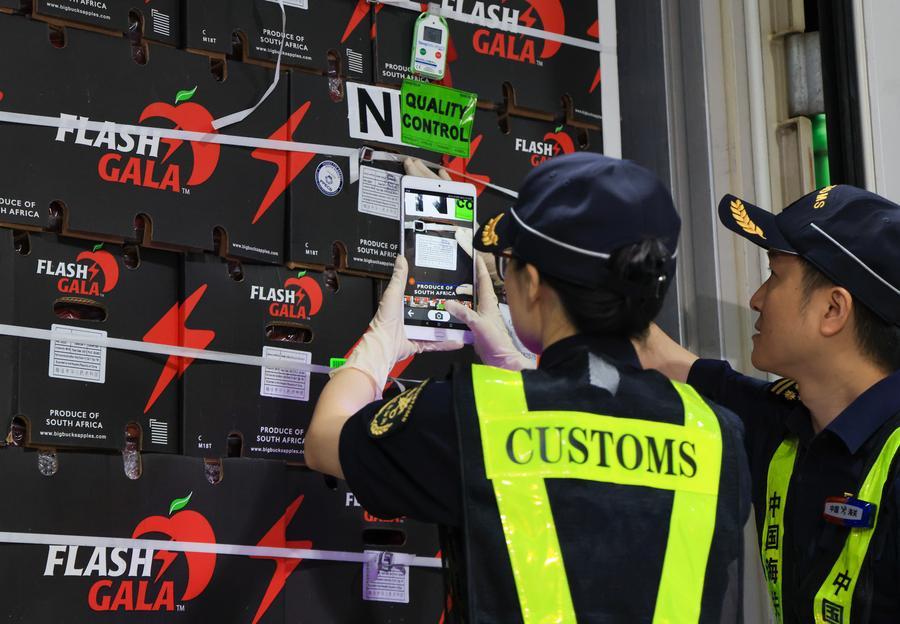
With 24 tonnes of South African apples entering China at Shenzhen Customs in the early hours of Friday as the first shipment under the newly effective initiative, China has become the world's first major economy to unilaterally grant tariff exemption to all African nations with diplomatic ties.
By offering full market access without requiring reciprocal concessions, China is setting a new benchmark for supporting industrialization in the Global South, noted Ricky Mukonza, an associate professor at Tshwane University of Technology in South Africa.
PIONEERING COMMITMENT & "GOLDEN HALLMARK"
China had already scrapped tariffs on 100 percent of tariff lines for imports from 33 least developed countries (LDCs) in Africa since Dec. 1, 2024.
Under the new policy, from May 1, 2026 to April 30, 2028, China will grant zero-tariff treatment, in the form of a preferential tariff rate, to 20 African non-LDCs that have established diplomatic ties with China, according to the Customs Tariff Commission of the State Council.
The Ministry of Commerce said in a statement that China's latest move will create opportunities on multiple fronts, adding that zero tariffs will lower the cost of African products entering the Chinese market and give them a competitive edge.
According to the ministry, the zero tariffs are also expected to help drive the diversification of African export products, increase their added value and optimize export structures, which will benefit farmers as well as micro, small and medium-sized enterprises, support job creation, and boost people's livelihoods.
The ministry also expects the zero-tariff policy to further advance China-Africa cooperation in areas spanning services trade, digital trade, green industries and sustainable development, which will be conducive to enhancing Africa's capacity for independent development and accelerating its modernization process.
African Union Commission Chairperson Mahmoud Ali Youssouf hailed the move as "very timely" for a continent bearing the brunt of global crises and vulnerable to isolationism.
"I would like to express, on behalf of the African Union Commission, our sincere gratitude for this very brotherly gesture that all Africans appreciate," Youssouf told media last week.
"The policy is a strong sign of China's long-term commitment to Africa's development," said Mukonza. He described it as a significant milestone in South-South cooperation that will strengthen confidence across the continent.
The move stands in stark contrast to the rising tide of unilateralism and protectionism globally. "While some regions are turning toward protectionism, China's approach offers an alternative based on openness and cooperation," Mukonza said.
China is Africa's largest trading partner. According to China's General Administration of Customs, China-Africa trade hit a record high of 348 billion U.S. dollars in 2025. Meanwhile, China's imports from Africa amounted to 123 billion dollars, up 5.4 percent year on year. In the first quarter of 2026, bilateral trade witnessed an increase of 23.7 percent year on year, with Chinese imports growing by 14.6 percent.
From January to February, China's new direct investment in Africa surged 44 percent year on year, according to Du Xiaohui, director-general of the Department of African Affairs at the Ministry of Foreign Affairs.
Du called the zero-tariff arrangement a "golden hallmark" for China-Africa cooperation in the new era, poised to become an enduring engine for the high-quality development of bilateral relations.
"The removal of tariffs lowers the risk for exporters and sends a strong signal that the Chinese market is stable and offers long-term opportunities for African brands," Mukonza said.
UNLOCKING OPPORTUNITIES, ADDING CERTAINTY
Experts say that the zero-tariff policy is expected to catalyze Africa's industrial and agricultural modernization. By slashing costs for African exports, it will help rebalance trade flows, diversify African exports, and position the vast Chinese market as a more appealing destination for higher added-value African products.
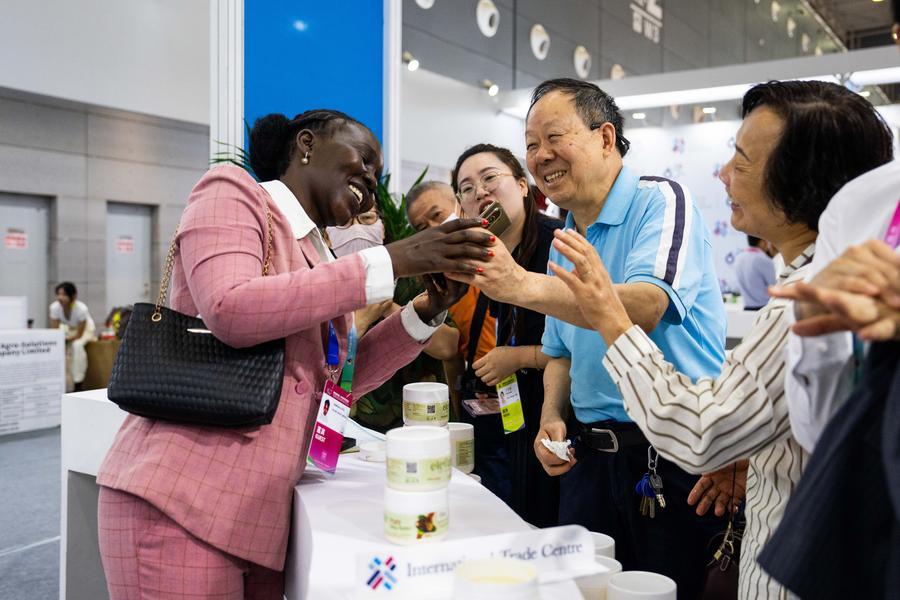
At the permanent exhibition hall of the China-Africa Economic and Trade Expo in Changsha, capital of central China's Hunan Province, over 2,000 types of African specialty products are displayed, ranging from coffee and spices to handicrafts, among others.
"With the zero-tariff policy, customs clearance costs for African goods will drop significantly, and market access will be further eased," said Yang Yi, general manager of the exhibition hall's operator, Hunan Yufei Industry Investment Co., Ltd. He anticipates a steady flow of premium African products into the Chinese market, enriching consumer choice.
Chinese enterprises are actively leveraging the new policy to build integrated cross-border supply chains. Li Huanguo, chairman of Jingzhou Guoling Technology Co., Ltd., plans to import 3,000 tonnes of Poria cocos from the Republic of Congo over three years.
"Relying on the zero-tariff policy, we will work with the Congolese side to build demonstration planting bases and create a Poria cocos health brand in Africa," he said, highlighting a model of industrial synergy.
Lan Shengbin, deputy director of Changsha Customs, said the policy would bring multiple positive impacts. The import of high-quality African agricultural products, such as macadamia nuts from South Africa and fresh avocados from Kenya, is expected to expand, according to Lan.
Zhao Yongsheng, a researcher at the University of International Business and Economics, described the tangible, win-win benefits from zero tariffs as the embodiment of the all-weather China-Africa community with a shared future for the new era.
"The policy's 'multiplier effect' is reflected on multiple levels," Zhao said. In the short term, it boosts employment and income in Africa. In the medium term, it promotes industrialization through investment and technology transfer. In the long run, it helps cultivate African consumption power, ultimately contributing to a more balanced global trading system.
Wang Xuekun, head of the Chinese Academy of International Trade and Economic Cooperation under the Ministry of Commerce, said the latest move marks a new stage in China-Africa economic and trade cooperation, transitioning from "unilateral openness" to "institutional empowerment."
It also embodies a pragmatic action by developing countries in the Global South to explore independent development paths, Wang added, noting that this also adds certainty to the global economy.
China has been deepening reform and opening up comprehensively with unswerving commitment. It has expanded unilateral opening up, adopting zero tariffs on all products from all the LDCs with which it has diplomatic ties, according to last year's government work report.
China will open wider to the world. The country will expand market access and open up more areas, particularly in the service sector. It will further expand opening-up trials for value-added telecom services, biotechnology, wholly foreign-owned hospitals and other fields, take well-ordered steps to expand opening up in the digital sector, and shorten the negative list for cross-border trade in services, according to the government work report released in March this year.
(Reporting by Pei Jianrong, Wang Hongjiang, Wang Xiuqiong, Zhang Xu, Hao Wangle, Yao Yuan, Qiang Lijing, Tian Yun, Zhang Yujie, Zou Duowei, Wang Feng, Jiang Guopeng and Bai Ge; Video reporters: Zheng Mengyu, Liu Fangqiang, Hua Hongli, Dai He, Xu Ruiqing and Ding Chunyu; Video editors: Cao Ying, Liang Wanshan, Roger Lott and Luo Hui.)■