SANYA, April 27 (Xinhua) -- When 34-year-old Sun Zhixu first encountered a teqball table in 2019, he could not have imagined that the curved structure, resembling a table tennis table, would reignite his passion for sport.
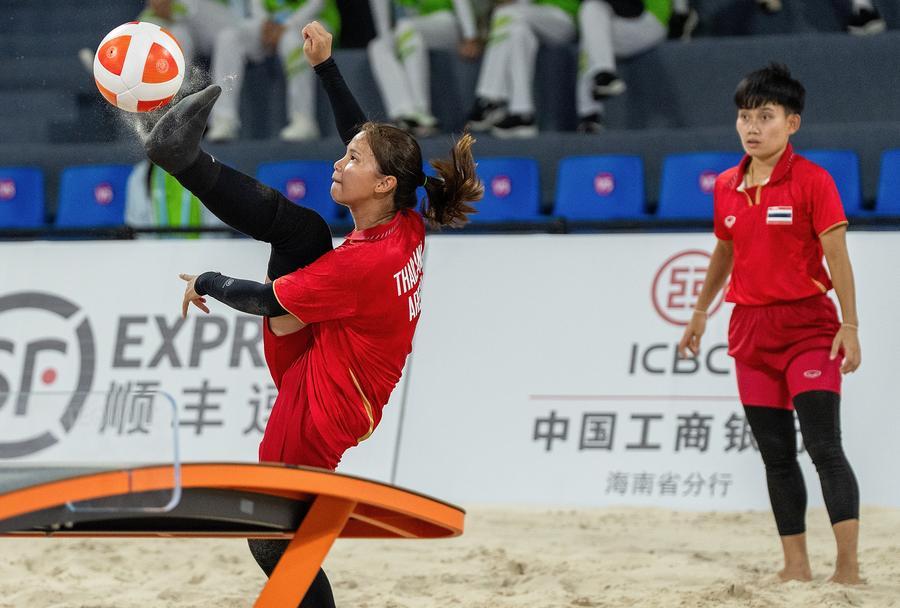
Teqball, a sport that originated in Hungary in 2012, combines football skills with a table-based format, allowing players to strike the ball with any part of the body except the arms and hands. Each side is allowed up to three touches per return. With no physical contact, the sport is both technically demanding and relatively low-risk.
For Sun, the sport came at a turning point. A former football player who had once pursued a professional career, he later moved into club management.
When teqball equipment was first introduced to Xiamen in south China's Fujian Province, Sun reconnected with his longtime classmate and teammate Zhang Junming, and the pair began exploring the sport together.
Zhang's path was shaped by injury. After playing for a professional club's reserve team and competing at the university level, he was forced to step away from football. "After recovering, I realized I might be better suited to a sport with less physical confrontation but higher technical demands," Zhang said. "Teqball gave me the chance to compete again."
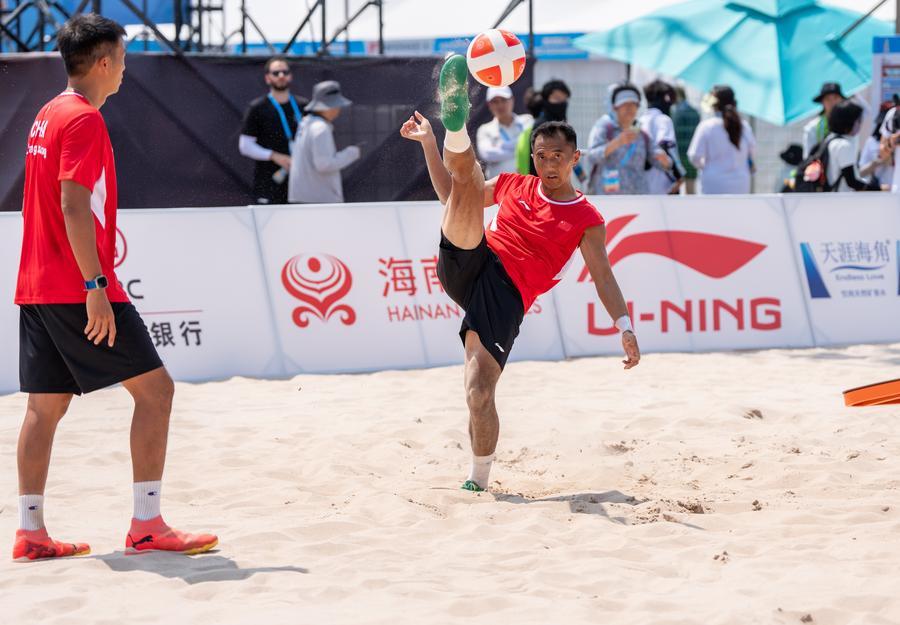
At the time, the sport was virtually unknown in China. "In the beginning, there were just the two of us playing in Xiamen," Zhang recalled. "But we knew there were international competitions, and we didn't want China to fall behind at the starting stage."
With limited access to coaching or competition, the pair relied largely on self-training in the early days. "We didn't have a coach or a system at that time," Zhang said. "We just practiced in our spare time and watched videos of overseas players online, trying to imitate their movements."
"Sometimes we would repeat the same action again and again, just to find the right feeling," he added. "It was a process of constant trial and error."
In recent years, teqball has gradually gained ground in China. Initially promoted by enthusiasts and private organizations, the sport has since received growing institutional support. The General Administration of Sport of China has begun organizing national teams and integrating the sport into multi-sport events, while universities are introducing courses and competitions.
"The sport is suitable for a wide range of people," Zhang said. "With flexible rules, people of different ages can all enjoy it."
Teqball's growing profile has also been boosted by its inclusion in regional competitions. At the 6th Asian Beach Games in Sanya, the first official adult teqball event at the Asian level, China fielded a six-member squad in the men's doubles, women's doubles and mixed doubles.
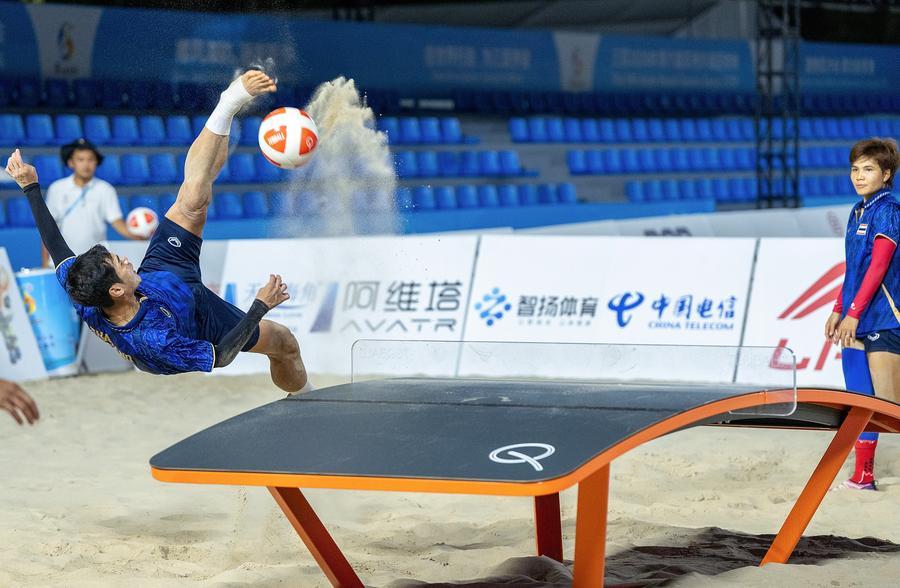
Sun and Zhang teamed up in the men's doubles but were eliminated in the quarterfinals last Sunday after a closely contested match against a Myanmar pair.
"We were just one step away from the semifinals," Sun said. "It's a pity, but also a valuable experience."
Despite the setback, both players highlighted the significance of competing on such a stage. For athletes in their 40s, opportunities to take part in international events are limited. "We had been preparing for this since 2020," Zhang said. "To finally stand on this stage means a lot as it fulfills my childhood dream."
Looking ahead, the pair are targeting upcoming events including the Asian Games later this September, which will mark the first time teqball is included in Asia's flagship multi-sport event. "We hope our participation can inspire more young players to join us," Sun said. "This sport needs fresh talent."
As teqball continues to expand worldwide, its blend of skill, accessibility and limited physical contact is attracting growing interest. In China, pioneers like Sun and Zhang are not only pursuing results, but also helping lay the groundwork for the sport's future.
"Maybe one day," Zhang said. "You'll see people playing teqball in schools and communities across the country." ■