
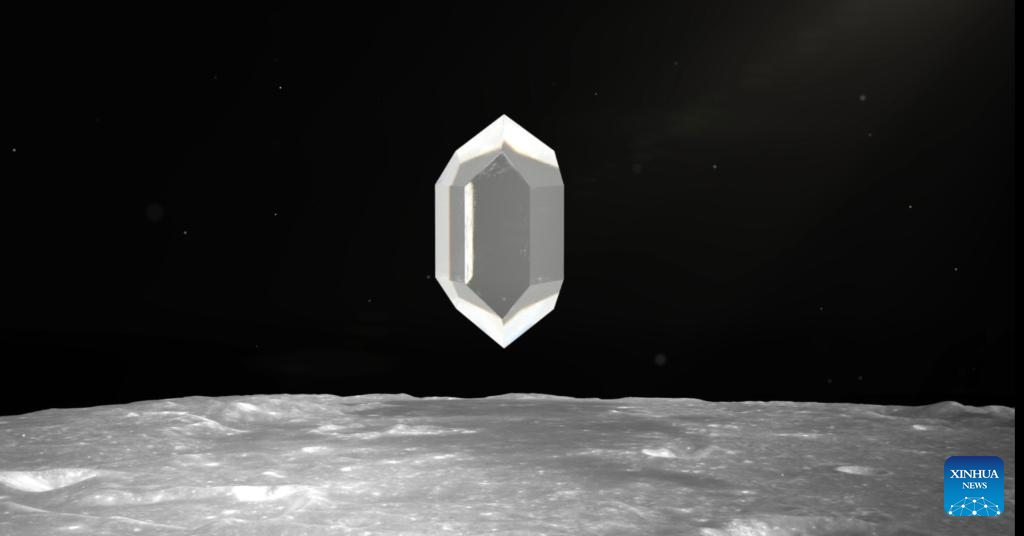
This file image provided by Beijing Research Institute of Uranium Geology, a subsidiary of China National Nuclear Corporation (CNNC), shows an ideal crystal structure of the magnesiochangesite-(Y). (China National Nuclear Corporation/Handout via Xinhua)
CHENGDU, April 24 (Xinhua) -- Chinese scientists have discovered two new lunar minerals from the lunar samples brought back by China's Chang'e-5 mission.
This marks the latest achievement following their first discovery of a lunar mineral, changesite-(Y), in 2022. To date, the total number of new minerals discovered from Moon samples worldwide has reached eight.
At the opening ceremony for 2026 Space Day of China held in Chengdu, capital of southwest China's Sichuan Province, on Friday, the China National Space Administration announced these two findings: magnesiochangesite-(Y) and changesite-(Ce), both of which have been approved by the Commission on New Minerals, Nomenclature and Classification (CNMNC) of the International Mineralogical Association.
TREASURE OF MOON
Li Ziying, chief scientist at the China National Nuclear Corporation (CNNC) and leader of the team that discovered magnesiochangesite-(Y), explained that this new mineral was found in the basaltic debris from the drilled samples brought back by the Chang'e-5 mission in 2020.
It is a calcium rare earth phosphate mineral belonging to the same group as changesite-(Y), yet possesses unique identifying features: extremely small in size, appearing as short columnar crystals with grain diameters of only 2 to 30 micrometers -- approximately one thirtieth to one third the width of a human hair -- invisible to the naked eye, with a distinctive structure, according to Li.
Ge Xiangkun, deputy director of the analysis institute at the Beijing Research Institute of Uranium Geology, a subsidiary of CNNC, noted that the Chang'e-5 lunar samples consist of extremely fine particles. The team had to screen through countless lunar soil grains, analyzing each one individually and making many comparisons, before finally capturing anomalous composition different from known minerals in the vast dataset. They eventually located a single ideal crystal for testing, merely 20 micrometers in size.
"The sample had to be transferred between multiple precision instruments for testing. During the operation, we had to hold our breath throughout and handle it with extreme care, fearing that a single breath might blow this 'lunar treasure' away without a trace," Ge said. Particularly when using focused ion beam scanning electron microscope to extract the single crystal grain, the cutting had to be precise to the micrometer level; any excessive force could "slice away" the tiny crystal.
Crystal structure analysis proved to be an even greater challenge. Following conventional crystal structure models, the team could not obtain satisfactory results and the research stalled at one point. Rather than adhering rigidly to established conventions, the team took a bold approach, systematically testing and validating their findings until they ultimately identified the critical evidence required to confirm the mineral's authenticity.
DOUBLE CONFIRMATION FROM EARTH AND MOON
Hou Zengqian, an academician of the Chinese Academy of Sciences and director of the State Key Laboratory of Deep Earth and Mineral Exploration at the Chinese Academy of Geological Sciences (CAGS), said that changesite-(Ce) is a new mineral species belonging to the merrillite group, characterized as rich in the light rare earth element (REE): cerium (Ce).
Compared to the merrillite-group minerals found in Earth, Mars, and asteroid samples, changesite-type minerals exhibit distinct REE enrichment characteristics. It is precisely this difference that enables scientists to distinguish lunar samples from materials originating from other celestial bodies, making it a kind of "fingerprint mineral."
Wang Yanjuan, the first discoverer of the new mineral from CAGS, explained that the discovery of changesite-(Ce) was based on precious samples from two completely different sources: one from the samples collected by the Chang'e-5 mission from the Oceanus Procellarum region on the near side of the Moon. The other came from a lunar meteorite discovered in the Taklamakan Desert in northwest China's Xinjiang Uygur Autonomous Region in 2024, the first lunar meteorite found within Chinese territory and officially approved by international organizations.
A member of the CNMNC commented in the voting report: "This is a remarkable discovery both on the Moon and on a meteorite that fell to Earth!"
After Chinese research team discovered changesite-(Y) in 2022, scientists from the United States also reported discovering the same mineral through analysis of Apollo samples.
Wang explained that the changesite-type minerals in the Apollo samples are commonly rich in heavy REEs, whereas those in the Chang'e-5 samples show a clear enrichment in light REEs. This indicates a significant differentiation in the behavior of light and heavy rare earth elements during the Moon's magma evolution. This difference provides key mineralogical evidence for understanding the crystallization and differentiation mechanisms of the lunar magma ocean.
REFRESHING HUMAN UNDERSTANDING OF MOON
The unique composition and structure of magnesiochangesite-(Y) provide a new mineralogical sample for studying the Moon's formation and evolution, magmatic activity, and chemical differentiation, Ge said.
He added that the research team has established a mature technical system for studying new minerals in lunar soil, with micron-scale single crystal sample preparation technology reaching internationally advanced levels.
Hou noted that the discovery of changesite-(Ce) not only enriches the variety of minerals in nature, particularly on the Moon, revealing the crystal chemical complexity of merrillite-group minerals in lunar soil, and indicating the diversity of lunar material composition and evolution processes.
As research on lunar samples continues to deepen, human understanding of the material composition and evolutionary processes of the Moon and even terrestrial planets will continue to expand, Hou added. ■
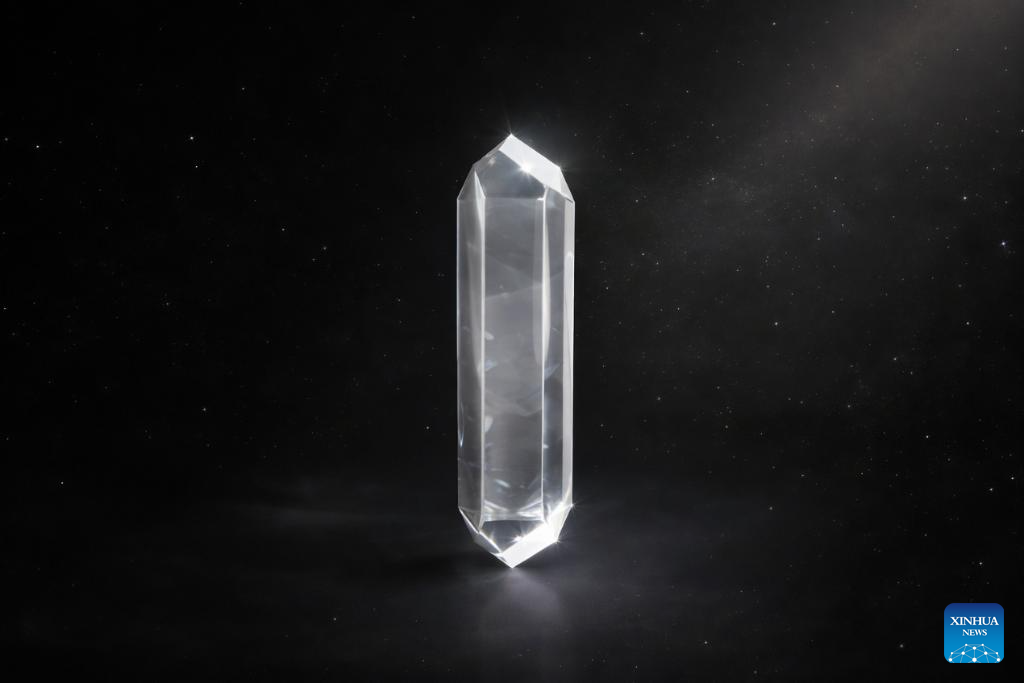
This file image provided by the State Key Laboratory of Deep Earth and Mineral Exploration at the Chinese Academy of Geological Sciences (CAGS) shows an ideal crystal structure of the changesite-(Ce). (State Key Laboratory of Deep Earth and Mineral Exploration at the Chinese Academy of Geological Sciences/Handout via Xinhua)
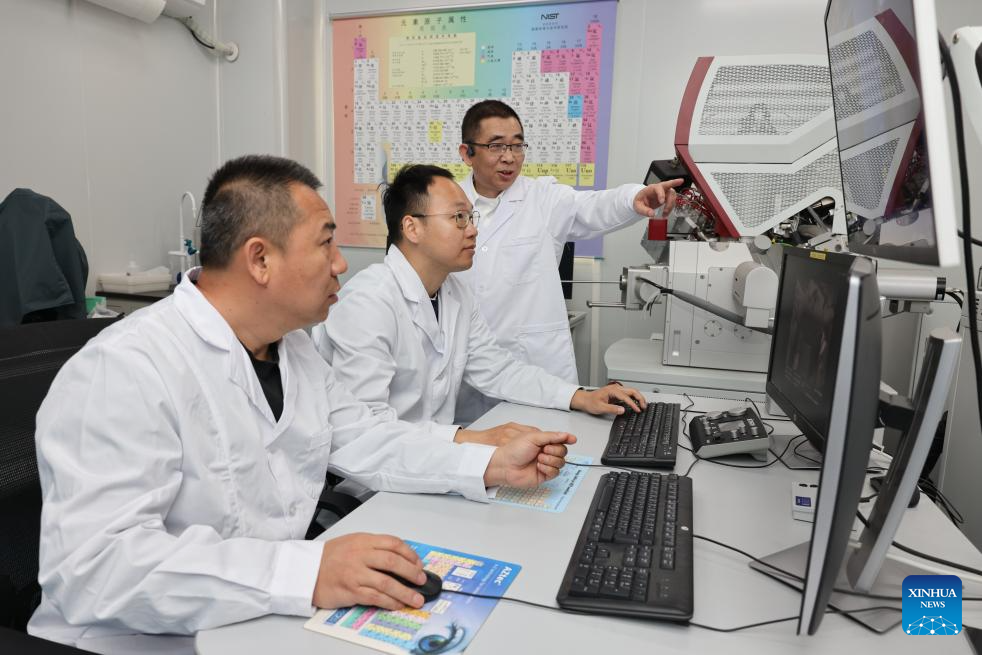
This file photo taken on April 2026 shows researchers discussing the cutting plan for preparing a single crystal particle of the magnesiochangesite-(Y) in Beijing, capital of China. (China National Nuclear Corporation/Handout via Xinhua)


