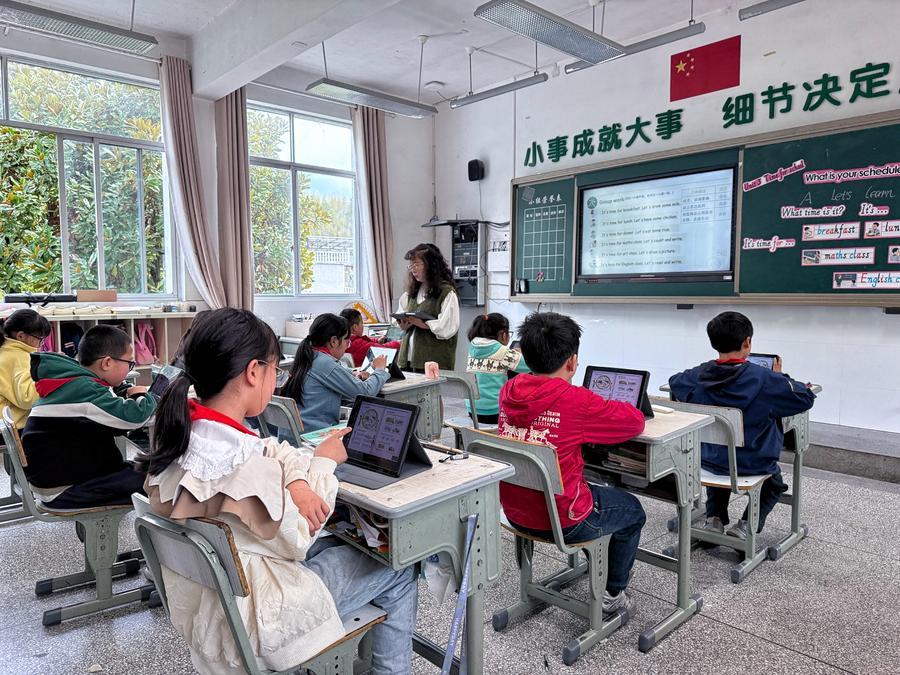
HANGZHOU, April 26 (Xinhua) -- In a reading corner at Qixi Township Central School in Kaihua County, a mountainous area in east China's Zhejiang Province, students sit with tablet computers, absorbed in stories as soft notification chimes mix with the sound of reading aloud.
Through smart devices and mobile networks, these children interact with an AI-powered assistant known as "Qian Xiaowa," which helps them read classics and recite poems, and recommends materials tailored to their abilities and interests.
"There are so many books and picture stories on the tablet that I had never read before," said Wang Xiaoxiao, a 10-year-old fourth grader. "With a tap, I can hear standard pronunciation, whether it's English stories or Chinese texts."
This scene reflects a broader push to narrow China's urban-rural reading gap via technology.
Qixi school sits at the source of the Qiantang River, where the borders of Zhejiang, Anhui and Jiangxi provinces meet. Most of its students are "left-behind children" raised by grandparents while their parents work elsewhere.
For years, the school's library held only a few hundred books, many of them outdated or inappropriate for young readers, said Wang Wenhui, a teacher at the school.
Change began about six months ago with a pilot program aimed at digitally empowering small rural schools across the province. Launched in November 2025, the initiative has provided smart terminals to schools with fewer than 100 students. At Qixi, pupils in grades four to six now have access to such devices.
"Digitalization mainly addresses the shortage of reading resources and the difficulty of access," Wang said. "With these tools, we can focus more on curating materials and offering personalized guidance, encouraging children to read more, read better and complete entire books. About half of the students at the school have developed a daily reading habit," she added.
Similar changes are underway elsewhere in Zhejiang and across China. In Putuo District of Zhoushan, an archipelago with more than 40 inhabited islands in Zhejiang, schools on outlying islands account for about one-third of all local primary and secondary schools and are mostly small ones with limited collections of books.
A digital platform now allows books to be borrowed and returned across libraries, with borrowed books delivered to students within two to three days.
In the southwestern mountainous province of Guizhou, meanwhile, a digital platform offers more than one million e-books, 10,000 digital journals, 36,000 video lectures and 1.5 million audiobooks. Readers in both urban and rural areas can access the same resources via computers or smartphones.
In Daguan County, southwest China's Yunnan Province, the local library has introduced children's e-reading devices and digital services, offering 60,000 e-books and 4,000 periodicals free of charge.
Official data also point to rapid growth in digital reading. By the end of 2025, China had 70.56 million digital reading works, up 11.87 percent year on year, while the digital reading rate among minors reached 75.9 percent, an increase of 0.8 percentage points from a year earlier, according to a national survey.
Policy support is expected to underpin the trend further. The year 2026 marks the first year of implementation of a regulation to promote reading among the public, which took effect in February, mandating the creation of rural reading plans and promoting equal access to basic public cultural services in cities and the countryside.
The regulation designates the fourth week of April each year as national reading week, which is being observed for the first time this year.
"Digital technology means rural children are no longer cut off from quality books because of geography," said Wu Xiangyu, an expert from Zhejiang Normal University. "By leveraging digital tools, China is guaranteeing access to reading as a basic public cultural service, helping boost rural revitalization and open a wider world of knowledge to rural children." ■