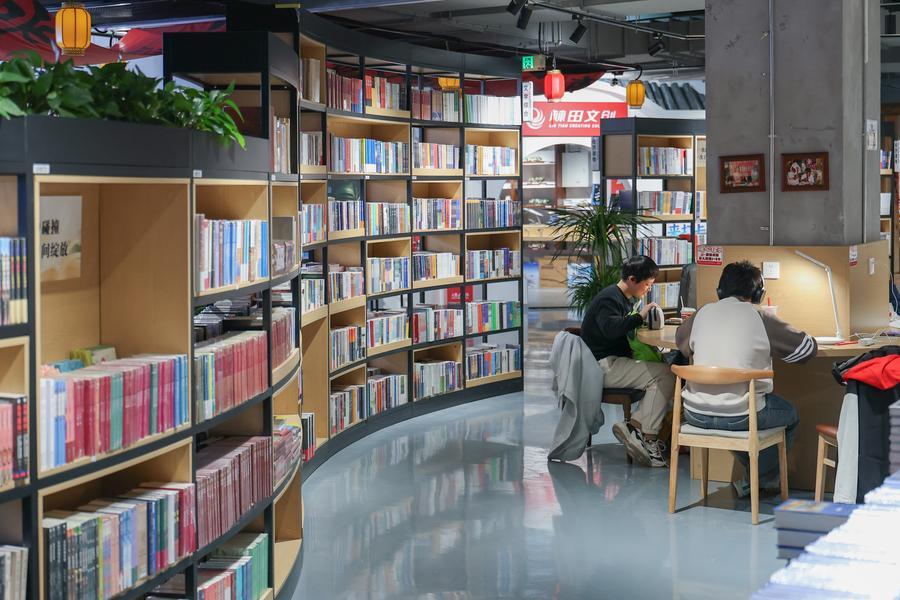
JINAN, April 26 (Xinhua) -- China's brick-and-mortar bookshops, once under pressure from the growth of online reading and e-commerce, are now adopting digital tools in an effort to reconnect with readers.
Founded in 2014 in Binzhou, east China's Shandong Province, Puhe Reading Space began as a small traditional bookshop reliant on book sales. When online competition squeezed margins, it moved away from price wars and began using digital platforms to cultivate reader communities.
"Online channels such as our e-shop and WeChat groups allow us to maintain full-lifecycle engagement with our members," said Wang Hong, the bookshop's founder. She added that the bookstore also uses livestream sessions as a kind of "online living room," where staff and long-time readers can deepen their connections through cultural conversations.
A recent national reading survey showed that the overall reading rate among Chinese adults rose to 82.3 percent in 2025. However, digital formats now dominate the market, with nearly 80 percent of readers using mobile phones to meet their literary needs.
Industry experts said brick-and-mortar bookstores will need to offer immersive, in-person experiences that digital reading cannot replicate, turning bookstores into part of a broader lifestyle.
"Even in the internet era, people cannot confine all aspects of life to the virtual world. They still need a connection with what is around them," said Ma Ruijie, an associate professor at the School of Journalism and Communication, Nankai University.
To draw people back into physical spaces, some bookstores are experimenting with formats that go beyond traditional reading, combining immersive in-person experiences with digital tools to reshape how readers engage with books.
In a shopping mall in the central Chinese city of Zhengzhou, a bookstore has introduced five small theaters that stage scenes from classic books as immersive performances, turning what was once a quiet retail space into a cultural venue.
In Wuhan, central China's Hubei Province, a bookstore has developed a circular reading model through an online mini-program, allowing readers to resell books after finishing them while receiving recommendations based on their reading habits.
Puhe has also embraced artificial intelligence (AI), hosting workshops that teach readers how to turn passages from classic literature into visual posters.
"AI has not replaced reading," Wang said. "Instead, it has become a powerful tool for broadening cultural reach."
Across the sector, such efforts reflect a broader rethinking of the services that bookstores try to provide.
Physical bookstores remain irreplaceable as cultural and social spaces, where readers seek not only books, but spiritual resonance and a sense of belonging, said Zhao Jianying, a professor at the University of Chinese Academy of Social Sciences.
He added that digital reading and physical reading serve different functions and are complementary rather than substitutes. "Digital reading solves the problem of access, while physical bookstores and print reading enable deeper engagement," he said.
That shift is also seeing strong policy support. A regulation on promoting nationwide reading, which took effect in February, encourages brick-and-mortar bookstores to improve reading conditions and carry out reading activities, while strengthening their role in providing public reading services.
This year's government work report for the first time calls for supporting the development of physical bookstores. At the same time, local governments have introduced measures such as rent reductions and integration into public cultural systems.
Zhang Xiao, an industry observer based in Zhejiang Province, said the core competitiveness of brick-and-mortar bookstores lies in combining quality content with improved operational efficiency.
AI technology helps address high labour costs and low service efficiency, Zhang said, adding that the sector is expected to encourage bookstores across the country to share resources and work more closely through technology, in an effort to explore more sustainable business models.
China is home to about 120,000 brick-and-mortar bookstores. Against this backdrop, some long-standing bookstores are beginning to return.
In the eastern Chinese city of Fuzhou, Xiaofeng Bookstore on Guping Road, which had been closed for eight years, recently switched its lights back on. Today, readers can not only read books and enjoy tea here but also participate in activities such as book club meetings and cultural salons.
Zhang Lianwang, who is involved in the reopening project, noted that while maintaining its own editorial focus, Xiaofeng aims to offer more personalized content and more convenient digital services, opening up greater possibilities for physical bookstores.
The comeback has been welcomed by many readers as a long-awaited "reunion." As one reader once put it: "There are places that algorithms can never reach." ■