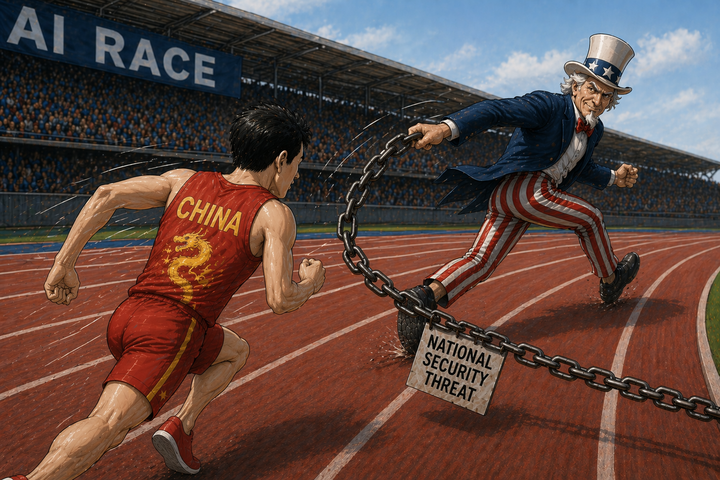
Washington has a well-worn playbook: whenever China makes technological progress, it is promptly recast as misconduct.
BEIJING, April 25 (Xinhua) -- Washington is once again casting Chinese AI firms as culprits, turning a routine engineering method into supposed evidence of intellectual property theft, a familiar tactic to justify another round of politically driven crackdowns on its Chinese competitors.
In fact, knowledge distillation -- the very practice in question -- is a standard technique in the AI industry that transfers knowledge from a large and complex model into a smaller and more efficient one, achieving greater deployability without sacrificing performance, and is an open and common engineering method.
Yet Michael Kratsios, U.S. President Donald Trump's chief science and technology adviser, made groundless accusations in a Thursday memo that American expertise and innovation were being siphoned away by proxy armies operating from China in such a way. Such claims misrepresent normal technological exchanges.
The pattern is all too familiar. Washington has a well-worn playbook: whenever China makes technological progress, it is promptly recast as misconduct.
When Huawei built competitive 5G infrastructure, it was labeled as a security threat; when TikTok drew millions of American users, it was framed as a surveillance tool; and when DeepSeek released a powerful model in early 2025 that matched American systems at a fraction of the cost, accusations of knowledge distillation quickly followed.
The alleged "distillation campaigns" are beside the point. The real story is that, when U.S. technological dominance is challenged, Washington moves to redefine the rules and discredit its competitors.
Geoffrey Hinton, the "Godfather of AI," might find a grim irony in how the techniques he pioneered have been weaponized for geopolitical leverage. A methodology designed to distill and share knowledge is now being used to justify its containment. Yet, history suggests that knowledge is inherently fluid -- it does not flow in a single direction, nor can it be permanently stalled by national borders.
Take San Francisco-based startup Anysphere. The maker of the popular AI coding tool Cursor acknowledged in March that its newly launched flagship model was built on top of an open-source model created by Chinese startup Moonshot AI.
Openness and collaboration have long served as the twin engines of technological progress. Washington must reckon with this reality before its logic of zero-sum rivalry hardens into a self-defeating constraint -- one that risks isolating American innovation from the very global networks that once fueled its dominance. ■