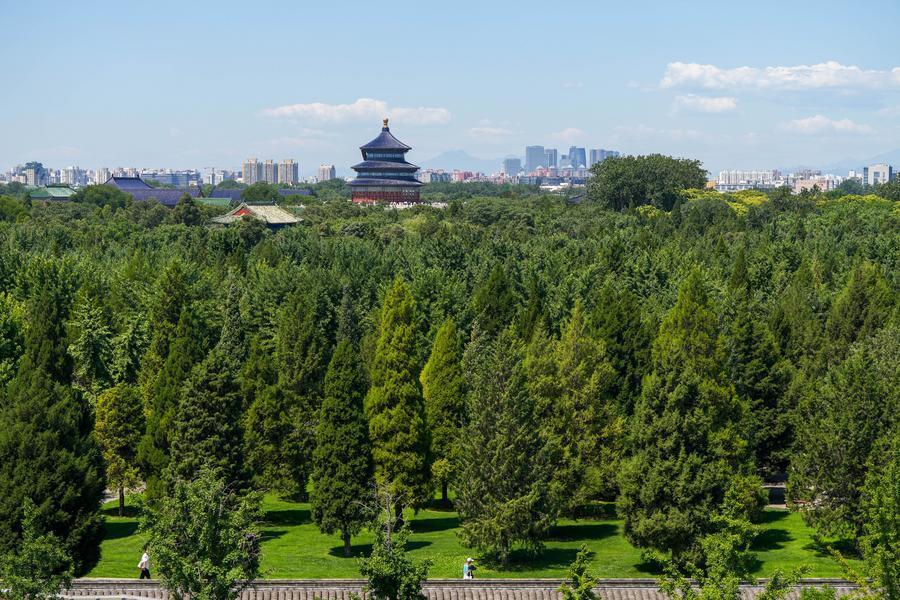
BEIJING, March 3 (Xinhua) -- As Beijing braces for its annual spring pollen season, set to begin this weekend, the city is shifting from "passive protection" to "active suppression" by applying an innovative organic spray that acts as an "invisible mask" for juniper trees.
According to the Beijing Municipal Forestry and Parks Bureau, the pollination period for the city's large juniper population is forecast to begin between March 7 and 11, with a peak expected from March 15 to 20. Within the Fifth Ring Road, there are approximately 337,000 juniper trees, of which about 168,000 are pollen-producing males.
In response, a comprehensive treatment plan is now underway. A key tool in this year's effort is a polymer organic compound known as a "pollen fixative," developed by Beijing University of Agriculture, as reported on Tuesday by Science and Technology Daily.
"This bag of fixative can be mixed into a water truck with a capacity of one tonne. While watering needs to be done three to five times a day, spraying our product just once a day can make pollen settle over 20 times more effectively than water," said Xing Yu, a professor at the university's College of Plant Science and Technology.
The fixative, which has been successfully trialed for three years, forms a translucent coating on the tree, trapping the pollen before it can be released into the air.
This pollen fixative has now entered mass production and will be deployed across the city's six core districts this year, according to the report.
"Based on our observations of the phenology of male juniper cones, we have determined that the scattering period will begin around March 7," Jiang Yingshu, director of the science and technology division of the Beijing Municipal Forestry and Parks Bureau, was quoted as saying.
Beyond technological interventions, a new regulation that took effect on Jan. 1 this year has, for the first time, incorporated pollen management into local law, clarifying local government responsibilities.
Meteorological and forestry departments are also collaborating to release real-time pollen concentration forecasts, providing citizens with precise guidance for personal protection, the report noted. ■