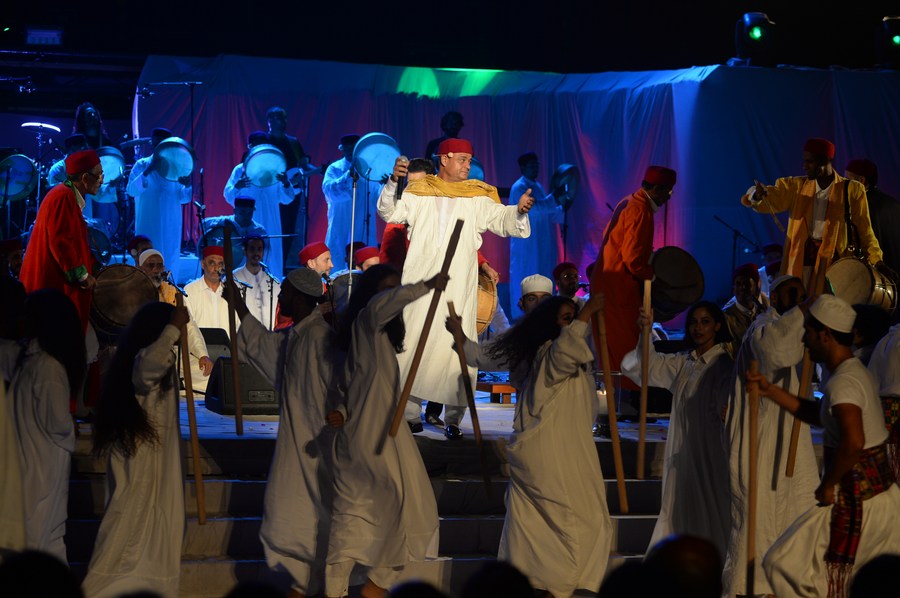
Tunisian artists perform traditional Tunisian song and dance during the Carthage International Festival in Tunis, Tunisia, on Aug. 18, 2022. (Photo by Adel Ezzine/Xinhua)
The festival provided Tunisians with more than just beautiful melody and shimmering costumes; for many, it served as a respite from the challenging economic circumstances their nation is currently experiencing.
by Xinhua writers Xu Supei, Ayten Laamar, Huang Ling
TUNIS, Aug. 20 (Xinhua) -- For the past five weeks, thousands of people flocked to the Roman theatre of Carthage in the capital Tunis, waiting patiently for the show to start. The return of Tunisia's 56th International Festival of Carthage (FIC) has brought people an unforgettable time of joy in hard times.
"Following a two-year hiatus due to the (COVID-19) pandemic, we have noticed a remarkable presence of the audience. We're glad to see so many people thirsty for a return to normal life through art," Kamel Ferjani, the 56th FIC artistic director, told Xinhua on Friday.
The FIC has been a well-known musical event held in the North African country since 1964. It takes place in July and August every year, with all shows performed in the Roman theatre of Carthage, a restored ancient theatre located on the outskirts of the capital Tunis.
This year, a selection of 33 shows was held from July 14 to Aug. 20, and Tunisia took the lion's share with 15 shows, in addition to 18 shows from Egypt, Lebanon, South Korea, Switzerland, and many other countries.
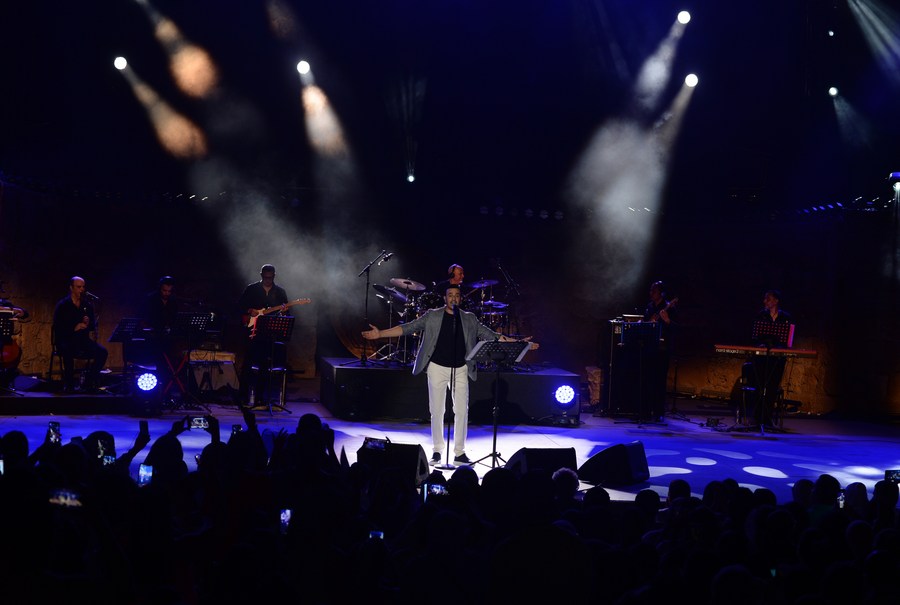
An artist performs during the 56th Carthage International Festival in Tunis, Tunisia, on Aug. 16, 2022. (Photo by Adel Ezzine/Xinhua)
"We tried to ensure that all artistic styles are represented and of a high quality that appeals to all age groups, particularly young people," Ferjani said, adding that nearly half of the performances were new ones making their debut during the festival.
Ferjani said they have worked against all odds to make the festival a success. "We have to prepare it under extremely difficult conditions, particularly during the sixth wave of the coronavirus that hit the country in January and February."
Mariam Ben Moulehom, a 21-year-old dental student, has been to the festival four times over the past month.
"I watched the opening ceremony, the concert of Saber Al Rebai, who is dubbed the prince of Arabic song, enjoyed Leila Toubel's play Taqouta on the occasion of Tunisian Women's Day, and the most famous Sufi performance in Tunisia the El Hadhra," Moulehom enthusiastically enumerated the shows she had seen.
"Every Tunisian enjoys the International Festival of Carthage, one of the most important music festivals in the Arab world. It provides us an excellent opportunity to see a variety of national and international performances," she told Xinhua.
Saber Kammoun, a fish trader in his 50s, traveled nearly 270 km with his family from their home in Sfax province to the capital to attend the festival for the first time.
"I love the relaxing atmosphere of the festival," he said.
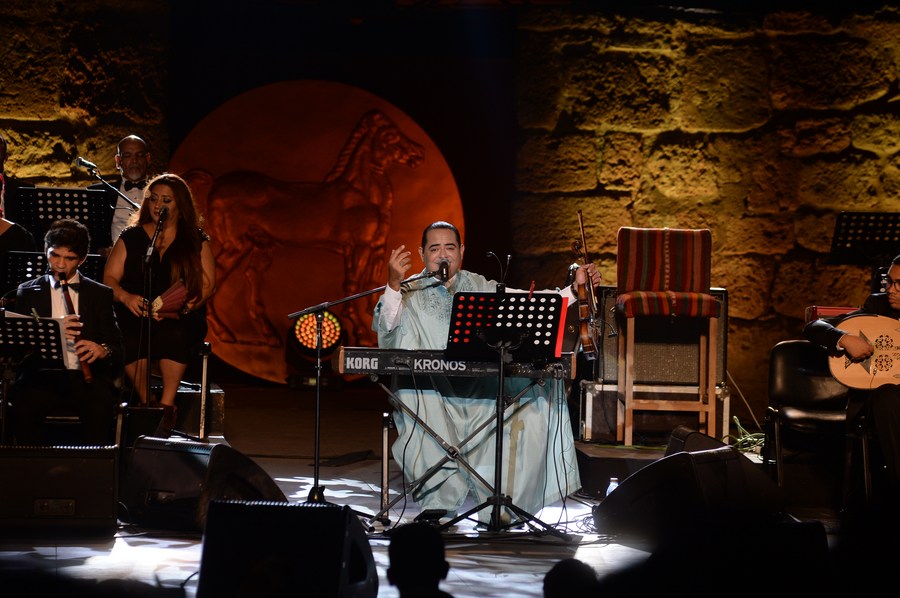
Tunisian artist Zied Gharsa performs at the 56th Carthage International Festival in Tunis, Tunisia on Aug. 11, 2022. (Photo by Adel Ezzine/Xinhua)
The festival provided Tunisians with more than just beautiful melody and shimmering costumes; for many, it served as a respite from the challenging economic circumstances their nation is currently experiencing.
Tunisian economic development has faced hurdles in recent years. Its economic problems, which had existed since 2011, were aggravated after the outbreak of the COVID-19 pandemic in 2020.
This year, a stronger U.S. dollar led by the Federal Reserve's rate hikes raised the cost of imports. As a net importer of food and energy, Tunisia's inflation, which has already been exacerbated by the conflict between Russia and Ukraine, continued to rise.
In July, Tunisia's inflation rose to 8.2 percent, the highest record since October 1991.
"I enjoyed the festival, because it is an opportunity for me to reduce the stress of daily life," Kammoun said, hoping he could still come to the festival next year. ■