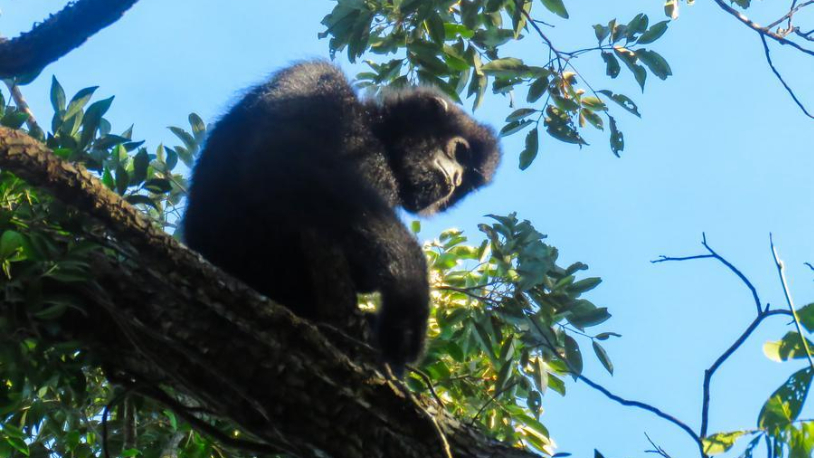
* The Hainan gibbon population has rebounded from fewer than 10 to 44.
* Conservation efforts are restoring Hainan's rainforest ecosystem and benefiting local communities.
* Hainan's experience offers lessons for global biodiversity conservation.
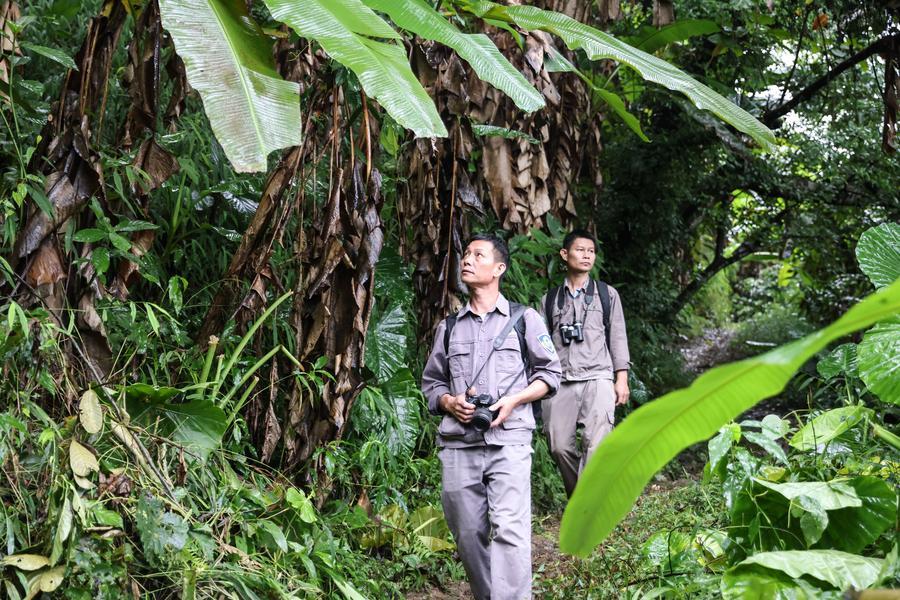
HAIKOU, Nov. 28 (Xinhua) -- At 4:30 a.m., long before daylight touched Bawangling, a mountainous area of Hainan Tropical Rainforest National Park in south China, Li Wenyong and his fellow wildlife monitors set out with flashlights, threading their way along narrow forest trails.
They moved as quietly as possible, knowing that a single unexpected sound could frighten away the Hainan gibbons they had come to track.
As dawn broke, the forest came alive with the gibbons' calls. Low, short hoots rose into long, piercing whoops that echoed through the valleys.
"Everyone loves the gibbons' songs," Li said. "Protecting the gibbons means protecting the entire rainforest."
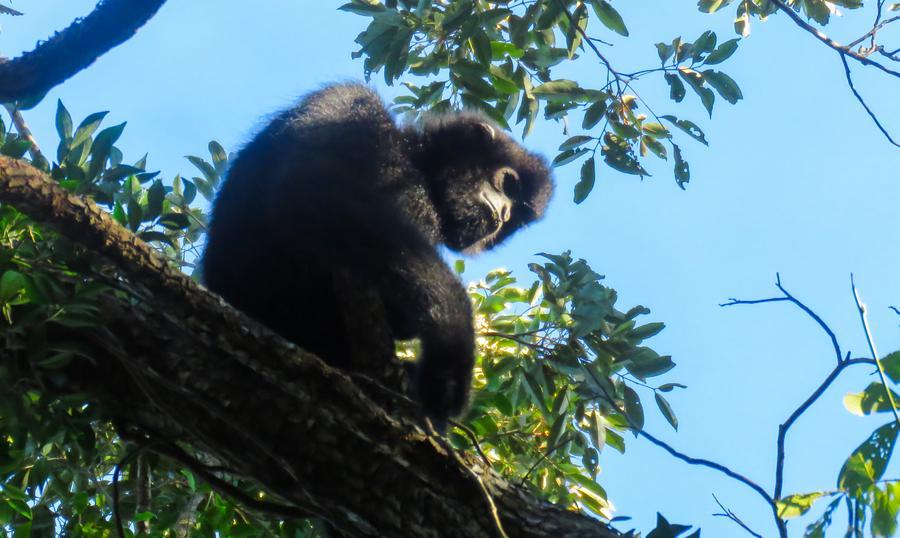
For decades, those distinctive calls were at risk of disappearing. More than 40 years ago, fewer than 10 Hainan gibbons remained. Today, the population has rebounded to 44 individuals in seven family groups, a turnaround that reflects decades of efforts to protect both these animals and their habitat.
Among the world's 20 surviving gibbon species, the Hainan gibbon is the only one with a population that has shown sustained growth, according to local conservation authorities.
Hainan Province is home to China's largest, best-preserved and most concentrated stretch of contiguous island tropical rainforest. This forest plays a vital role in conserving water, storing carbon, supporting biodiversity and sustaining local livelihoods.
In October 2021, China established Hainan Tropical Rainforest National Park, bringing more than 20 previously separate nature reserves and forest parks under unified management.
Covering over 4,269 square kilometers, the park hosts 4,367 recorded species of higher plants and 651 vertebrate species.
It is one of China's first five national parks, which together protect some of the country's most important ecosystems, including giant panda habitats in Sichuan, Gansu and Shaanxi provinces and tiger and leopard habitats in northeast China.
China has also implemented its national park law and revised regulations on nature reserves, marking a new stage of law-based and standardized development for its nature reserve system with national parks as the main body.
In Hainan, conservation efforts have focused on restoring habitats, creating ecological corridors to connect fragmented forest areas, strengthening wildlife monitoring, and involving local communities in conservation.
"The rainforest ecosystem is gradually finding its natural rhythm again," said Chen Kang, director of the Hainan Tropical Rainforest National Park Administration.
More than 90 new species have been discovered in Hainan's tropical rainforest in recent years, noted Zhou Runbang, an official with the provincial forestry department.
Fan Pengfei, a professor at Sun Yat-sen University, said efforts to protect flagship species and their habitats have helped restore the wider ecosystem, taking conservation in Hainan beyond individual species to the forest as a whole.
The benefits of rainforest conservation, notably, extend beyond wildlife to local communities.
Over the past five years, the national park in Hainan has recruited 1,593 local residents as full-time ecological rangers, while ecological compensation has benefited 372 village collectives and 6,194 rural households.
The park's gross ecosystem product (GEP), a measure of the economic value of ecosystem services, reached 208.97 billion yuan (around 31.15 billion U.S. dollars) in 2024, according to a think-tank report.
Ecotourism is growing, supported by a 466-kilometer scenic highway linking attractions and villages of the Li and Miao ethnic groups across nine cities and counties in Hainan.
Hainan is also seeking UNESCO World Heritage status for its tropical rainforest and the traditional settlement of the Li ethnic group, which have been jointly added to the World Heritage tentative list.

Speaking at the 2026 Tropical Rainforest Ecosystem Partners Conference recently held in Haikou, capital of Hainan, Carlos Aldeco, the Food and Agriculture Organization of the United Nations representative in China, described Hainan as an example of how nature conservation and sustainable development can go hand in hand.
He highlighted the province's efforts to protect biodiversity while creating opportunities for environmental education, sustainable livelihoods and responsible ecotourism.
As climate change intensifies and extreme weather events become more frequent, tropical rainforests face growing risks of habitat degradation and biodiversity loss.
Paul Shrivastava, co-president of the Club of Rome, said China's concept of ecological civilization encourages people to live sustainably within ecosystems rather than simply extracting resources from nature.
Shrivastava commended China for being at the forefront of such efforts, saying its actions could help drive positive change around the world.

But protecting tropical rainforests also requires cooperation across borders.
Zhang Xinsheng, former president of the International Union for Conservation of Nature (IUCN), said no country or organization can protect tropical rainforests in isolation, calling for closer collaboration across countries, sectors and scientific disciplines to share knowledge and address common threats.
The IUCN has introduced this experience to the international community as an example of "Chinese wisdom, Hainan experience and the Bawangling Model."
Hainan has also led the establishment of the Global Gibbon Network, with its secretariat located at the Hainan Institute of National Park, bringing together 36 conservation institutions from 11 countries to jointly carry out gibbon conservation research.
Back in Bawangling, the results of conservation are visible in the footage collected by Li and his fellow wildlife monitors.
Their videos now regularly show gibbons swinging along ropes installed to help them cross gaps in the forest canopy, while each morning, their calls continue to echo through the valleys.
"I hope I can keep hearing them forever," Li said.■
(Video reporters: Guo Liangchuan and Wu Maohui; video editors: Wu You and Li Qin.)