BEIJING, Nov. 21 (Xinhua) -- World leaders and observers spoke highly of the first-ever face-to-face meeting between the heads of state of China, Russia and the United States, saying the talks have brought the world hope for peace, stability and cooperation.
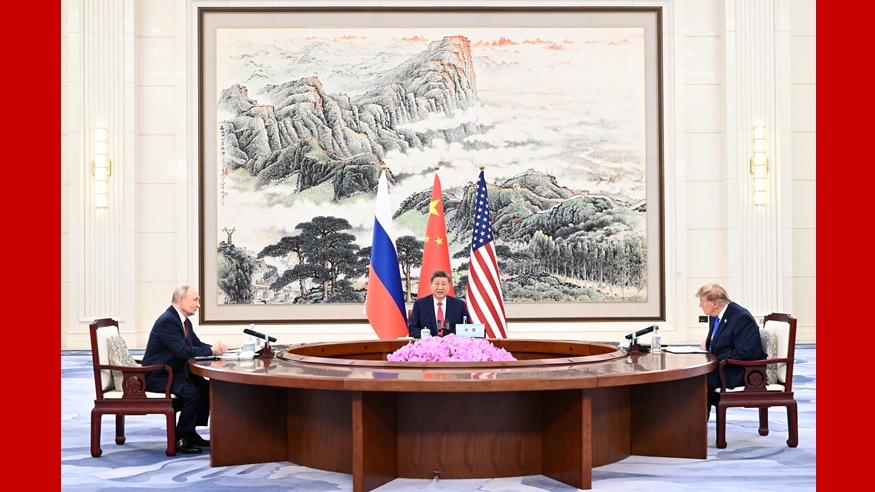
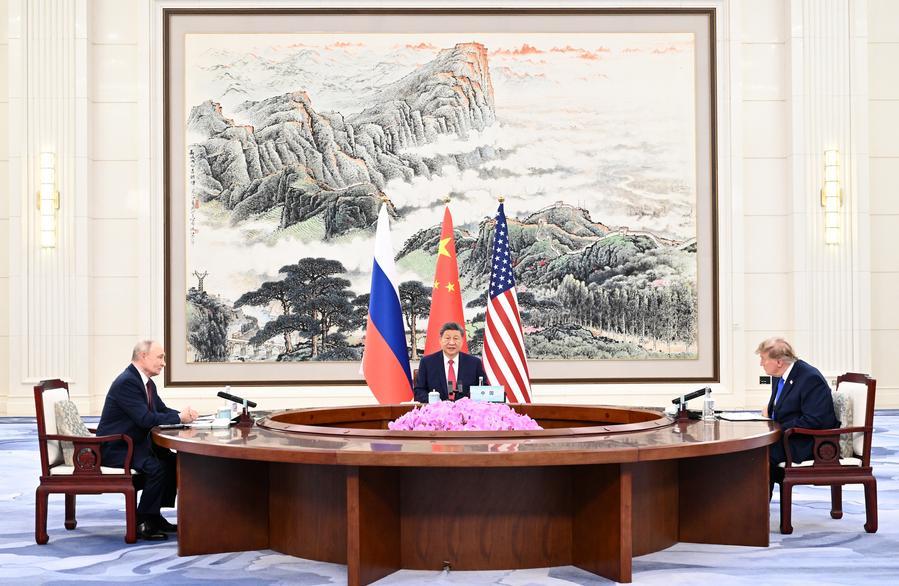
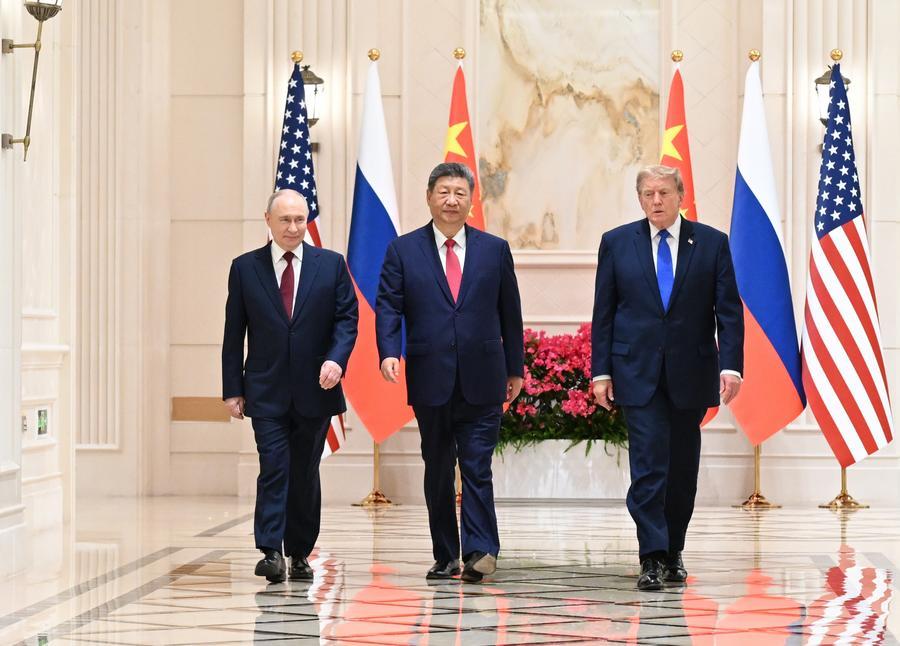
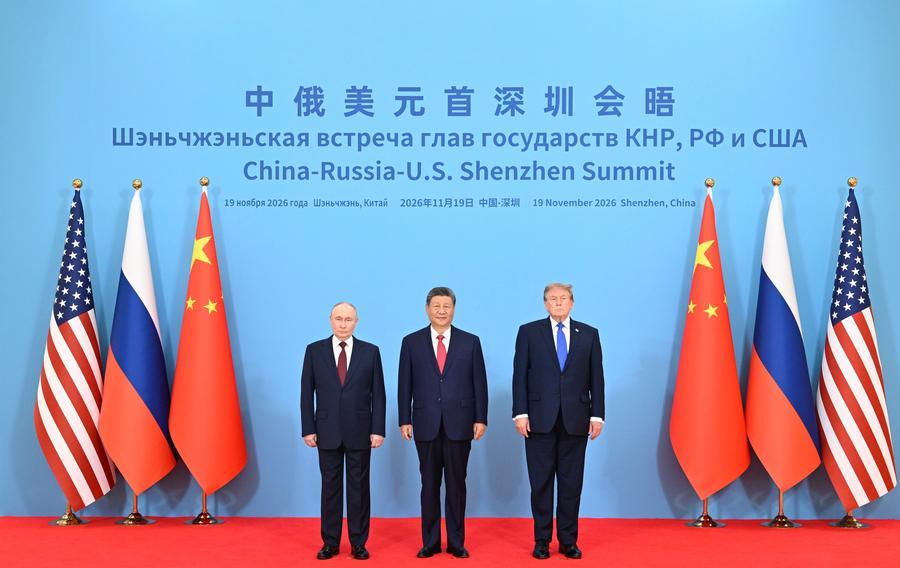
Chinese President Xi Jinping chaired the historic summit in the city of Shenzhen, south China, on Thursday with Russian President Vladimir Putin and U.S. President Donald Trump.
As major countries and permanent members of the UN Security Council, China, Russia and the United States should set good examples, work together to meet global challenges, jointly uphold world peace and stability, and make greater contributions to the progress of humanity, Xi said.
Following the summit, the three countries released the China-Russia-U.S. Heads of State Declaration toward Peace, outlining their common understandings on issues including the UN reform, energy security, the jurisdiction of the International Criminal Court and nuclear risk reduction.
LANDMARK STEP FOR GLOBAL SECURITY
At a White House news conference on Friday, Trump hailed the Shenzhen meeting as "one of the most momentous international summits in many years." He said the "historic summit" had produced a trilateral peace declaration in which China, Russia and the United States reaffirmed that a nuclear war must never be fought.
Malaysian Prime Minister Anwar Ibrahim said China's efforts to host the summit will help create and open up space for meaningful dialogue and mutual understanding toward lasting peace and harmony.
Indonesian President Prabowo Subianto said the three leaders had shown wisdom and statesmanship in taking a step that mattered to the wider international community.
Slovak Prime Minister Robert Fico said he noticed how often the leaders had spoken of peace during their meeting.
At the United Nations, Farhan Haq, deputy spokesman for the secretary-general, said the organization welcomed efforts by world leaders, including those of the Security Council's permanent members, to seek common solutions to global problems.
Denis Simon, former executive vice chancellor of Duke Kunshan University, said the summit could open a new channel for dialogue on international security among the three countries whose decisions carry considerable military, economic and diplomatic weight.
"I see the meeting as an important opening," said Paul Frimpong, executive director of the Africa-China Center for Policy and Advisory. With several international crises unfolding at once, he said, sitting together gave each leader a chance to hear directly from the other two about the risks they considered most pressing and where they saw room to act together.
Gergely Salat, a senior researcher at the Hungarian Institute of International Affairs, said the meeting showed that China has been maintaining channels with both Washington and Moscow and has enough credibility with both to bring them to the same table. "Few capitals could do that today," he said.
FINDING RIGHT WAY TO GET ALONG
At the summit, Xi made four points on how major countries could find the right way to get along and jointly underpin world peace, calling for mutual respect, peaceful coexistence, win-win cooperation, and dialogue and consultation.
"China, Russia and the United States should continue to encourage parties to a conflict to sit down and talk, and settle disputes through political and diplomatic means," he said.
Sourabh Gupta, a resident senior fellow at the Institute for China-America Studies in Washington, noted the repeated references at the summit to preserving the outcomes of World War II. As permanent members of the UN Security Council, the three countries bear a special responsibility for maintaining international peace and security, he said.
Wang Yiwei, a professor at Renmin University of China's School of International Studies, said advances in artificial intelligence were adding a new layer of risk for nuclear powers. Against that backdrop, he said, China's emphasis on preserving strategic stability at the summit sent an encouraging signal about the prospects for peace.
Shraga Biran, head of Israel's Institute for Structural Reforms, pointed to the Middle East, noting that with several regional flashpoints in play, reliable communication can keep one miscalculation from triggering another and reduce the risk that a crisis escalates by accident.
ENCOURAGING CONSENSUS
Xi called on the three countries to follow through on the consensus reached at the summit, strengthen communication, build common ground through dialogue, promote peace via cooperation, and work together to build a better world.
Ezzat Saad, director of the Cairo-based Egyptian Council for Foreign Affairs, said that a better understanding among the major countries could give diplomats more room to work and help contain tensions across the Middle East region.
"When fuel and freight costs rise, businesses pay more to move goods, and families can feel it in food prices," said Frimpong with the Africa-China Center for Policy and Advisory.
In the heads of state declaration released following the summit, the three countries plan to increase the production and supply of refined petroleum products for the benefit of all nations. They reaffirmed the importance of stable energy flows.
In regions recovering from conflict, Frimpong said, more reliable energy supplies would also make it easier for businesses to reopen and invest.
For Alphonse Muleefu, principal of the College of Arts and Social Sciences at the University of Rwanda, the declaration issued in Shenzhen showed that the three countries could find common ground. Building on it, he said, would take mutual respect, sustained dialogue and practical cooperation.
"I believe this meeting marks an encouraging step toward a more stable world," he said.■