SHANGHAI, Nov. 10 (Xinhua) -- The scorching summer that gripped Europe this year remains a fresh memory. Extreme weather is also posing a growing threat to China, underscoring the shared challenge facing a warming planet.
As the 31st United Nations Climate Change Conference (COP31) opened in Türkiye on Monday to gather global momentum for climate solutions, an international import expo in Shanghai in east China offered a glimpse into how China-Europe climate cooperation is playing out at the corporate level.
From offshore wind power and energy-saving technologies to advanced materials for electric vehicles, European companies at the ninth China International Import Expo (CIIE) are showcasing how their technological expertise, combined with China's vast market, manufacturing capabilities and innovation ecosystem, can help speed up the transition toward a low-carbon future.
This could serve as an inspiring message for European policymakers who are concerned about trade imbalances with China.
At the booth of German energy technology company Siemens Energy, a large-scale sand table offers a panoramic view of its innovations spanning the energy value chain, from offshore wind turbines to green hydrogen applications.
The company, which employs about 6,000 people in China, has long worked with Chinese customers and partners across the energy sector, including collaborations on offshore wind power projects and the supply of gas turbines.
"China is accelerating the development of a new energy system and a new power system, creating vast opportunities for innovation in energy technologies and industrial cooperation," said Yao Zhenguo, global senior vice president and head of Greater China at Siemens Energy.
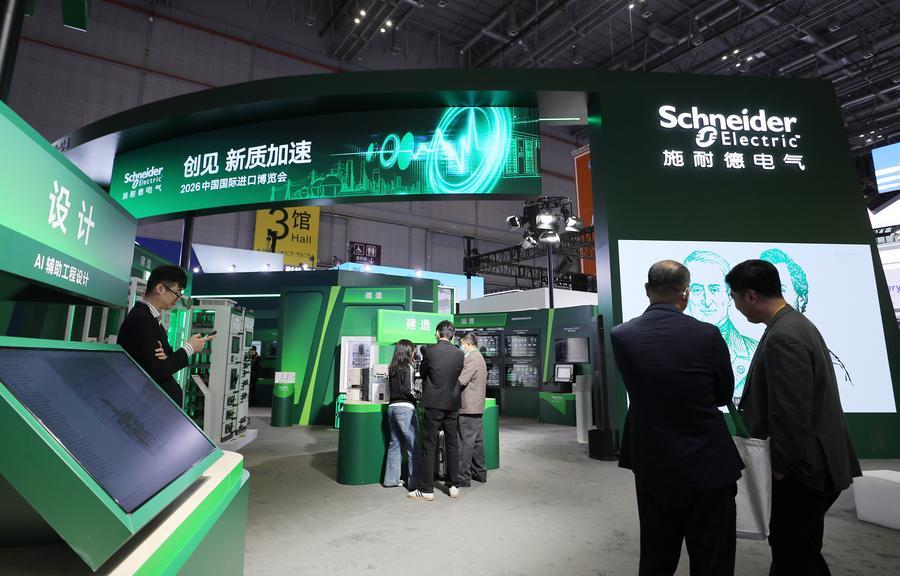
At the booth of French multinational Schneider Electric, meanwhile, an AI-powered energy-saving solution known as AI Box demonstrates how digital technologies can help buildings and industrial facilities use less electricity.
Combining machine learning with physics-based models, the system optimizes the operation of cooling equipment to reduce energy waste while maintaining cooling performance. According to a representative at the booth, this solution can deliver energy savings of around 12 to 15 percent.
Against the backdrop of China's booming data center industry, Schneider Electric is also showcasing its end-to-end data center solutions at this year's CIIE, designed to support the development of efficient, reliable and environmentally sustainable computing infrastructure.
Large-scale energy and industrial transitions require collaboration across industrial ecosystems, said Yin Zheng, executive vice president of China & East Asia Operations of Schneider Electric, adding that China offers a strong industrial foundation, abundant innovation resources and a diverse range of use scenarios.
Shen Yi, an international relations scholar at Fudan University, identified the green energy sector as among the most promising areas for China-Europe cooperation.
European companies looking to expand their businesses and advance the green transition stand to benefit from China's market demand, manufacturing capabilities, technological expertise and large-scale production capacity in sectors such as batteries and solar power, the professor said.
The boom of new energy industries such as the electric vehicle industry in China is also opening up opportunities for European suppliers.
Jurgen Cobbaut, chief marketing officer of AMORNEX, a joint venture between Luxembourg-based steelmaker ArcelorMittal and China Oriental Group, pointed to the company's plan to locally produce new energy magnetic materials, which span applications from electric vehicle motors to wind turbines.
He explained that electric motors lose some energy in the form of heat during operation, while the company's materials can help minimize such losses and improve efficiency. Similar materials can also improve the efficiency of converting mechanical energy into electricity in wind turbines.
"China is a huge market with a wide range of applications for such materials," Cobbaut said. "We're bringing this technology to China because of the country's strong push toward decarbonization."
Swedish heavy truck manufacturer Scania is likewise tapping into the Chinese market, describing it as "one of the world's fastest-moving markets for the electrification of heavy-duty transport."
In view of an expanding fleet of electric heavy trucks on Chinese highways, Scania Group China is developing its battery-electric models.
"We are now deeply integrated into China's ecosystem, combining our global expertise with China's advanced technology and supply chain," Amanda Liu, head of communications and event experience at Scania Group China, told Xinhua.
Beyond the expo floor, climate cooperation has long anchored China-EU relations. Against the backdrop of the U.S. withdrawal from the Paris Agreement, Chinese and EU leaders in 2025 reaffirmed their commitment to global climate action, noting that the two sides have a solid foundation for cooperation and broad potential for collaboration in the green transition.
China has long placed high importance on addressing climate change. It has set the dual carbon goals of peaking carbon dioxide emissions before 2030 and achieving carbon neutrality before 2060.
China last year announced its 2035 nationally determined contributions, including a target of reducing economy-wide net greenhouse gas emissions by 7 percent to 10 percent from peak levels, while striving to do even better. ■