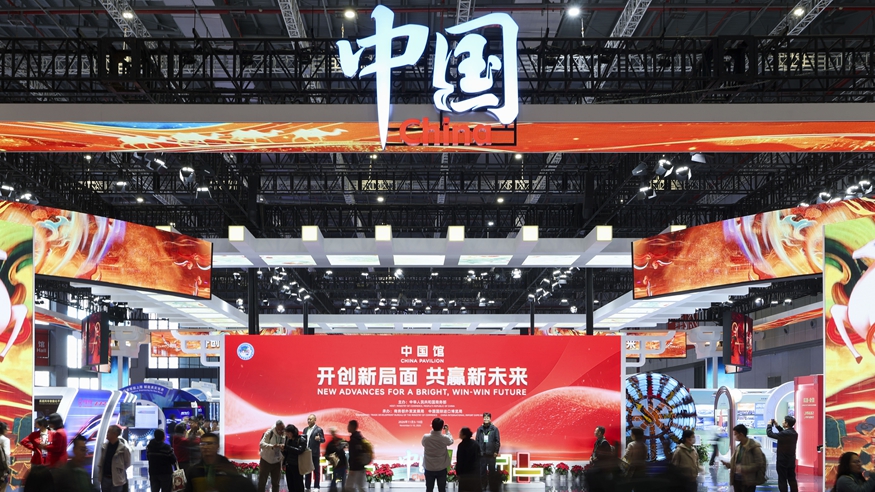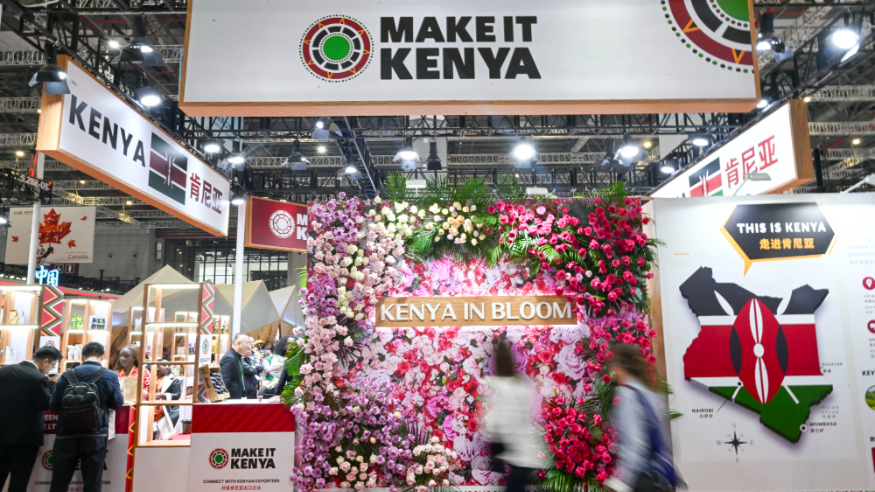
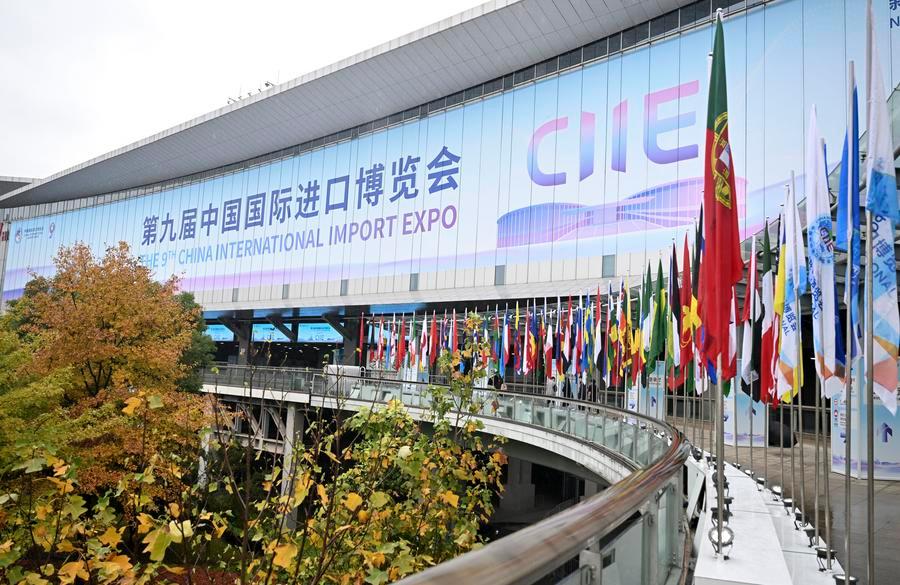
* The ninth China International Import Expo (CIIE), which concluded in Shanghai on Tuesday, attracted a record 4,142 overseas exhibitors and featured more than 480 global, Asian or China debuts. Organizers reported 85.45 billion U.S. dollars in intended deals.
* Greek financial news outlet Business Daily described the CIIE as an "importathon" -- a blend of "import" and "marathon," suggesting a sustained drive to bring goods into the Chinese market.
* John Ross, a former director of economic and business policy for the mayor of London, told Xinhua that China was not seeking a trade surplus but rather greater openness in world trade. For foreign exporters, he called the CIIE "the best export opportunity that you've got in the world."
SHANGHAI, Nov. 10 (Xinhua) -- In 2018, German warehouse-equipment maker Jungheinrich showcased a German-made forklift at China's inaugural import expo. This year, it unveiled an artificial intelligence (AI)-assisted warehouse-planning tool developed partly in China -- a sign of the country's growing role as a source of innovation for global businesses, not just a vast market.
The ninth China International Import Expo (CIIE), which concluded in Shanghai on Tuesday, attracted a record 4,142 overseas exhibitors and featured more than 480 global, Asian or China debuts. Organizers reported 85.45 billion U.S. dollars in intended deals.
For decades, China's manufacturing strengths have drawn foreign companies, many of which have used the country as a base to serve global markets. In 2025, foreign-invested enterprises accounted for 27 percent of China's exports and 16 percent of its trade surplus, according to official figures.
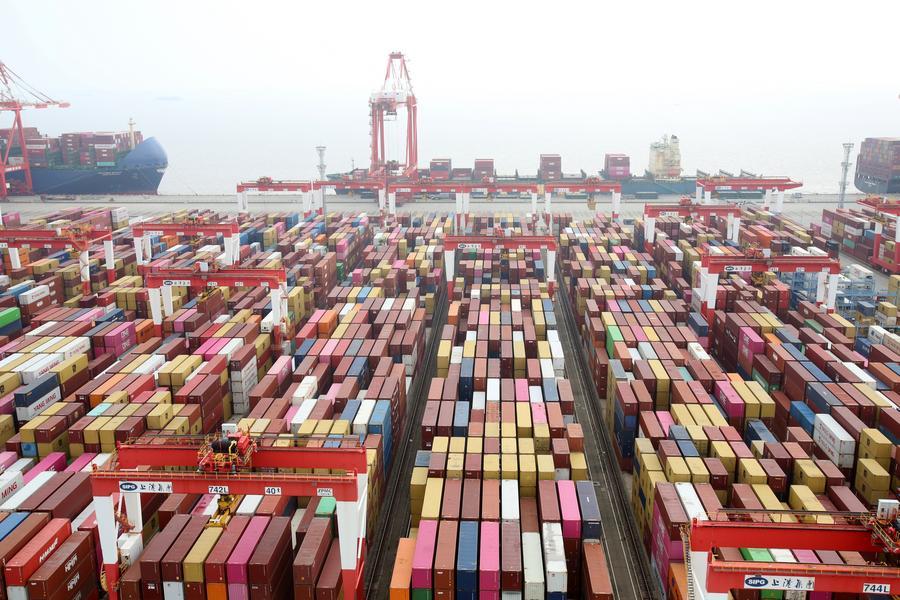
Shanghai has long been a major gateway for China's exports. In 2025, its port recorded total container throughput of more than 55 million twenty-foot equivalent units (TEUs), retaining its position as the world's busiest container port for the 16th consecutive year.
The city has also become a gateway for foreign businesses seeking access to China's import market. Since 2018, it has hosted the CIIE, the world's first national-level expo dedicated to imports, described by Chinese officials as "an international public good shared by the world."
For Ethiopian economist Alemayehu Geda, China's expanding import market offers an opportunity for African producers to move beyond raw-material exports. China is "not only encouraging exporters as was traditionally the case, but also importers into China," the Addis Ababa University professor said.
Greek financial news outlet Business Daily described the CIIE as an "importathon" -- a blend of "import" and "marathon," suggesting a sustained drive to bring goods into the Chinese market.
Nepalese entrepreneur Shankar Koirala has witnessed those opportunities grow over six CIIE appearances. His booth expanded from nine to 72 square meters. Each handmade cashmere scarf bears its maker's signature. Together, the products connect Chinese buyers with more than 600 artisan families in Nepal.
"When we didn't know where to promote our products, the CIIE gave us a platform," Koirala said.
John Ross, a former director of economic and business policy for the mayor of London, told Xinhua that China was not seeking a trade surplus but rather greater openness in world trade. For foreign exporters, he called the CIIE "the best export opportunity that you've got in the world."
China imported more than 90 trillion yuan (about 13.4 trillion U.S. dollars) worth of goods between 2021 and 2025. At this year's CIIE, free exhibition space for the least developed countries increased by 17 percent, while the Asia-Africa products zone was upgraded.
Beyond the exhibition halls, China has expanded preferential access to its market. Since May 1, eligible imports from all 53 African countries with which it has diplomatic relations have enjoyed zero tariffs. That morning, 24 tonnes of South African apples became the first shipment cleared under the policy in Shenzhen.
When China joined the World Trade Organization (WTO) in 2001, its annual goods trade stood at about 500 billion U.S. dollars. By 2025, it exceeded 6 trillion dollars. China's role as a buyer has grown as well: imports from more than 130 countries and regions increased last year, customs data showed.
China has also taken steps in support of the multilateral trading system. In 2025, it announced it would not seek new special and differential treatment in current or future WTO negotiations. This year, it pledged 1.1 million dollars to WTO programs that support developing and least-developed economies.
These efforts come as the multilateral trading system faces mounting challenges. The WTO's World Trade Report 2026 says global trade policy and the organization face "the most serious and sustained disruptions" since the multilateral trading system emerged 80 years ago.
Addressing the opening ceremony of the CIIE, Chinese Vice Premier Ding Xuexiang called on countries to share market opportunities and promote balanced trade by making the economic pie bigger together. He also urged deeper investment cooperation, innovation and the removal of trade barriers.
For French yeast maker Lesaffre, making that pie bigger through innovation can bring benefits well beyond China. At its Shanghai industrial baking center, the company tests processes for customers across Asia-Pacific. Solutions refined in China can be applied elsewhere, an approach the company calls the "China fulcrum effect."
"A solution validated on these lines in China can be scaled for customers across Asia-Pacific," said Jérôme Vanachter, president of Lesaffre Greater China.
In cosmetics, French group L'Oréal joined forces with Chinese company Nanomed to develop a Lancome skincare device. Displayed at the 2025 CIIE, the device had reached markets in more than 20 countries and regions by July 2026. In telecommunications, U.S. chipmaker Qualcomm showcased a sixth-generation (6G) communications terminal prototype following tests with China Mobile and Chinese telecommunications equipment maker ZTE.
The CIIE also served as a platform for emerging innovators. This year's innovation incubation section featured 633 projects from nearly 40 countries and regions, up almost 20 percent from the previous edition.
Taken together, these examples point to an evolution beyond unveiling imported products and technologies. International companies are increasingly developing new technologies and manufacturing innovative products in China, drawing on local expertise to serve both Chinese and overseas markets -- part of what has come to be known as "China Opportunity 2.0."
Shanghai's own history offers a wider perspective on this evolution. The city became home to China's first pilot free trade zone in 2013. This July, representatives of 29 countries signed an agreement in Shanghai to establish the World Artificial Intelligence Cooperation Organization, which will be headquartered in the city.
China will host the 33rd APEC Economic Leaders' Meeting in Shenzhen in south China next week. The theme of this year's summit is "Building an Asia-Pacific Community to Prosper Together," while China has identified openness, innovation and cooperation as the three priority areas for this year's APEC cooperation. In 2025, APEC's 21 member economies were home to 3 billion people and accounted for 61.6 percent of global real GDP.
The gathering carries historical resonance. Shanghai hosted APEC leaders in October 2001, just weeks before China's WTO accession, at a meeting that marked a fresh start for Asia-Pacific cooperation in the new century. At the 2014 Beijing summit, leaders endorsed a roadmap toward a Free Trade Area of the Asia-Pacific, an initiative that APEC trade ministers reaffirmed their commitment to advancing in May.
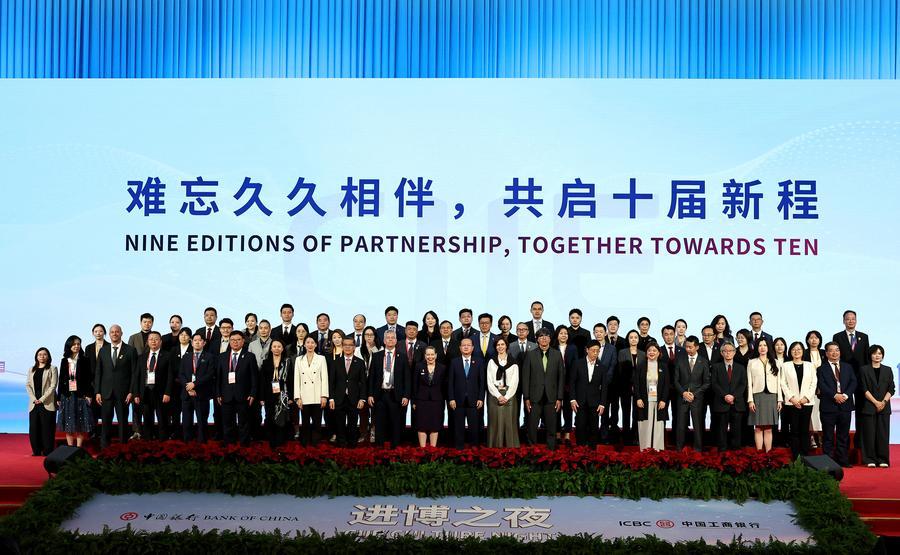
Back in Shanghai, 49 companies and institutions signed up on Nov. 6 for the CIIE's 10th edition in 2027. Among them was German optics group ZEISS, which this year showcased a new-generation intraocular lens developed by its joint venture in China.
For Martin Fischer, president and CEO of ZEISS Greater China, China is not only the company's largest market globally, but also a vital source of innovation.
"The time it takes to turn an idea into a prototype is shorter in China than anywhere else," he said.
(Video reporters: Zhu Cong, Hong Liang, Sun Qing; Video editors: Yang Zeyi, Roger Lott, Zhang Mocheng) ■