* Media professionals at the 7th World Media Summit emphasized that embracing AI technology must go hand in hand with upholding journalistic principles, and that international cooperation is essential to navigating the transformation.
* "Xinhua is willing to strengthen dialogue with all parties to advance the industry's development and promote exchanges and cooperation," said Fu Hua, president of Xinhua News Agency.
* "Whatever technology we adopt, we should never lose sight of the fact that the most important aspects of journalism are done by people," Reuters President Paul Bascobert said.
BEIJING, Nov. 9 (Xinhua) -- Artificial intelligence (AI) is reshaping the global media landscape, opening up new possibilities for media organizations to improve efficiency and reach wider audiences, while posing pressing challenges to journalistic integrity, human judgment and the future of the very profession.
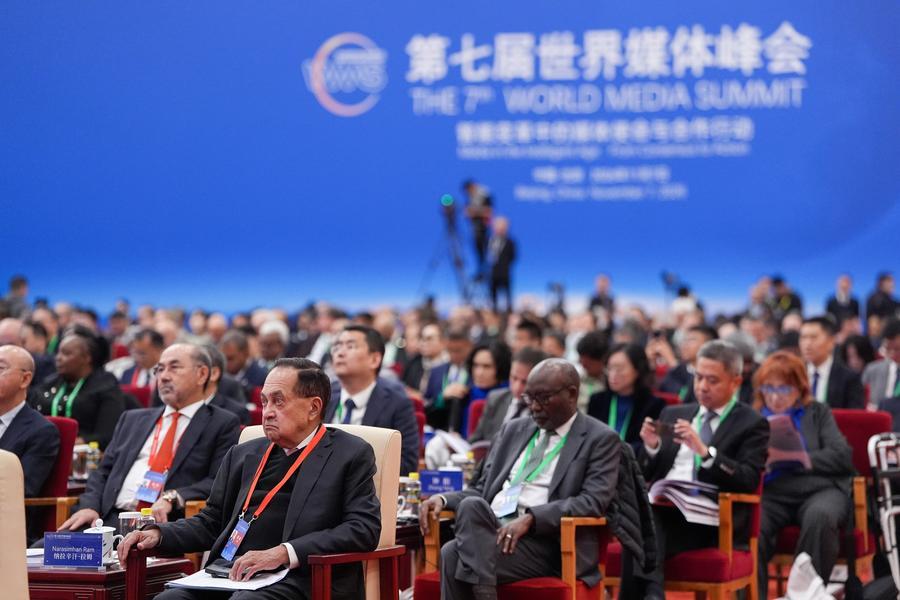
At the 7th World Media Summit, held in Beijing from Nov. 5 to 9, media professionals from around the world explored ways to better harness AI to improve news production while avoiding ethical pitfalls that could undermine trust in their content.
They emphasized that embracing the technology must go hand in hand with upholding journalistic principles, and that international cooperation is essential to navigating the transformation.
The summit, jointly organized by Xinhua News Agency and the Beijing municipal government under the theme "Media in the Intelligent Age: From Consensus to Action," brought together about 500 representatives from nearly 330 media organizations, think tanks, government bodies and international organizations across 112 countries and regions.
"AUGMENTED JOURNALISM"
AI is finding its way into virtually every stage of news production, from story planning, information gathering and processing to fact-checking, proofreading, and even the generation of news images and videos.
Addressing the opening ceremony, Fu Hua, president of Xinhua News Agency, called on media professionals to share new technologies and applications, exchange experience in using them, and close gaps in AI research, development and understanding.
"We should lead the way in ensuring that all media professionals have a fair chance to benefit from AI," he said.
"Newsrooms everywhere are under pressure. Audiences expect faster coverage, more formats, more languages and more explanations," Agence France-Presse (AFP) Chairman and CEO Fabrice Fries told a high-level dialogue during the summit, which brought together executives from Xinhua News Agency, The Associated Press, Reuters, AFP and CNN.
"AI can help us automate repetitive tasks, process large amounts of information, translate content more efficiently and support our journalists in their daily work," he said.
The AFP chief described this approach as "augmented journalism," in which journalists spend less time on routine production and more time observing reality, meeting people, identifying emerging trends and explaining complex developments with greater depth and context.
At the opening ceremony, Reuters President Paul Bascobert also mentioned AI as "a resource, a tool that increases speed, efficiency and scale" for journalists. "Those are real gains, but AI does not replace our standards. It has to meet them. We automate tasks. We do not automate judgment," he added.
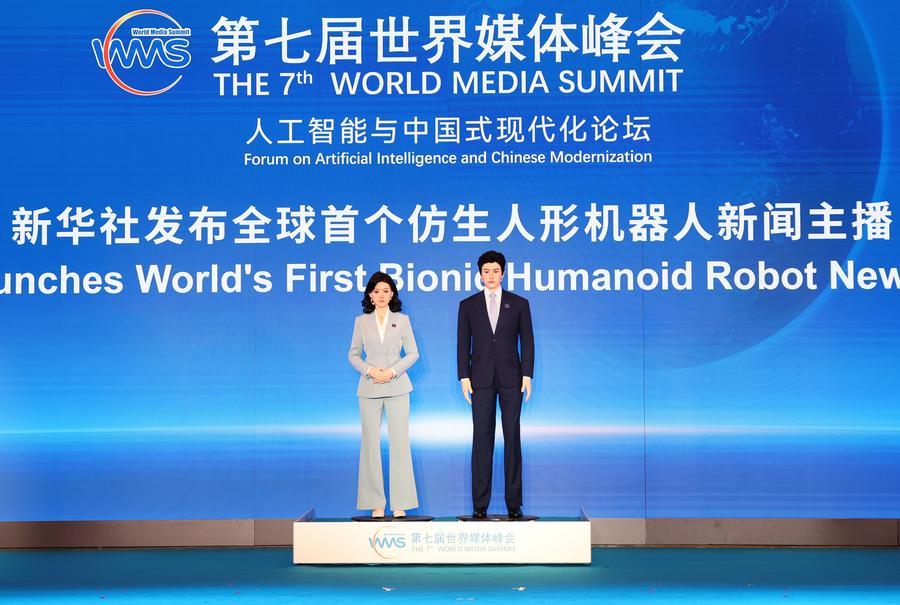
During the summit, two life-sized robot news anchors, as the world's first bionic humanoid robot news anchors, made their official debut, greeting the audience in fluent English.
"I heard about and saw AI anchors presenting news during my previous visit, which really impressed me," Sumeyra Teymur, CEO of Turkish news platform Haberler.com, told Xinhua ahead of the summit. She also expressed interest in the potential use of humanoid robots to cover dangerous situations, such as earthquakes and conflicts, where deploying human reporters could pose risks.
Fu said that as AI technology advances, media practitioners should make good use of AI while safeguarding the credibility of mainstream media.
"Xinhua is willing to strengthen dialogue with all parties to advance the industry's development and promote exchanges and cooperation," he told media executives at the high-level dialogue during the summit.

TOOL VS HUMAN JUDGMENT
AI is becoming increasingly embedded in the media industry, yet one message came through clearly in discussions among media representatives at the summit: it is a tool to assist journalists, not to replace them. Many speakers used the same word, "tool," to describe AI's role in news production.
Toshimitsu Sawai, president of Japan's Kyodo News, said generative AI is an "assistive tool" for editorial work. However, he said, AI carries risks such as copyright infringement and the dissemination of misinformation and disinformation. He also noted cases triggered by "out-of-control behavior" by AI models.
"Humans bear final decision-making authority and responsibility for content," Sawai said. "In this respect, it is increasingly important that professional journalists have a strong grasp of how to handle information and make judgments about news."
In the same vein, CNN Senior Vice President Kostas Oikonomou said AI is "a tool to strengthen our reporting, not replace the human judgment that defines it."
Bascobert of Reuters said that news delivery methods had evolved dramatically over the years, from carrier pigeons and telegraphs to today's digital technologies. "The tools have changed a great deal since then. The principle has not," he said, stressing that the core task of journalism remains getting the facts, checking them and reporting them.
While AI is a valuable tool, Bascobert said, it cannot replace the human qualities that make a good journalist, including the ability to gain people's trust, read people, and understand nuances in conversation. "Whatever technology we adopt, we should never lose sight of the fact that the most important aspects of journalism are done by people," he said.
Fries of AFP expressed optimism about the future of journalism, saying professional journalism becomes even more important in the future because it remains one of the few ways to maintain a direct connection with reality.
"AI and journalism should not be viewed as rivals," he said. "They need one another. Our challenge is to build a future in which technological innovation and trustworthy information grow stronger together."
For media organizations and journalists standing at the intersection of technology, information and public trust, Tatiana Valovaya, director-general of the United Nations Office at Geneva, highlighted three priorities: protecting information integrity and public trust; ensuring AI benefits everyone; and keeping human dignity and responsibility at the center.
COOPERATION FOR INCLUSIVE DEVELOPMENT
While AI offers extraordinary opportunities, "it also presents serious challenges, from synthetic content and information manipulation to threats to privacy, algorithmic bias, and unequal access to technology," Valovaya said.
"We believe international cooperation is essential," she said, emphasizing that AI's opportunities and risks are "too consequential to be left to a handful of countries or companies."
Media representatives at the summit shared the view that no single organization could address these challenges alone.
"International cooperation holds the key," said Sawai of Kyodo News, expressing hope that "discussions at this summit will deepen our collaboration and lead to a more informed, connected -- and peaceful world."
In this evolving environment, collaboration between media companies is "a strategic necessity" to combine their respective strengths, create greater value and offer audiences a richer, more comprehensive view of the world, said Oikonomou of CNN.
Strong partnerships also "create opportunities to learn from one another, embrace innovation and explore new ways of working across content, platforms and business models," he added.

A concrete step toward such cooperation came with the summit's release of the Global Media Initiative for the Joint Development of AI Application Standards on Saturday.
Launched by Xinhua, the initiative brings together major media outlets and other professional organizations to safeguard the authenticity of information, protect data security, and uphold media ethics, thereby maintaining public trust in the media.
Under this initiative, participants plan to work together for about two years to develop a set of standards that address different media uses of AI and are validated by media outlets. The initiative also calls for a global database of AI applications.
Xinhua looks forward to further strengthening cooperation with fellow media organizations to promote closer people-to-people ties and play a positive and constructive role in advancing relations between countries, said Fu.
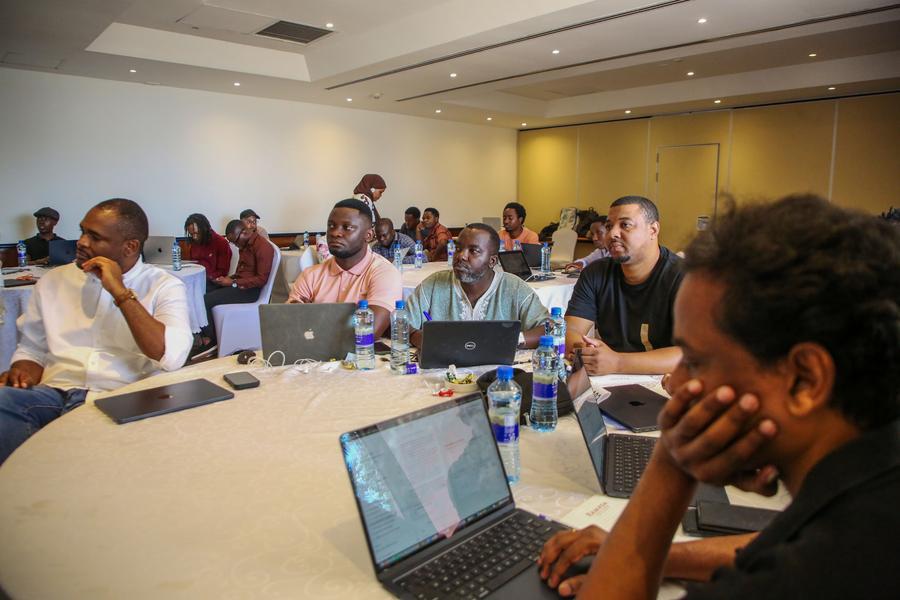
The need for inclusive media cooperation was also highlighted by representatives from the Global South.
"We hope the initiative will become a practical avenue for cooperation, sharing expertise and building capacity, and media organizations of different sizes and with different resources can apply the standards," said Mohammed Alyami, director general of the Union of News Agencies of the Organization of Islamic Cooperation, which is also among the first participants, in an interview with Xinhua.
"International cooperation must therefore ensure that developing countries and small island states can contribute not only to AI's development, but also to the principles governing it," said Aminath Namza, chairperson of Public Service Media in the Maldives.
Likewise, Wong Chun Wai, chairman of the Malaysian National News Agency (Bernama), called on Global South countries to work together more closely in the changing media landscape and ensure that media organizations worldwide can share in the benefits of AI.
(Video reporters: Zhang Yichi, Wang Xiunan, Wang Pu; Video editors: Wei Yin, Zhang Yueyuan, Liu Ruoshi, Cao Ying)■