BEIJING, Nov. 9 (Xinhua) -- From intelligent connected new energy vehicles and biomanufacturing to quantum precision measurement, China is materializing its industrial ambitions with the guidance of a cluster of detailed five-year sector blueprints.
During the 15th Five-Year Plan period (2026-2030), the country aims to speed up the development of strategic emerging industries while cultivating future industries as new growth drivers.
These sector plans, together with national guidelines on new quality productive forces issued in October, provide a detailed framework for moving Chinese industry up the value chain.
More than listing promising technologies, these plans identify how innovations will be led to production, and where new products can be applied. This is crucial to the next stage of China's high-quality development.
ANCHORING FRONTIER TRACKS
These sector-specific blueprints highlight sci-tech innovations, with advancing industrial modernization acting as the guiding principle.
The five-year plan for electronic information manufacturing development issued in September clearly illustrates this approach. It calls for developing frontier electronic measurement technologies such as high-bandwidth, terahertz and quantum precision measurement.
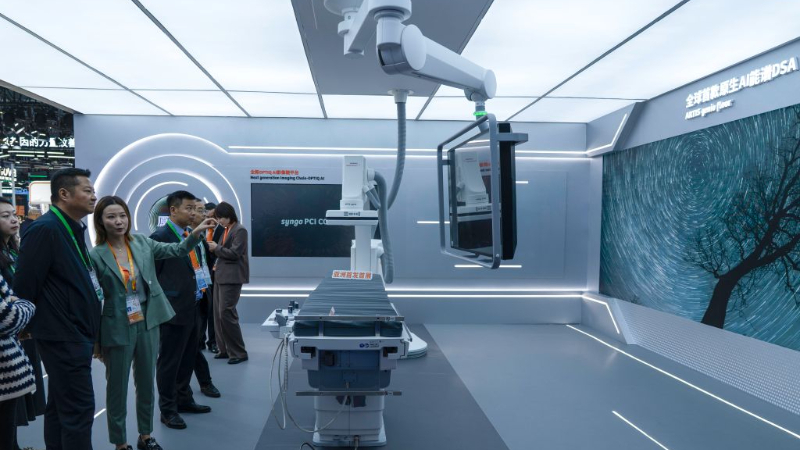
Motivated by this deployment, Ceyear Technologies Co., Ltd. has strengthened its technological research and launched a new generation of electronic measurement products, the performance of which, it says, matches advanced international standards. Its products, notably, already serve several strategic emerging industries like aerospace, satellite communications and AI.
Similar priorities run through other plans, but with different industrial entry points. The plan for the pharmaceutical industry puts innovation first among eight major tasks, and identifies frontier technologies for basic research, technology transfer and industrial maturation.
The plan for renewable energy development emphasizes frontier, original and disruptive technology research and equipment breakthroughs, while the green and low-carbon industry plan urges tackling key technologies for clean and low-carbon hydrogen, and speeding up the development and application of high-performance and degradable bio-based materials.
These forward-looking measures could spark breakthroughs in frontier technologies needed to drive overall industrial upgrading, help China's industries move toward the middle and high ends of the global value chain, and strengthen their international competitiveness, said Deng Zhonghan, an academician of the Chinese Academy of Engineering.
BUILDING INDUSTRIALIZATION BRIDGES
Selecting promising fields is only the first step. Hard-technology projects often require long investment cycles, while many research teams lack pilot facilities and first customers. The plans therefore seek to make companies central to innovation and connect research with industrial demand.
Chinese enterprises already account for more than 75 percent of the country's total R&D spending for several consecutive years, making them the mainstay of sci-tech innovations.
In Chongqing Municipality in southwest China, a biomanufacturing pilot platform offers a glimpse of such a bridge being built. Rows of reactors and purification equipment are undergoing process validation before production begins. Put into use in June 2026, this platform has signed up more than 20 research teams and enterprises, allowing them to test and refine processes without each having to build a full pilot line.
"The pilot platform has addressed our urgent need in commercializing research results and significantly reduced R&D investment and trial costs," said Ou Zhen, director of the general manager's office at Hymos (Chongqing) Bioscience Co., Ltd., adding that the company has developed 17 types of recombinant human keratin and is advancing the commercialization of multiple keratin products with the platform's support.
China's policy toolkit extends beyond shared facilities. Companies are encouraged to lead national science and technology tasks, while cross-sector innovation consortia can bring manufacturers, suppliers and researchers together. Universities and research institutes, meanwhile, are encouraged to license results to small and medium-sized enterprises on a "use first, pay later" basis.
Talent and finance policies complete the support system, promoting closer industry-education integration and calling for more patient capital that invests early, in small companies, for the long term, and in hard technology.
PROVIDING NEW OPPORTUNITIES
The strategy is not confined to industries still in their infancy. The October guidelines specify support for upgrading traditional industries via digital, intelligent and green technologies, while identifying industries such as mining, metallurgy, chemicals, light industry, textiles, machinery, shipbuilding and construction.
In a high-tech zone in Weifang, east China's Shandong Province, engines move along intelligent production lines at a Weichai Group workshop. From diesel engines to new energy, technological upgrade of this leading traditional power equipment maker illustrates how innovation can transform an established manufacturer, rather than simply replace old industries with new ones.
This combination of new industries and modernized existing ones is key to the development of new quality productive forces. Frontier sectors can create fresh growth drivers, while a broader industrial base supplies components, engineering expertise and markets for their products.
"The real test of new quality productive forces is not under the spotlight at a press conference, but in companies' actual financial statements," said Yan Yang, vice president of the Beijing Internet of Things Intelligent Technology Application Association.
These plans also create potential entry points for international partners. The October guidelines call for a global innovation cooperation network, including joint science parks, Belt and Road joint laboratories, and international centers for applying advanced technologies. They encourage foreign venture-capital institutions and international standards organizations to develop in China, and call for efficient, convenient and secure cross-border data flows.
Some foreign companies are already positioning themselves around the opportunities brought by China's emerging and future industries. Corning Incorporated is expanding optical-communications capacity in east China's Shanghai, and south China's Guangdong and Hainan, as the country's industrial digitalization increases demand for upstream materials.
General Electric's energy investment arm in China, meanwhile, has joined China Huadian Corporation and Peking University's energy research institute in research on hydrogen applications. Such projects show how overseas technology, capital and expertise can connect with Chinese manufacturing, infrastructure and research capabilities.
The guidelines urge local governments to adapt industries to local strengths, avoid blind investment and prevent "involution-style" competition. If these guardrails hold, the blueprints could turn a dispersed set of technology bets into a more coherent industrial pipeline, which will foster new growth engines, upgrade China's manufacturing foundation, and provide overseas partners with a clearer roadmap for initiating and advancing collaboration. ■