URUMQI, Nov. 4 (Xinhua) -- With the cotton-picking season underway in Xinjiang Uygur Autonomous Region in northwest China, Zhou Jinshan, 62, has already finished machine-harvesting his own fields. However, his work is far from over.
After arranging a machine for his neighbor, Ablekim Musa, to harvest cotton, Zhou plans to send another machine to deep-plow the Uygur farmer's fields as winter approaches, preparing the land for spring sowing next year.
For Zhou, helping Ablekim comes naturally. "We are as close as brothers, even closer than real brothers," he said.
Zhou and Ablekim live in Pomegranate Lane in Daxi Village of Yuli County. Stretching about 800 meters, this lane accommodates 18 households from both the Han and Uygur ethnic groups and has long been celebrated for the warm relationships among its residents.
China is home to 56 ethnic groups, including the Han and 55 ethnic minorities that collectively account for nearly one-tenth of the country's population, according to the latest national census.
In China, the image of pomegranate seeds clustered closely together often symbolizes unity among ethnic groups. The lane in Daxi Village takes its name from this familiar metaphor.
For Zhou and Ablekim, this name is not an aspiration yet to be fulfilled, but a reality they have lived for years.
Their friendship began around two decades ago, when Zhou's car got stuck in a remote area. Ablekim, who happened to be passing by on his bicycle, helped lift Zhou out of danger.
After becoming neighbors in Pomegranate Lane, the two grew even closer. Drawing on his rich experience in cotton farming, Zhou offered Ablekim hands-on guidance at every stage of cotton production.
"Zhou taught me everything he knew," said Ablekim. "With his help, I've expanded my cotton fields from 20 mu (1.33 hectares) to over 100 mu, and the cotton yield per mu has also increased significantly."
The support, notably, has gone both ways. Last year, when Zhou's orchard was hit by disease, Ablekim immediately rallied fellow villagers in the lane to help prune affected branches and save the trees.
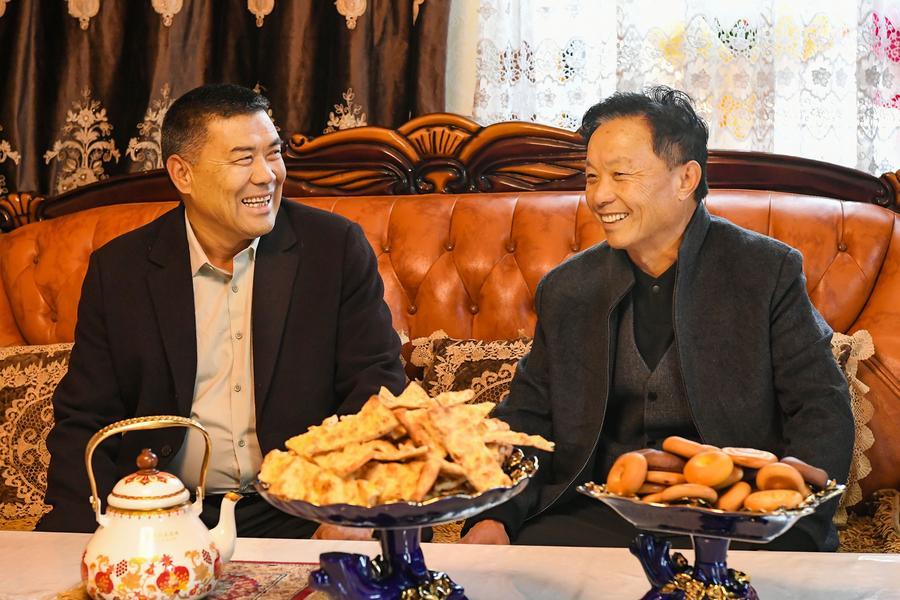
In their spare time, the two farmers often visit each other's homes, chatting about everything from the latest developments in agricultural technology to family matters.
Such neighborly ties are part of everyday life in Pomegranate Lane. "People in Pomegranate Lane live by a simple rule: when there's naan bread, we eat together, and when there's hardship, we stand together," Zhou said.
A tradition has also taken root among the lane's residents. During the Spring Festival, they gather for a hearty meal to celebrate China's most important traditional holiday and exchange best wishes for the year ahead.
Xatgul Rahman, Party chief of Daxi Village, describes Pomegranate Lane as a microcosm of the village's ethnic unity. In recent years, the village has promoted a regular pairing program to strengthen ties among residents of different ethnic groups, with 318 pairs formed so far.
The story of Pomegranate Lane has also attracted growing attention beyond the village and brought in more visitors. The villagers often welcome them into their homes, sharing their experiences of living and working together.
"We are proud to share our stories and help more people understand our hometown," Xatgul said.
Zhou sees the influx of visitors as an opportunity to boost his income. He is already considering opening a homestay -- with Ablekim as his business partner, of course.
"Just as the lane's name suggests, we will stick together tightly like pomegranate seeds to build businesses and create a better future," Zhou noted. ■