

JERUSALEM, Nov. 4 (Xinhua) -- Israel's parliamentary election has stripped Prime Minister Benjamin Netanyahu's right-wing alliance of its majority, but the refusal of most of his Jewish opponents to rely on Arab parties could keep him in power, exposing the limits of political change, analysts say.
Official results released Wednesday showed Netanyahu's bloc falling from 68 to 53 seats in the 120-member parliament. Parties opposed to him secured 67 seats, including a record 19 won by two Arab-led parties, namely the Joint List, a coalition of three parties, and the Muslim Ra'am party.
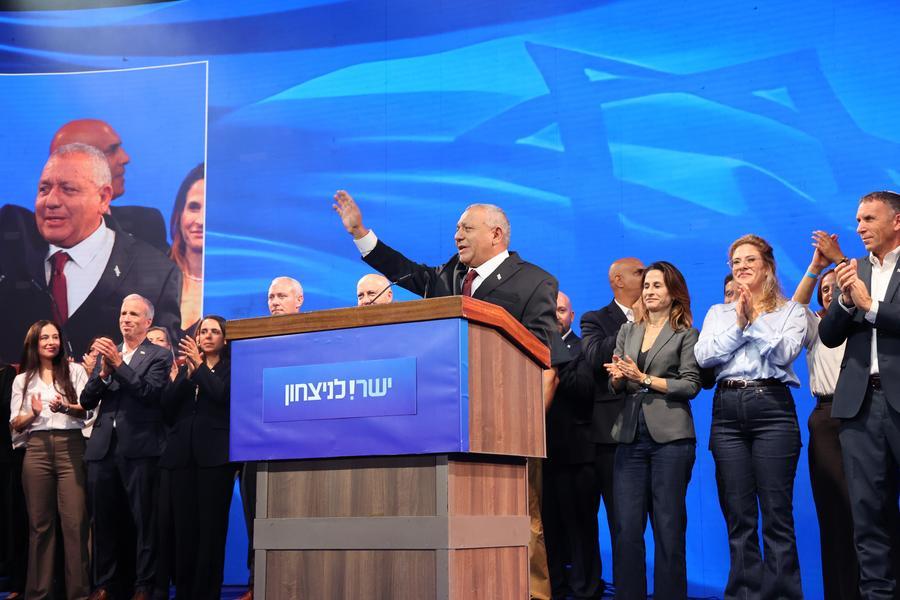
Former military chief Gadi Eisenkot's four-party alliance holds 48 seats. Of the four parties, three reject Arab support, while the left-wing Democrats advocate cooperation, leaving the anti-Netanyahu majority without an agreed path to power.
A RECORD VOTE, FAMILIAR BARRIERS
The Joint List won 11 seats and Ra'am eight, nearly doubling their combined 10 seats in the outgoing parliament. Voter turnout in Arab localities surged to about 77 percent from 53.2 percent in 2022, according to the Israel Democracy Institute, a think tank.
Eyal Zisser, a professor at Tel Aviv University, told Xinhua the surge reflected hostility toward the outgoing government -- a coalition of right-wing, pro-settler and ultra-Orthodox parties -- and a desire for greater political influence.
"They want to remove Netanyahu from office and to remove this government from office," he said.
Arab citizens of Israel, who make up about 20 percent of the population, are largely Palestinians who remained after the 1948 war and their descendants.
Reda Jaber, a researcher specializing in law and Arab politics in Israel, told Xinhua that Arab voters sought to assert their citizenship against discriminatory policies, including restrictions on political activity, home demolitions and rising crime.
Yet most Jewish opposition leaders reject cooperation with Arab parties despite their offers to help replace Netanyahu.
Joint List leader Yousef Jabareen told CNN his alliance would act as a "safety net" for a new government, supporting it from outside to oust Netanyahu. He cited Arab parties' backing of former Prime Minister Yitzhak Rabin's government in the 1990s, which provided the majority needed to advance the Oslo peace accords with the Palestinians.
Jabareen called on opposition leaders to follow Rabin's example, saying cooperation with Arab parties could open "a new direction in Israeli politics."
Ra'am leader Mansour Abbas, whose party joined the coalition that ousted Netanyahu in 2021, has explicitly expressed willingness to join an Eisenkot-led government.
Jaber argued that the opposition's refusal reflected deeper barriers to Arab political influence. Israel, he said, has "no liberal bloc willing or able to expand the scope of citizenship to include Arabs." Continued exclusion could alienate Arab voters in the next elections and benefit Netanyahu's camp, he warned.
CHANGE OF LEADERSHIP, NOT NECESSARILY POLICY
Eisenkot could seek a minority government backed by Arab parties, try to win over lawmakers from Netanyahu's bloc or negotiate a unity government. All face major political obstacles. Failure could trigger another election, leaving Netanyahu in power as caretaker prime minister.
The window to oust Netanyahu may be narrow. "They have been handed the last chance to change the government in Israel. There will be no next time," veteran Haaretz commentator Yossi Verter warned Monday, arguing that the government's efforts to reshape state institutions and the judiciary could make future transfers of power increasingly difficult.
The deadlock also exposes ideological overlaps between Netanyahu's camp and much of the Jewish-led opposition, particularly over the Palestinians.
Eisenkot has ruled out establishing a Palestinian state under his leadership and supports settlements in the occupied West Bank that meet Israeli legal and security criteria. His bloc also includes right-wing Avigdor Lieberman and former Prime Minister Naftali Bennett, a staunch supporter of settlement expansion who opposes Palestinian statehood.
"Most parties across the political spectrum today oppose Palestinian independence," Jaber said. An alternative government might ease conditions for Palestinians, he said, but would be unlikely to end the occupation or dismantle the settlement system.
Zisser is more optimistic, saying a new government could adopt a less confrontational tone and improve relations with Arab countries, even without a fundamental policy shift.■