
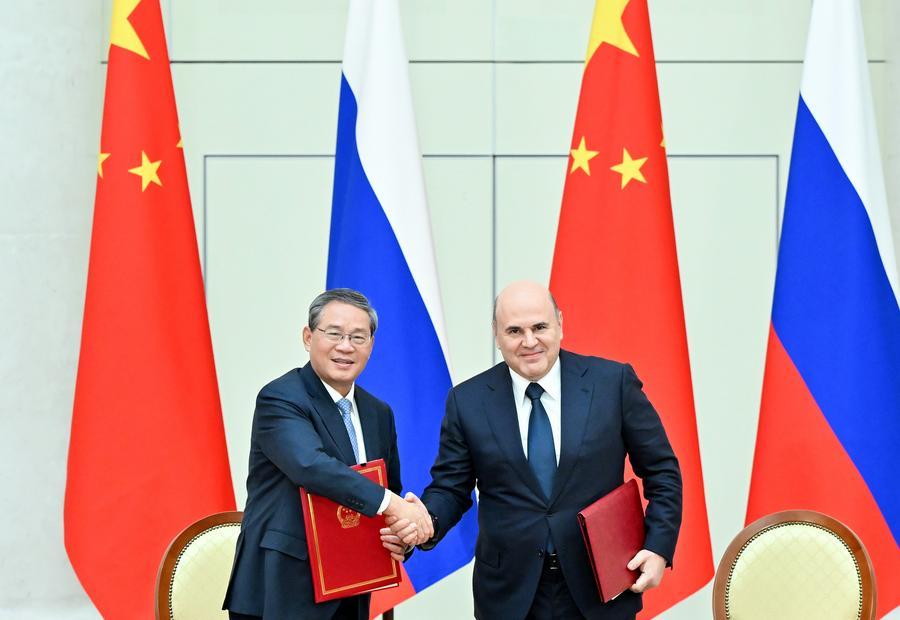
ST. PETERSBURG, Oct. 22 (Xinhua) -- China and Russia have leveraged more dynamic and resilient cooperation to cushion the impact of external uncertainties and instability, and bilateral ties are entering a new stage marked by greater achievements and faster development, said Chinese Premier Li Qiang on Wednesday.
Li made the remarks while co-chairing the 31st regular meeting between Chinese and Russian heads of government with Russian Prime Minister Mikhail Mishustin.
This year marks the 30th anniversary of the establishment of the China-Russia strategic partnership of coordination. For three decades, the regular meeting, held every year since its inception in 1996, has served as an important mechanism for implementing the consensus reached by the two heads of state and promoting bilateral cooperation and people-to-people exchanges, no matter how the international situation evolves.
China and Russia have in recent years stood side by side and moved forward together in the face of a complex and turbulent international landscape, Li said.
"This environment calls for continuous coordination and timely adjustment of plans. By advancing all-round cooperation, our two countries (Russia and China) are effectively countering the destructive forces and trends," said Andrei Vinogradov, head of the Center for Contemporary China Studies at the Institute of Oriental Studies under the Russian Academy of Sciences.
During the regular meeting on Wednesday, both sides agreed that China and Russia should advance cooperation in key areas such as economy and trade, investment, energy and resources, foster new drivers of development in frontier areas such as artificial intelligence, biotechnology and the digital economy, jointly ensure the success of the China-Russia Years of Education, and strengthen people-to-people and cultural exchanges.
These commitments build on the strong foundation of practical cooperation between the two countries, with economic and trade ties remaining a major pillar of the bilateral relationship.
Data from China's Ministry of Commerce showed that in 2025, China-Russia trade reached 227.9 billion U.S. dollars, staying above 200 billion dollars for the third consecutive year. China remained Russia's largest trading partner for the 16th consecutive year.
The structure of bilateral trade has also continued to improve, with electromechanical and high-tech products accounting for a growing share. Chinese automobiles, home appliances and machinery have maintained strong exports to Russia, while Russia has remained a stable supplier of energy, minerals and agricultural products to China.
"It is noteworthy that the two countries are working not merely to identify new converging interests, but also to explore new development avenues by leveraging the combined potential of their two economies," Vinogradov said.
Bilateral trade maintained relatively rapid growth in 2026. Statistics from China Customs showed that in the first seven months of the year, China-Russia trade reached 159.2 billion dollars, up 26.3 percent year on year.

"Russian and Chinese economies are complementary. This allows each side to pursue its own development path and advance its national interests," said Vladimir Lvovich Nezhdanov, an expert at the Institute of Contemporary International Problems, Diplomatic Academy of the Ministry of Foreign Affairs of the Russian Federation.
"Russia needs a stable and dynamically growing China, just as China needs a stable and dynamically growing Russia. This is a mutual interest," he added.
On the global dimension, a joint communique issued after the 31st regular meeting said that China and Russia firmly uphold the United Nations-centered international system and the international order based on international law. The two countries also support consolidating fair international relations on the basis of mutually beneficial cooperation among sovereign states and oppose dividing the world into rival regions or blocs, it said.
"China proceeds in a steady manner, recognizing that no initiative or policy measure can be implemented without mutual trust," said Nezhdanov, noting a white paper titled "More Just and Equitable Global Governance: China's Principles, Proposals and Actions" released by China in June.
Cultivating mutual trust under the Global Governance Initiative is a practice that major countries, which are willing to assume responsibility for international affairs, have long followed to normalize and strengthen international dialogue, he added.
This year also marks the 25th anniversary of the signing of the Treaty of Good-Neighborliness and Friendly Cooperation Between China and Russia. Over the years, the two countries have always adhered to the treaty's established principle of non-alliance, non-confrontation and not targeting any third party, and stayed committed to equality, mutual respect, good faith and win-win cooperation, making important contributions to safeguarding international fairness and justice and promoting a new type of international relations, and serving as a vital constant amid century-defining changes sweeping across the world, said Xi in May during Putin's state visit to China.
The two sides should deepen multilateral coordination, further increase coordination and collaboration on multilateral platforms such as the United Nations, the Shanghai Cooperation Organization, BRICS and APEC, unswervingly uphold the postwar international order and the authority of international law, unite the Global South, and steer the reform of the global governance system in the right direction, Xi said then.
"Russia-China relations are a truly high-quality model of relations between major countries, delivering benefits and shared interests at every level, from grassroots communities to national governments and the global stage alike," Nezhdanov said. ■