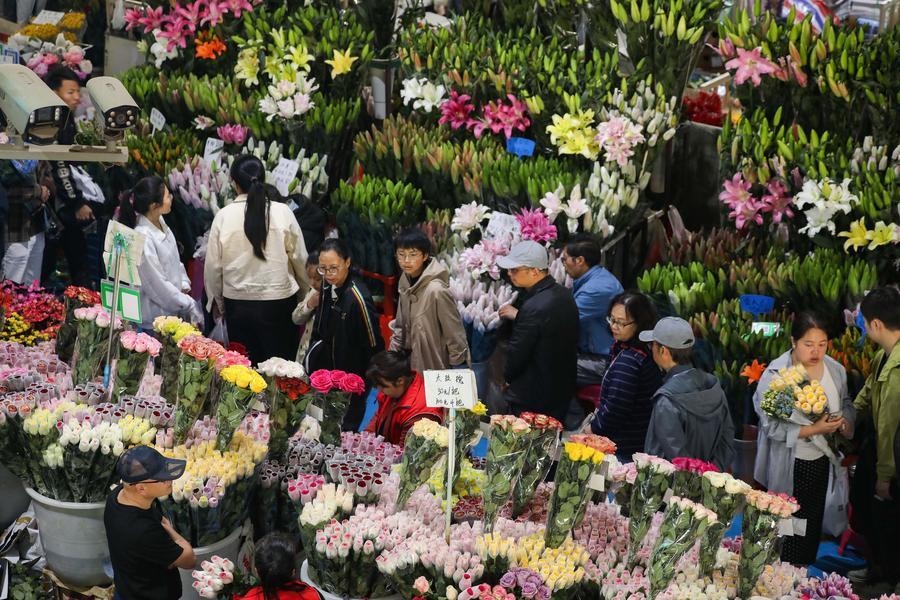
KUNMING, Oct. 19 (Xinhua) -- From digital trading to creative design, a new generation of entrepreneurs is reshaping the flower industry in southwest China's Yunnan Province, helping local blooms reach wider markets and bringing greater value to the communities that grow them.
Over the past decades, Yunnan has been the powerhouse of the country's flower industry and its capital, which is known as China's "City of Flowers," is home to Dounan Flower Market, Asia's largest and the world's second-largest flower trading hub.
In Kunming, blossoms are never far away, even at Kunming Changshui International Airport, where if visitors forget to bring flowers to greet friends, there is no need to worry. For about 20 yuan (approximately 3 U.S. dollars), visitors can pick up a bouquet of sunflowers, roses, carnations and greenery.
In 2025, Yunnan produced 22.1 billion stems of cut flowers, which accounted for more than 70 percent of China's total. The industry's value exceeded 140 billion yuan, supporting 190,000 farming households and providing 480,000 jobs.
Since the first gladiolus corms were planted in Yunnan in the 1980s, the local flower industry has grown from a few trial plots into Asia's largest fresh flower market. Now a younger generation of growers is transforming the industry.
Yang Ping was born in 1985 into a Bai ethnic family and grew up in the flower fields, where she learned to tend plants and sort blooms for sale. Her mother used to transport flowers by bicycle to markets, giving Yang an early understanding of the hard work behind producing every bouquet.
She saw the industry's challenges: opaque pricing, limited market information and uncertain payments. Farmers often traveled to markets before dawn, while buyers faced high costs and inconsistent quality.
After graduating with a degree in computer science, Yang and her partners launched Huaeb, an online flower trading platform, allowing farmers to secure orders before harvesting.
"Farmers used to haul flowers to market in the early hours, hoping for a good price. Now, they can wake up to orders on their phones," Yang said.
At peak times, Huaeb records a transaction every five seconds. The platform has attracted around 12,000 farming households and cooperatives, helping participating households increase their annual income by 20,000 to 30,000 yuan on average.
Huaeb also provides digital farming equipment that precisely controls water and fertilizer, light, temperature and humidity to safeguard flower quality, alongside real-time market analysis and traceable cold-chain logistics that support quality inspection and graded sales. Third-party payment guarantees help protect both buyers and sellers.
Rose grower Gao Chuanfu has benefited from the service. With regular guidance from Huaeb technicians, he learned to manage water and fertilizer more effectively, improve harvesting practices and sell online.
"Now my flowers are more consistent in quality, and my selling costs have fallen by nearly 30 percent," Gao said.
To reach remote communities, Yang's team provides e-commerce training in villages across Yunnan and operates 41 flower collection points to connect growers with wider markets.
"We follow development of flower industry there, help flowers from remote areas reach buyers across China through digitalization, while allowing purchasers to connect with Dounan suppliers without traveling there," Yang said.
For some young people born into flower-growing families, selling flowers is the beginning. They are finding ways to add value through design and promotion of new lifestyles.
Mo Shuna's parents were among Dounan's early flower growers in the 1980s. Her interest in floral design began in the early 1990s, when a visiting trader who rented a room in her family's home introduced her to the craft.
Over more than two decades, Mo has become a nationally certified floral design technician and senior assessor, designing floral displays for the China-South Asia Expo over multiple years, while also gaining certification from the American Floral Art School.
"As the second generation of flower growers, we cannot stop at growing and selling flowers, and we need to give them artistry, value and stories," Mo said.
China's flower retail market reached 249 billion yuan in 2025, up about 13.18 percent year on year, according to the China Flower Association. Flowers are increasingly purchased not only for festivals and special occasions, but also as an everyday way to lift people's spirits.
After art design tasks, Mo also teaches floral arrangement in communities and workplaces across Kunming, to help more people bring the fragrant art into everyday life.
"Flower arranging is not just a skill. It can also be healing. People immerse themselves in the process, relax and enjoy creating something beautiful," she said. ■