
TIANJIN, Oct. 21 (Xinhua) -- At an automotive industrial park in north China's Tianjin Municipality, Egyptian students Abdelrahman Ayman Zaky and Adham Ayman are gaining hands-on experience in new energy vehicle (NEV) chassis systems alongside their Chinese peers.
Having acquired vocational skills at an Egyptian Luban Workshop, the two came to China to deepen their expertise. Adham, 20, hopes to improve his Chinese and vehicle maintenance skills before returning to Egypt to pursue a career as an automotive engineer.
Their experience highlights the mission of the China-initiated Luban Workshops, which over the past decade have equipped young people worldwide with useful skills, fostered local talent, and supported industrial development.
Named after Luban, an ancient Chinese craftsman and inventor who lived more than 2,500 years ago, the initiative draws on a longstanding Chinese tradition of craftsmanship and innovation.
Jointly established by Chinese and foreign educational institutions, Luban Workshops now offer vocational education and skills-training programs in 32 countries.
In Egypt, Luban Workshops are helping students like Adham translate classroom learning into engineering capabilities.
Mohamed Mostafa, a student at an Egyptian Luban Workshop now studying at Tianjin Light Industry Vocational Technical College, said hands-on practice has strengthened his ability to tackle real-world engineering challenges.
"In the EPIP (Engineering Practice and Innovation Project) classroom, we don't just work on simulated problems. We work on real-world engineering problems in teams, discussing solutions, refining our techniques and testing them again and again. We break down complex challenges to achieve the best results and meet engineering standards," Mostafa said.
He added that he has shared the approach with students in Egypt, where they have applied the same methods to develop their own projects.
The two Egyptian Luban Workshops have provided formal education to more than 3,100 people and skills training on over 4,000 occasions, creating new opportunities for industrial cooperation.
Wang Baolong, dean of the School of Mechanical Engineering at Tianjin Light Industry Vocational Technical College, said graduates trained in advanced technologies can meet the needs of local businesses, strengthening Chinese companies' confidence in investing in and establishing factories in Egypt while supporting local economic development.
An employment training base jointly established by the Egyptian Luban Workshops and the China-Egypt TEDA Suez Economic and Trade Cooperation Zone has provided young Egyptians with a direct pathway to employment.
"After receiving professional technical training, these young people can operate production equipment proficiently. They are exactly the kind of skilled workers that companies need," Wang added.
Beyond teaching technical skills, the workshops also help build local capacity for sustained vocational training. While setting up training centers and supplying advanced equipment, Chinese partners send teachers and technicians to train local instructors and arrange exchanges and learning opportunities in China.
In 2016, the Tianjin Bohai Vocational Technical College and the Ayutthaya Technical College in Thailand jointly established the world's first Luban Workshop. Over the past decade, all six of the workshop's internationalized majors have been incorporated into Thailand's national education system.
"We are not just cultivating talent for the local area, but leaving the whole system behind. Chinese standards and models are truly integrating into and promoting local development," said Mei Wentao, a staff member at the Tianjin Bohai Vocational Technical College.
More than 100 Chinese companies in Thailand operate businesses ranging from NEV components to vehicle distribution. In August 2025, the China-Thailand automotive intelligent manufacturing industry-education integration community was established in Thailand. With a steady supply of skilled graduates, companies can recruit directly from schools, helping young Thai people find jobs more easily and quickly.
In Central Asia, the Tajik Luban Workshop is helping local young people explore new career opportunities. In nearly four years of operation, it has provided learning and training opportunities to more than 3,600 undergraduate and postgraduate students.
When Bakhtiyor Bozorzoda enrolled at the Tajik Technical University, he was uncertain about his chosen major in geodesy and cartography. Advanced surveying equipment, digital mapping technologies, and virtual simulation courses at the Tajik Luban Workshop helped him recognize the field's potential and develop a stronger interest in surveying.
During his studies, Bozorzoda gained hands-on experience with high-precision instruments and digital mapping technologies.
"I hope to continue my studies in China in the future, learn more advanced surveying technologies and contribute to infrastructure development in Tajikistan," he said.
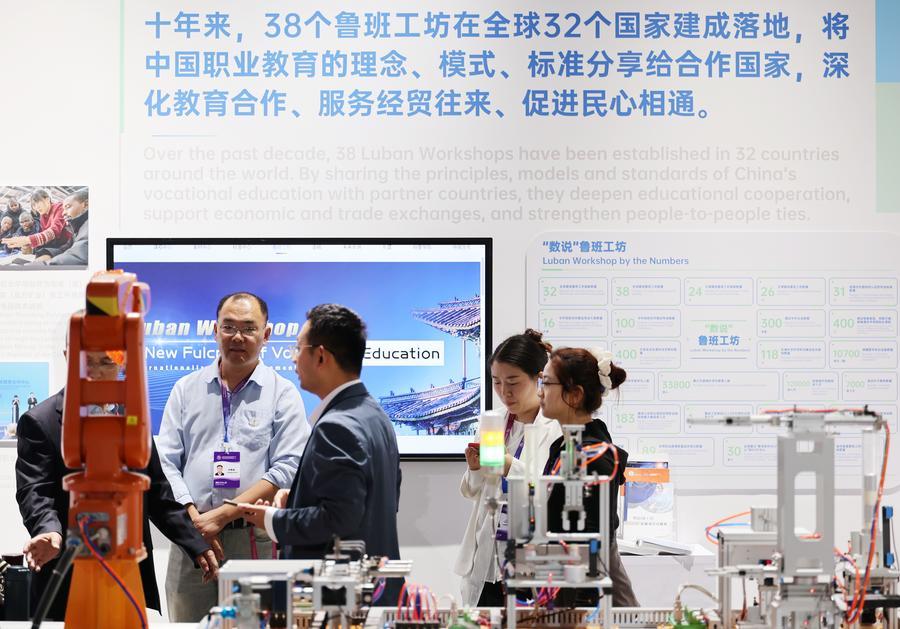
Today, Luban Workshops have become a hallmark of China's international vocational education cooperation. Data from China's Ministry of Education show that the country has established 38 Luban Workshops in 32 countries, providing formal education to more than 30,000 students and non-degree training to over 160,000 people.
The Luban Workshops reflect a commitment to harmony, coexistence and the common good in Chinese cultural tradition. By responding to local needs, they help young people in different countries acquire skills that can benefit them throughout their careers, said Tian Xuejun, president of the China Education Association for International Exchange, at the 2026 World Vocational and Technical Education Development Conference, held in Tianjin from Oct. 15 to 17.
China has the world's largest vocational education system, with 9,151 secondary vocational schools, 1,554 higher vocational colleges and 124 vocational undergraduate institutions.
As of the end of 2025, China's vocational education catalog covered 19 major categories, 97 subcategories and 1,491 majors, spanning virtually all sectors of the national economy and all 41 major industrial categories.
China is continuing to strengthen its vocational education system to support the development of emerging industries and expand opportunities for people both at home and abroad. At the 2026 World Vocational and Technical Education Development Conference, representatives from 45 countries jointly released the Framework of World Vocational and Technical Education Standards developed under China's leadership.
The framework calls for improving vocational school systems, establishing lifelong education and training opportunities for all, developing teaching materials through industry-education collaboration, building teaching teams through school-enterprise partnerships, and using artificial intelligence to drive reform in education and teaching. ■