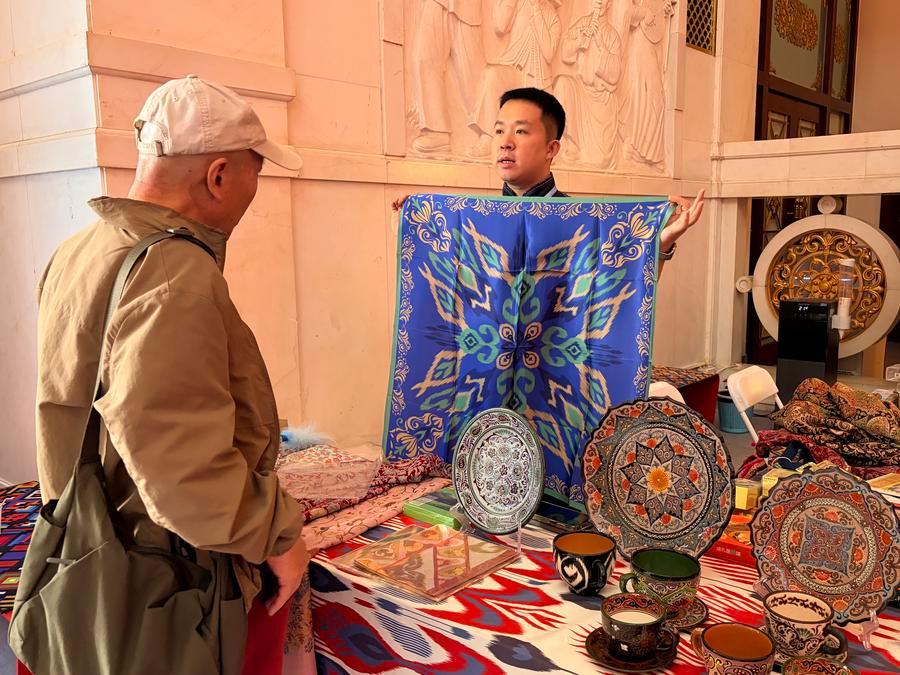
BEIJING, Oct. 21 (Xinhua) -- A slim, sky-blue scarf caught the eye of young visitors at an exhibition in downtown Beijing, with its contemporary zodiac motifs offering a fresh take on Xinjiang's traditional Atlas silk, known for its vivid colors and distinctive patterns.
The scarf was the work of designer Gong Yue, a young entrepreneur from Korla, northwest China's Xinjiang Uygur Autonomous Region, at an exhibition showcasing specialty agricultural products and cultural and creative products from Bayingolin Mongolian Autonomous Prefecture.
Gong's booth features a wide range of creative cultural products designed and made by him and his team. Drawing on local materials and traditions, these products vary from Atlas silk tissue holders and mouse pads to refrigerator magnets with ethnic wedding themes, to cashmere scarves featuring contemporary interpretations of traditional Xinjiang motifs.
Born in 1996 in Korla, Gong used to work in a pharmaceutical firm in Shanghai. He later returned home and launched a business with two friends.
The idea grew out of his habit of bringing Xinjiang specialties and souvenirs to colleagues in Shanghai, whose positive responses convinced him that locally inspired products could appeal to consumers beyond the region.
Located in southeastern Xinjiang, Bayingolin Mongolian Autonomous Prefecture features diverse landscapes ranging from mountains and grasslands to deserts and lakes, and is home to numerous historical sites, including the ruins of the ancient city of Loulan, offering Gong a rich source of inspiration for his designs.
Among his team's newer products are ceramic plates and coffee cups made with sand from local desert and Gobi areas. After repeated trials, the team found that the sand and local water gave the ceramics a distinctive blue-green finish.
Beyond experimenting with local materials, Gong also draws on both technology and traditional craftsmanship to bring Xinjiang's cultural heritage into contemporary life. His AR fridge magnets, for instance, are inspired by the well-known Han Dynasty brocade armband inscribed with the Chinese characters "five stars rise in the East." Scanning a QR code takes users to a slideshow explaining the historical artifact and its cultural significance, adding context to the designs.
He has also reimagined traditional motifs for embroidered cashmere scarves and blankets, adapting clustered-grass, vine-and-grass and flame patterns to contemporary tastes. Gong develops the designs and works with local embroiderers, who bring them to life by hand.
"For example, I incorporated traditional motifs symbolizing flourishing growth and career advancement into the scarf design to resonate with young consumers' aspirations for success," Gong said.
Turning these designs into finished products requires close cooperation with traditional craftspeople. Gong's team now works with 13 family-run workshops in the region, and producing a single handmade blanket can involve 10 to 16 embroiderers.
In working with the artisans, Gong comes to appreciate the meticulousness of traditional handicrafts and the time and patience required to produce each piece. He realizes that bringing traditional crafts to a wider market is not simply a matter of scaling up production, but also of respecting the skills, working rhythms and craftsmanship of the artisans behind them.
Gong's designs speak to both tourists and local residents. Li, a Korla resident who has bought a pair of cups inspired by the city's signature fragrant pears, said the products capture her hometown's character while offering a fresh, fashionable take on local culture.
The stores have also gained followings on social media platform Xiaohongshu. As posts about the stores spread online, they become popular check-in spots in Korla. Gong's team now operates three stores and is collaborating with museums and galleries in Beijing's 798 Art District.
Gong is not alone in bringing Xinjiang's local culture to consumers. In Yili Old Town, Cao Hongbing's leathercraft workshop produces sheepskin pyrography artworks. The business has grown from two people to more than 10 employees, most of whom are local residents.
In Yuli County's Lop Nur Village scenic area, college students are turning local fishing and hunting traditions and folk culture into wood carvings, bookmarks and other souvenirs.
Local authorities are also helping young entrepreneurs bring Xinjiang's local products and cultural offerings to wider audiences. Gong's trip to Beijing, for example, was part of a promotional event by local authorities showcasing Bayingolin's specialty products and cultural and tourism resources. Other measures to support local businesses include startup loans, access to business premises and incubation services, as well as job fairs tailored to relevant industries.
Meanwhile, Xinjiang's booming tourism market offers further opportunities for local cultural and creative businesses. In 2025, the region received a record 323 million tourist visits, with tourism spending reaching 370 billion yuan (about 55 billion U.S. dollars).
Developing strong brands is key to preserving and advancing traditional crafts, while creative design and new technologies can help connect them with modern life, meet consumer needs and enhance their market value, said Huang Yonglin, head of the National Research Center of Cultural Industries under the Central China Normal University.
For Gong, the goal is to make Xinjiang's cultural traditions more tangible and accessible. "I hope my products will attract more people to visit Xinjiang in person to experience its flavors, breathtaking landscapes and exquisite handicrafts," he said. ■