
BEIJING, Oct. 21 (Xinhua) -- China has achieved significant results in tackling climate change in recent years, gradually forging a green and low-carbon development path, a senior environment official said on Wednesday.
Li Gao, vice minister of ecology and environment, made the remarks at a news conference, where an annual report on China's policies and actions on climate change was released by the Ministry of Ecology and Environment.
The report showed that in 2025, China's carbon dioxide emissions per unit of GDP fell by 17.7 percent compared with 2020 levels. Non-fossil energy accounted for 21.7 percent of total energy consumption last year, while combined installed capacity of wind and solar power reached 1.84 billion kilowatts. Forest stock volume stood at 20.99 billion cubic meters in 2025.
This progress is backed by the country's sustained efforts to accelerate its green and low-carbon transformation.
China has built the world's largest and most complete clean energy industrial chain, with green and low-carbon industries becoming an important engine of economic growth, Li said.
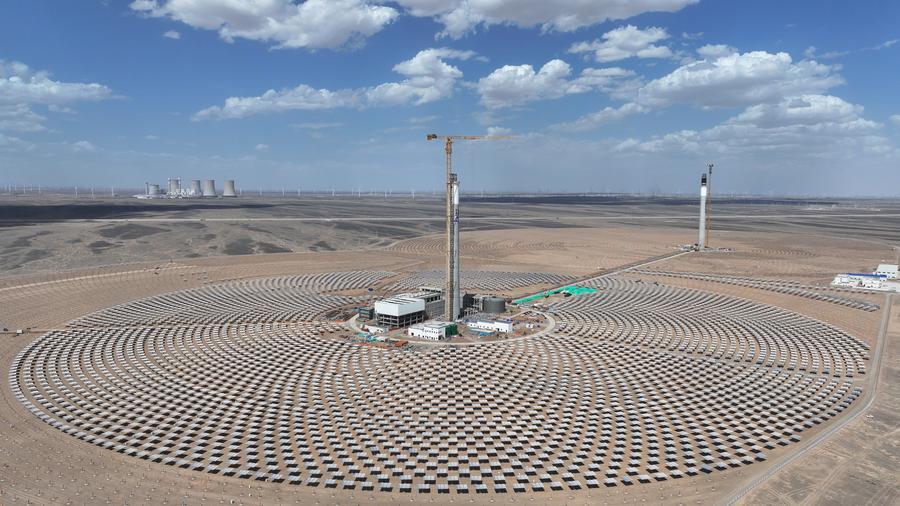
By mid-2026, the country's total installed renewable energy capacity had reached 2.46 billion kilowatts, accounting for 60.7 percent of total national power generation capacity. At the end of July, installed solar power capacity had surpassed coal power for the first time in China's history, making it the country's largest single power source.
Moreover, China's combined installed capacity of operational and approved nuclear power units has risen to first place globally. New energy vehicle production and sales, meanwhile, have ranked first in the world for 11 consecutive years.
Li noted that the country has established the world's largest carbon emission trading market, covering about 8.3 billion tonnes of carbon dioxide, or more than 65 percent of the country's total emissions. Cumulative allowance trading volume recently surpassed 1 billion tonnes.
China has long placed high importance on addressing climate change. It has set the dual carbon goals of peaking carbon dioxide emissions before 2030 and achieving carbon neutrality before 2060.
China last year announced its 2035 nationally determined contributions, including a target of reducing economy-wide net greenhouse gas emissions by 7 percent to 10 percent from peak levels, while striving to do better.
It represented the first time China had put forward an absolute emission reduction target covering all greenhouse gases across the entire economy, Li said.
The country is also actively participating in and leading global climate governance while helping other developing countries build their capacity to address climate change.
China has signed South-South cooperation memoranda of understanding on climate change with 46 developing countries, helped build low-carbon demonstration zones, implemented a series of flagship climate projects, and trained more than 10,000 officials and technical personnel from over 120 developing countries.
China in 2023 launched the "Africa Solar Belt" photovoltaic project, which has helped nearly 20,000 households in five African countries gain access to electricity and lighting. By 2027, this flagship project is expected to benefit 50,000 African households.
Looking ahead, China's commitment to addressing climate change will not waver.
In July, the government released a national climate change plan for the 2026-2030 period, targeting a 17-percent reduction in carbon dioxide emissions per unit of GDP by 2030 compared with 2025 levels. The plan also vowed to deliver the country's carbon peaking target on schedule and fulfill the 2030 nationally determined contributions.
Li said China will promote green and low-carbon development in key sectors including energy, industry, transport, and urban and rural construction, accelerate the development of the national carbon market, and advance the building of a climate adaptive society.
Also on Wednesday, the Ministry of Industry and Information Technology released an action plan on controlling both the total amount and intensity of carbon emissions across the industrial and information technology sectors for the 2026-2030 period to speed up China's green and low-carbon transition.
The plan called for improving carbon emission management in key industries, accelerating the development of zero-carbon factories, zero-carbon computing facilities and low-carbon supply chains, establishing a carbon footprint management system for industrial products, and setting up carbon accounting mechanisms.
By 2030, the plan targeted the formulation and implementation of around 400 carbon footprint accounting standards for key industrial products, the establishment of roughly 500 national-level zero-carbon factories and zero-carbon computing facilities, and an over 10-percent reduction in energy consumption per unit of value-added output of major industrial enterprises. ■