
FRANKFURT, Oct. 21 (Xinhua) -- Recent protests across Europe have brought social and economic strains into sharper focus, reflecting concerns that extend beyond prices to housing, incomes, public services and economic security. Governments face growing pressure to respond, but high debt, tight budgets and long-standing structural problems leave few quick or easy solutions.
DEMONSTRATIONS ACROSS EUROPE
Holding a cardboard sign reading "I am 81 and being evicted," retiree Maria Teresa Faleiro joined crowds in Lisbon protesting against soaring living costs and a deepening housing crisis.
Despite never missing a payment on the 724-euro (813-U.S. dollar) monthly rent for the home she has lived in for 22 years, Faleiro faced eviction after her landlords refused to renew her lease. With nowhere else to go, she plans to appeal the court-ordered eviction, she said.
Faleiro's struggle highlights the growing plight many pensioners in Portugal face in securing affordable housing. It also reflects a broader cost-of-living squeeze across Europe, where thousands have taken to the streets to protest rising housing, food, fuel and energy costs, even as headline inflation has eased.
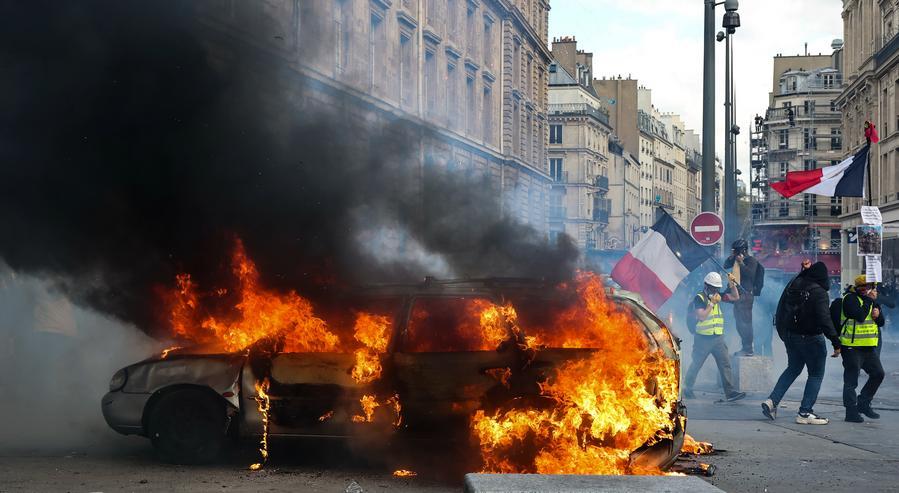
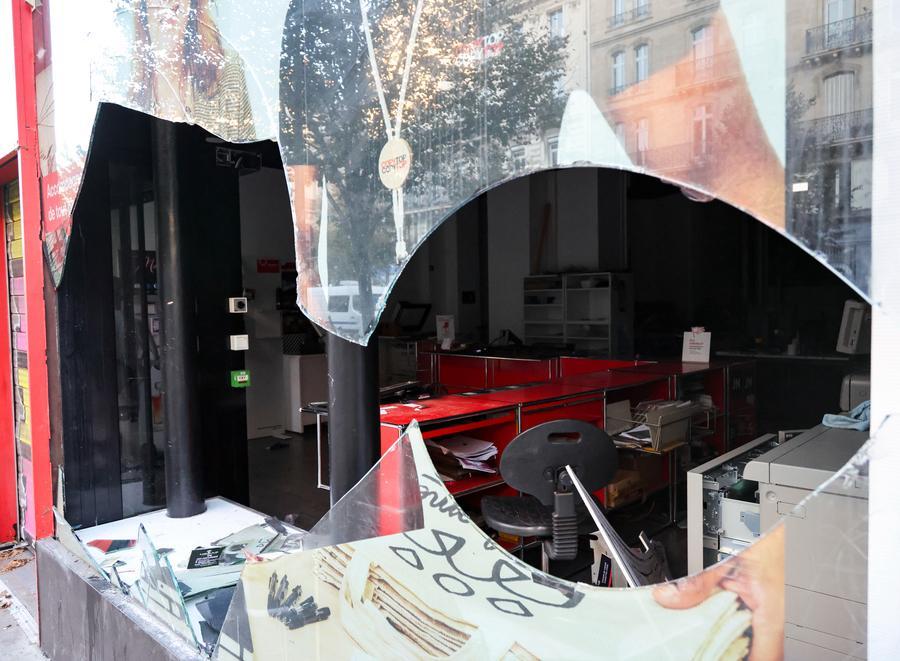
In France, protests that began with students demanding better school conditions and more teaching staff broadened into nationwide demonstrations over rising living costs and wider social grievances. Violence soon erupted on the sidelines of some rallies, with clashes, looting and arson reported in several cities. The historic city hall in Limoges was largely destroyed by fire.
In Spain, more than 50 protests took place in Madrid and dozens of other Spanish cities on Oct. 3, demanding action on soaring rents, evictions and housing affordability after the government failed to pass emergency housing legislation.
Elsewhere, protests in Italy and Belgium have reflected a broader mix of concerns over wages, prices, public services and fiscal tightening. In Milan, hundreds of black-clad demonstrators besieged Piazza del Duomo on Saturday, throwing firecrackers and bottles at police. At least four officers and 20 protesters were injured, while about 50 demonstrators were detained, according to the Italian news agency ANSA.
ECONOMIC SECURITY UNDER STRAIN
Beyond higher daily expenses, mounting financial pressures are fueling a broader sense of economic insecurity across the continent. Although inflation has eased from its peak, households continue to feel the cumulative impact of earlier price increases.
The European Central Bank said food prices across euro-area countries were already 20 percent to 57 percent higher in August 2025 than at the end of 2019. Renewed energy pressures have added to the squeeze, with euro-area consumer energy inflation reaching 18.9 percent in September 2026, according to Eurostat.
Housing pressures are particularly acute among young Europeans. Data released by Eurostat showed that in 2025, 26.9 percent of young people aged 15 to 29 in the European Union (EU) lived in overcrowded households. And 9.1 percent of them lived in households spending at least 40 percent of their disposable income on housing, way above the 7.7 percent recorded for the total population.
Similar pressures are visible beyond the EU. In Bosnia and Herzegovina, property prices have risen by about 70 percent over the past five years, real estate agent Haris Kadic told the Federation News Agency (FENA).
Local media also reported that some residents are borrowing money or relying on help from children and friends to cover basic expenses as housing and fuel costs rise.
Emmanuel Conte, Milan's city councilor responsible for housing, told Italian daily la Repubblica this month that when people who keep a city running can no longer afford to live there, housing is no longer just a social and economic issue but a political one.
Similarly, Jean Faniel, director general of Belgium's Centre for Socio-Political Research and Information, told Belgian media outlet BRUZZ that violence accompanying recent protests should be understood in the context of mounting social frustration.
Faniel said peaceful demonstrations and violent confrontations are potentially interconnected rather than entirely separate phenomena, noting that successive austerity measures have placed mounting pressure on people's living conditions, generating frustration and resentment.
STRUGGLE TO BALANCE FISCAL, SOCIAL NEEDS
European governments have introduced housing, energy and income support, but high debt, aging populations and competing demands for defense and investment are narrowing their room for further action.
As the European Commission expects France's deficit to reach 5.1 percent of GDP in 2026 and public debt to reach 118.1 percent, Oliver Nachtwey, a sociologist at the University of Basel, said the country's efforts to contain public debt through spending cuts leave governments with less room to invest in schools, teachers and other public services.
Experts said the challenge is to reconcile fiscal discipline with social stability. Thomas Decreus, a scholar at the Department of Philosophy at Tilburg University, warned that weakening basic social protections could undermine social peace. "A budget must be sound, but social investments are also necessary," he said.
Former Croatian Economy minister Ljubo Jurcic told Xinhua that price freezes can help contain immediate pressures, but governments must consider who ultimately bears the cost. In the longer run, stronger productivity and a better economic structure offer more sustainable protection for households, he said.
While subsidies and price controls can provide relatively quick relief, expanding housing supply, improving public services and raising productivity can take years, analysts said.
The challenge lies in how governments should respond to demands for immediate results while pursuing reforms that may take much longer to deliver tangible benefits, they said.■