
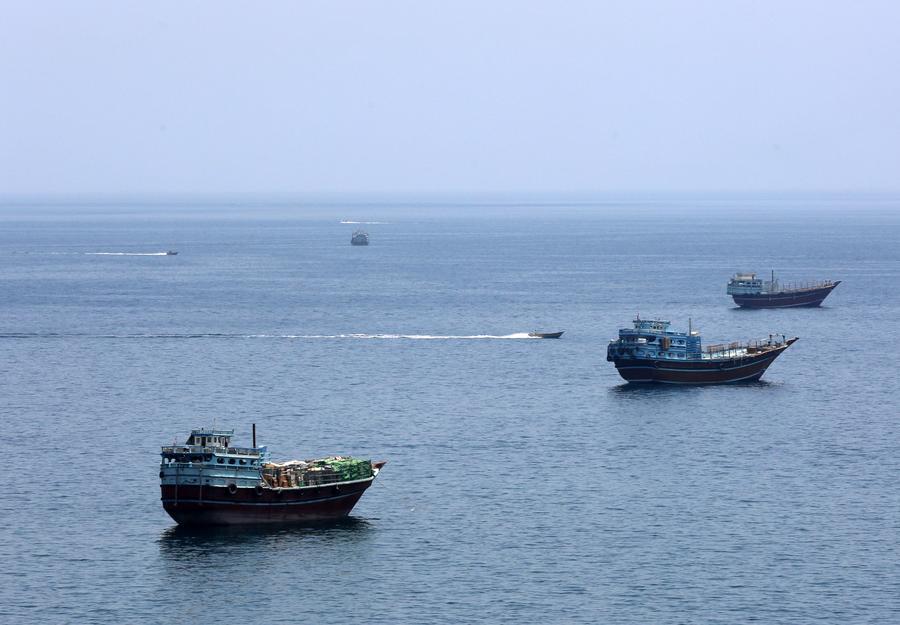
TEHRAN, Oct. 9 (Xinhua) -- The navy of Iran's Islamic Revolution Guard Corps (IRGC) announced Friday that its forces had hit a "giant" ship carrying liquefied petroleum gas within the preceding hours as it sought to cross the Strait of Hormuz through the "illegal" route south of the waterway.
In a statement published on the IRGC's official news outlet Sepah News, the navy said following the strike, the vessel, identified as NV Sunshine, caught fire in its engine room and propulsion system.
It stressed that the U.S. military is directly responsible for such incidents and the escalation of tensions in maritime transport in the region, adding that the U.S. military causes such incidents through its interventions, manipulation of shipping and insurance companies and payment of massive bribes.
It warned that companies allowing themselves to be deceived by the United States will be sanctioned, "and the necessary punitive measures will be enforced against all vessels belonging to the violating companies."
The IRGC Navy also emphasized that from now on, taking actions against violating vessels will not be limited to the Strait of Hormuz, and any vessel crossing the unauthorized route will be "pursued, and definitely punished" anywhere in the region.
According to the statement, the IRGC's naval forces are in full control of the Strait of Hormuz, will prevent the "aggressive" armies' presence in the region, and will deal decisively with the "enemy's" attempts to disrupt this management.
Separately, Iranian President Masoud Pezeshkian on Thursday stressed that his country will not abandon the negotiating table although the United States has attacked it twice amid previous talks between the two sides, according to a statement issued by his office.
In a meeting with Russian President Vladimir Putin in Turkmenbashi, Turkmenistan, Pezeshkian said, "We are negotiating. However, whenever we engage in dialogue with the United States, they attack again. Nevertheless, we will not abandon the negotiating table and dialogue."
Pezeshkian added that Iran had put forward some proposals, in response to which the United States also presented new proposals, noting, "We have made our revisions to these proposals, and once finalized, the plan is to sit down and conclude them through the existing mediators."
On Feb. 28, Israel and the United States launched joint attacks on Tehran and other Iranian cities. Iran responded with waves of missile and drone attacks targeting Israel and U.S. bases and assets in the region, and tightened its grip on the Strait of Hormuz.
A ceasefire was achieved between the warring parties on April 8. On June 18, Iran and the United States signed a memorandum of understanding (MoU) on ending the war on all fronts.
Under the MoU, the two countries were scheduled to hold negotiations within 60 days, ending on Aug. 17, to reach a final agreement. However, the two sides failed to make sufficient progress as tensions continued to escalate.■