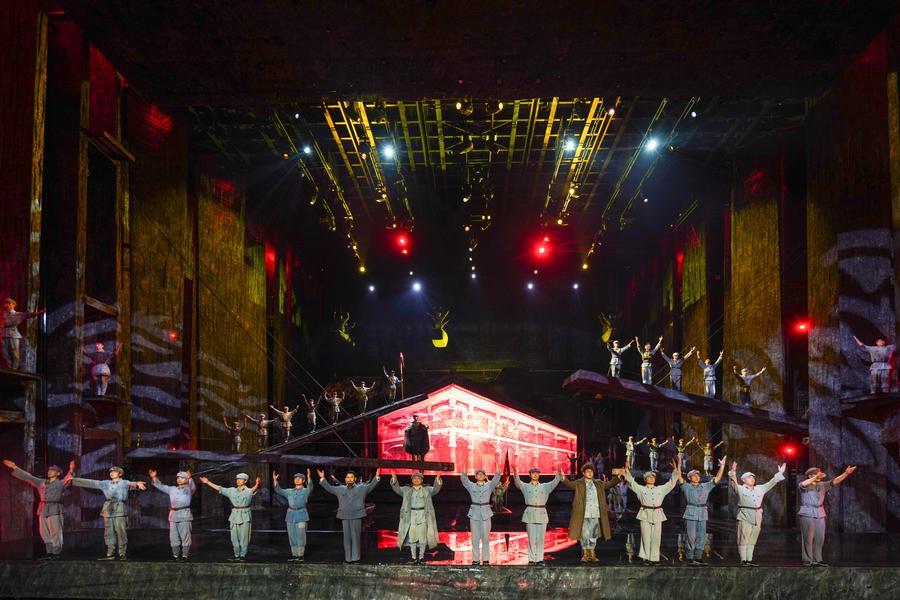
GUIYANG, Oct. 9 (Xinhua) -- As firelight flickers across the walls and gunfire breaks the darkness, figures emerge from the smoke and move through the audience. These holographic images inside a theater recreate a battlefield from 90 years ago.
The spectators do not simply watch. They walk with the performers, finding themselves surrounded by scenes of retreat, pursuit and survival.
Through holographic projections, live-action performances and digital interaction, an immersive production called the "Red Ribbon" in Guiyang, capital of southwest China's Guizhou Province, is bringing the history of the Long March closer to today's audiences.
The Long March, a roughly 12,500-kilometer military odyssey that began in 1934, not only preserved the revolutionary forces, but also gave the Communist Party of China (CPC) a new foothold from which to grow the strength of the revolution, and a new starting point for carrying the revolution forward to victory. It has since become one of the defining chapters in the history of the CPC and a lasting symbol of the Long March spirit.
In the grueling journey, the Central Red Army set out with 86,000 soldiers, but only about 7,000 reached the revolutionary base in northwest China, meaning roughly one in 12 survived to witness the victory.
During the march, the Red Army crossed nearly 100 rivers, traversed vast grasslands once known as a "death trap," and climbed over more than 40 mountains, including more than 20 snow-capped mountains rising above 4,000 meters.
For generations, the Long March has lived not only in history books, but also in literature, on screen and on stage. More than two thousand books have been written about the Long March, including Edgar Snow's "Red Star Over China." Countless documentaries, films and television dramas have been made, and a growing number of immersive performances are bringing the audience into the epic journey.
As China marks the 90th anniversary of the victory of the Long March in October this year, these works of art are offering new generations different ways to approach a history that might otherwise seem distant -- turning names, dates and battles into sights, sounds and human stories.
During this year's summer holiday, Guiyang's "Red Ribbon" production increased performances from five to eight a day and added special evening shows, attracting more than 190,000 people. Since its opening in 2023, over 2.6 million people have participated in the immersive shows.
For some visitors, however, the Long March is not simply something to encounter. It is part of their own family history.
Ha Thi Tuong Thu, deputy editor-in-chief of Vietnam Pictorial, felt a particular connection to the journey. Her grandfather, Vietnamese general Nguyen Son (Chinese name Hong Shui), was among the few foreign soldiers who joined the Long March.
"My grandfather went through the entire Long March. What I'm seeing here at the performance is what he experienced. In the holographic show, a scene shows Chairman Mao Zedong calling on the Central Cadre Corps to come over. My grandfather must have been among them," she said during a visit to Guiyang in July.
Thu has long been fascinated by her grandfather's revolutionary life and plans to return with her children to retrace the Long March.
At the theater, one scene shows the Red Army crossing the Chishui River four times, repeatedly changing direction and outmaneuvering a much larger pursuing force. The river appears through digital images; troops advance, turn and disappear, evoking the twists and turns of one of the most celebrated maneuvers of the Long March.
Another aerial performance evokes the arduous trek across snow-covered mountains and grasslands -- landscapes that once tested the limits of human endurance.
"On stage, I can deeply feel the faith that carried them across the snow-capped mountains. When I see tears in the audience's eyes, I know that faith has found its way to people today," said Guo Hanxu, 24, who plays a female Red Army soldier in the "Red Ribbon" performance.
Productions about the Long March and the Red Army are not confined to the theater.
About a two-hour drive from Guiyang, another production is on at the foot of Loushan Pass, placing audiences amid the landscape where history unfolded. Over the past two months, it has drawn about 50,000 visitors.
Set against the actual mountain terrain, the large-scale outdoor performance "Victory at Loushan Pass" uses explosions, warhorses and billowing smoke to recreate the battle widely regarded as the Red Army's first major victory during the Long March.
Visitors follow the story from preparations before the battle to the final charge. Rather than watching from a distance, they move through the performance space at close range, hearing the gunfire and feeling the ground shake beneath them.
Guizhou Province was more than a stop along the Long March route. It was a place where the course of the journey changed, as the Red Army regrouped and turned military setbacks into strategic gains.
Today, across the province and along the wider Long March route, places once associated with those moments are searching for new ways to make the past tangible.
In Yudu, east China's Jiangxi Province, where the Long March began, a large-scale historical production, "The Long March's First Crossing," focuses not only on soldiers, but also on ordinary people whose lives became intertwined with the Red Army.
Among its characters is Yinggu, whose story is based on Duan Guixiu, a local woman and widow of a Red Army martyr. Duan passed away at the age of 108 in August this year.
Duan's husband, Wang Jinchang, joined the Red Army shortly after their marriage in 1932. He never returned and was later confirmed as a martyr. His absence shaped Duan's lifelong wait -- now part of a stage performance watched by people decades later.
In the play, Yinggu turns to the audience with an emotional appeal:
"Never forget: they were your family, your loved ones, the people to whom you owe a debt that can never be repaid."
The words transform history from something to be remembered into something inherited.
At the former site of the Zunyi Meeting in Guizhou, another immersive production takes visitors back to a pivotal moment in the Long March.
Through interactive performances, visitors can take the roles of residents, helping Red Army soldiers transport supplies, tend to the wounded, and guide soldiers through the terrain.
"We hope to make the spirit of the Long March tangible through these experiences," said Zhu Jingbo, head of a local culture and tourism bureau in Zunyi.
The approach seeks to breathe new life into revolutionary heritage, moving beyond the static displays traditionally found in museums and memorial halls. By inviting visitors to participate rather than simply observe, it also offers younger generations a more immediate way to encounter the past, while the approach itself contributes to local cultural tourism and development, Zhu said.
Along the route, memories of the journey have seeped into everyday life -- into place names, stories and local products.
In Zunyi, even pomelos carry a memory of the Red Army.
The local fruit is known as the "Red Army pomelo," a name linked to the story of Song Jiatong, a wounded Red Army soldier who stayed in the village to recuperate.
Today, the story lives alongside a 126.7-hectare orchard, which is expected to generate an output value of 1.2 million yuan (about 176,300 U.S. dollars) this year, turning a memory of wartime hardship into a source of livelihood.
Far to the northwest, in Ningxia Hui Autonomous Region, traditional potato starch noodles are named "Red Army noodles," recalling techniques that the Red Army is said to have taught the locals.
The names have outlived the events that gave rise to them.
"One generation plants trees; the next enjoys the shade," said Belgian media professional Romuald Bronchart. "The true essence of the Long March lies in empowering people -- a vision China continues to fulfill through infrastructure building and inclusive development."
The journey is over, but the memory never stops moving.
For Dutch Sinologist and reporter Elsbeth van Paridon, the takeaway is simpler. "This is not forgotten history, but living heritage," she said. ■