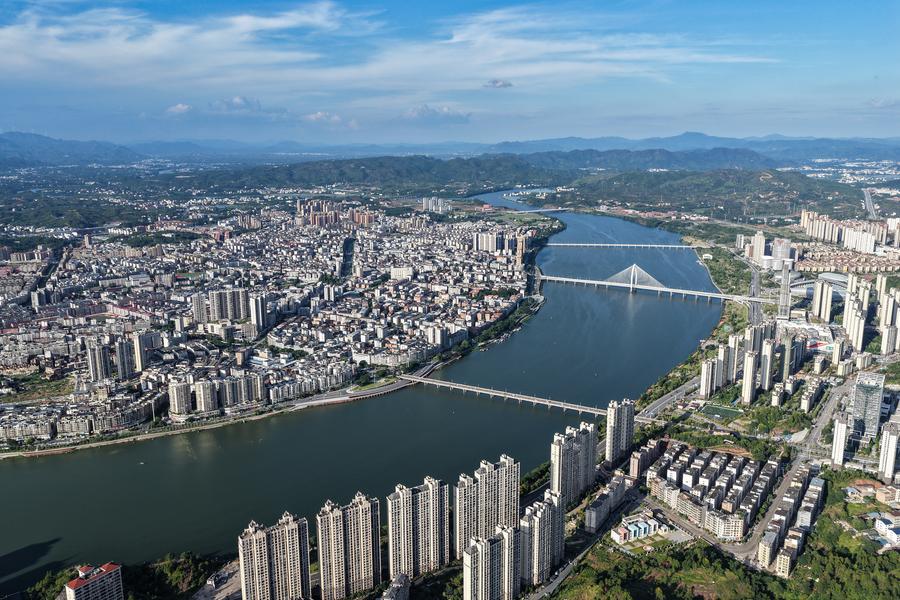
NANCHANG, Oct. 8 (Xinhua) -- The former ferry crossing is about half an hour's walk from the home of Sun Guanfa, 77, in Yudu, a hilly county in east China's Jiangxi Province.
For his father, the journey from this riverbank more than nine decades ago was part of an epic.
In October 1934, some 86,000 soldiers of the Red Army crossed the Yudu River to embark on what later came to be known as the Long March.
In a country beset by foreign invasion, social turmoil and destitution, the fledgling Red Army, led by the Communist Party of China (CPC), was fighting for national independence and the liberation of the Chinese people. But at the time, it was encircled by the overwhelming and much better-armed Kuomintang forces.
What followed was an epic military maneuver: from Yudu, Red Army troops trekked roughly 12,500 kilometers across China, crossing snow-covered mountains and treacherous marshlands, all the while battling enemy forces. They eventually reached the country's northwest, where, in 1936, they were joined by several other Red Army branches, marking the victorious conclusion of the Long March.
This military maneuver preserved the Red Army. It also gave the CPC a new foothold in northwest China, from which it built up its strength, fought back against invading Japanese troops and eventually toppled the corrupt Kuomintang regime, leading to the founding of the People's Republic of China in 1949.
In Yudu, the Long March is not simply a chapter in a history book. It is a family story.
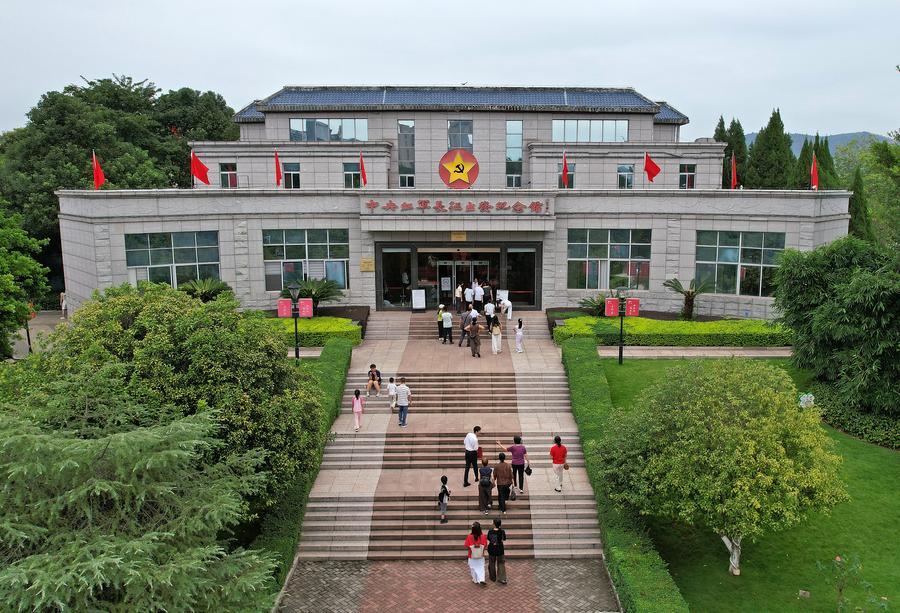
More than 17,000 residents joined the departing army. Only 277 were recorded as eventually returning home, said Zhong Min, a guide at a museum built beside the river to commemorate the departure.
Her voice still catches when she says that number.
Her maternal great-grandfather died fighting the encirclement campaigns. Her husband's grandfather marched away with the troops and was never heard from again. Sun's father fell in a battle that saw the forces of the Red Army reduced to just over 30,000.
"We are not telling other people's stories," Zhong said. "We are telling our own families'."
Here, the Long March is measured not only in kilometers and battles, but in the people who left home knowing they might never return.
For Sun, the legacy of that generation is deeply personal. Under a local tradition, Sun was adopted as the son of the soldier who left the riverbank and never returned, so that the soldier's family line could continue.
"People of my father's generation were willing to give their lives so ordinary people could be liberated," Sun said.
On the same riverbank in 2019, Chinese President Xi Jinping spoke of what had enabled the Party and the Red Army to come back from the brink of destruction time and again: firm ideals and convictions, and strong willpower.
"We must not forget our Party's original aspiration and founding mission," said Xi, also general secretary of the CPC Central Committee and chairman of the Central Military Commission. The Party's long-stated mission, dating to its founding in 1921, is to seek happiness for the Chinese people and rejuvenation for the Chinese nation.
During the visit, Xi placed a flower basket at a monument commemorating the Red Army's departure and bowed in tribute. He then walked behind the monument to a railing overlooking the river and stood there for a long while.
The river remains. For Xi, it was also a place from which to look ahead to China's future.
"We came to this place to revisit what it was like when the Red Army set out," he told local people gathered nearby. "Today we are on a new journey -- to build a modern socialist country. We must carry on the work of those who came before us, gear up anew, and set out once more."
That new journey was unfolding against a vastly changed backdrop. When Xi visited Yudu, the nationwide campaign he had launched to combat poverty was entering its final stage.
It would culminate in the elimination of absolute poverty in a nation of 1.4 billion. Nearly 100 million rural residents were lifted out of poverty under Xi's "targeted poverty alleviation" campaign, which mobilized the entire Party and the nation.
Xi announced the victory, as a key part of building a moderately prosperous society in all respects, in 2021 when the CPC marked its centenary.
During his 2019 visit, Xi saw for himself whether the former revolutionary base areas were on track to meet their poverty-reduction targets.
At Sun's home, he walked through the main hall to the backyard and checked the kitchen and the bedrooms. There was rice and cooking oil in the kitchen, and the bathroom was clean.
Xi asked about the family's income and how Sun's son and daughter-in-law made a living, where their children went to school, and what the school meals were like.
"By the time they grow up, we will have achieved the rejuvenation of our nation," Xi said, pointing to Sun's two grandchildren.
China aims to basically realize socialist modernization by 2035 and build a great modern socialist country in all respects by the middle of this century, according to the vision set by the Party.
Earlier, at the museum where Zhong served as a guide, Xi had stopped before a map of China made from straw sandals.
The display recalled how local people worked through the night to make straw sandals for the soldiers, many of whom fought barefoot. They also dismantled doors, bed boards, roof beams and even timber intended for coffins to build pontoon bridges, helping the soldiers cross the Yudu River.
"The country has developed and people's lives have improved, but we must remember where it all came from," Xi said. "We must not forget our revolutionary forefathers and those who died for the revolution, or the people of the old revolutionary base areas."
Nowadays, golden waves of selenium-rich rice ripple around the 700-year-old village, and rows of modern vegetable greenhouses stand nearby. In the residential area, white-walled houses with gray-tiled roofs sit amid trees, while pavilions nestle between them.
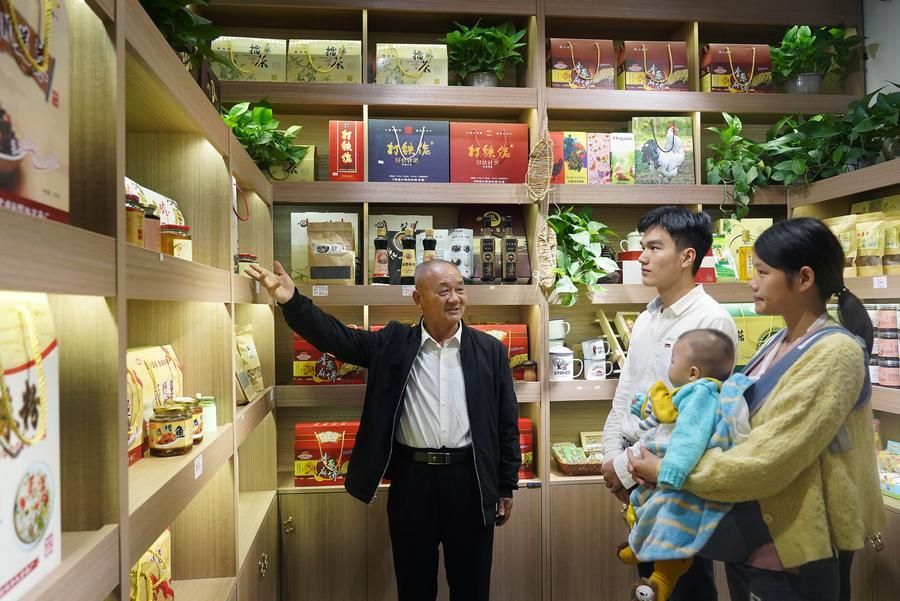
"Now we have wages from working, rent from our guesthouses and dividends from our shares," Sun said. "Our annual income has tripled to more than 200,000 yuan (around 29,000 U.S. dollars)."
The transformation extends well beyond Yudu.
Much of southern Jiangxi, once cut off from the outside world by rugged mountains, is far more connected. High-speed rail links it with the city of Shenzhen, the country's economic powerhouse close to Hong Kong. Expressways also reach every county, and paved roads now extend into villages.
For local business owners, it no longer means spending two days and two nights on the road to source a critical part. Now they can hop on a high-speed train, pick up what they need in the morning and return that afternoon, drastically speeding up the development of a prototype.
The change is not only about getting around. Industries such as non-ferrous metals and advanced materials, electronics and information technology, and textiles and apparel have taken root here. For ordinary people, the changes are closer to home. Housing has improved, drinking water is safer, and schools and medical care are more accessible.
More people can now earn a living without leaving their hometowns. In March, the Hong Kong Polytechnic University launched a facility dedicated to research into smart wearables and smart clothing in Xingguo, a county next to Yudu.
This summer, Yudu welcomed students from more than 170 universities across China who came to retrace the Long March at the places where it began. Many realized that the Red Army soldiers who set out were their age.
"Standing where those young soldiers began their journey gave me a deeper understanding of what they accomplished," said Liu Fanshuo, an undergraduate studying automation.
Today, five modern bridges span the Yudu River near the crossings where local people once built pontoon bridges to help the Red Army cross.
On the banks, Sun pours hot tea for tourists whose lives might have been very different had those soldiers never crossed. ■