
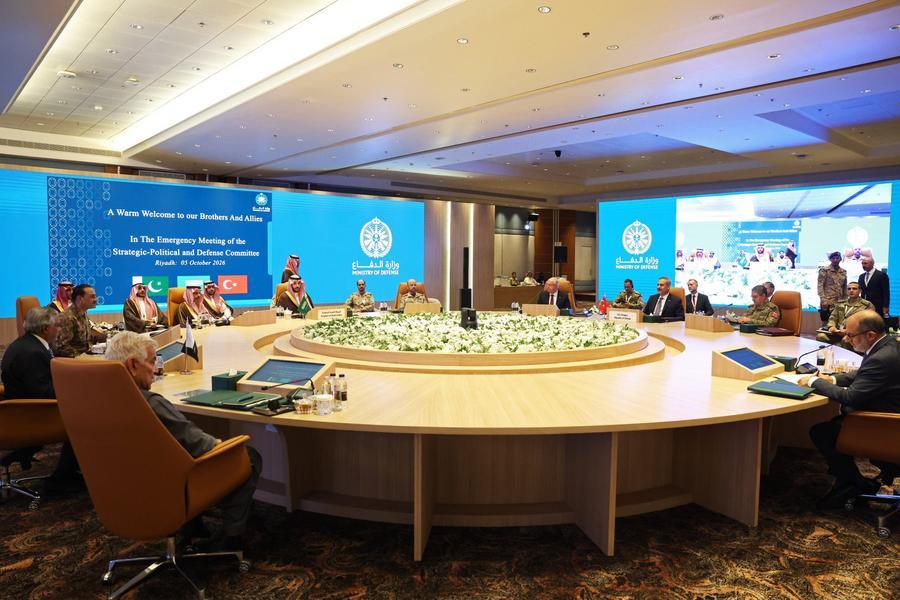
SANAA, Oct. 6 (Xinhua) -- As Saudi warplanes pound Houthi positions and Yemeni government forces push ahead in areas along the Red Sea coast, Riyadh is taking another step to counter the growing Houthi threat by bringing Turkish and Pakistani forces onto Saudi territory.
At an emergency meeting in Riyadh on Monday, Saudi Arabia, Türkiye and Pakistan agreed to ensure "the rapid deployment of agreed forces and capabilities" to Saudi Arabia under their commitments to the Mecca Joint Defense Agreement, giving the two-month-old security pact a more concrete military dimension, as Riyadh faces escalated Houthi attacks.
Analysts see the outlines of a multipronged Saudi strategy: bolster defenses at home, increase military pressure on the Houthis in Yemen and rally wider regional support, while leaving the door open to diplomacy. The outcome remains to be seen.
ADDITIONAL LAYER OF DETERRENCE
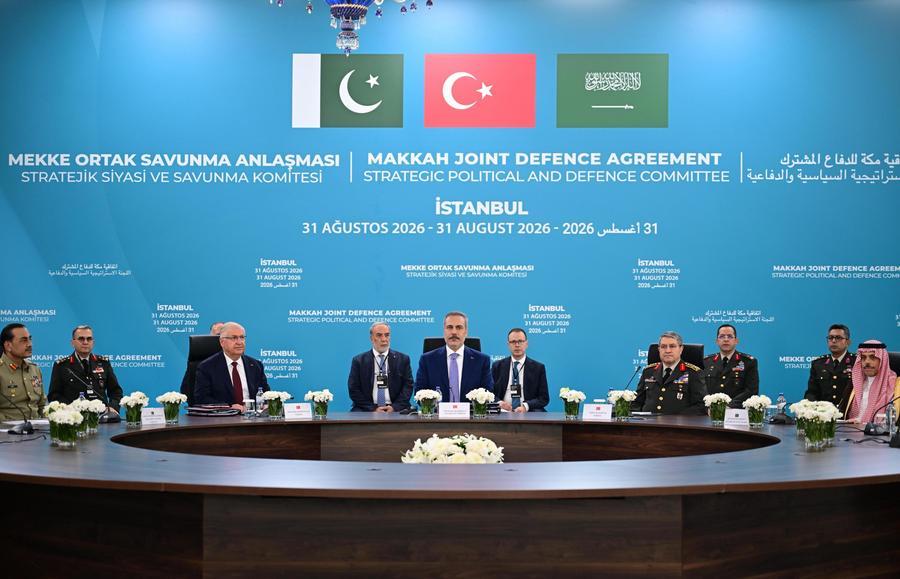
Signed in Mecca on Aug. 7, the defense agreement stipulates that an armed attack against one member will be regarded as an attack against all three. The latest decision takes the commitment a step closer to military implementation, although details of the forces, equipment and deployment have yet to be disclosed.
Adel Al-Shuja'a, a politics professor at Yemen's Sanaa University, said the significance of the pact lies less in the prospect of Turkish or Pakistani troops entering the war in Yemen than in expanding the scope of collective deterrence.
"The agreement sends a political and strategic message to the Houthis that an attack on Saudi Arabia would no longer be viewed as an isolated confrontation with Riyadh, but within a broader regional security framework," Al-Shuja'a said.
Taleb Alhasani, a Yemeni political analyst, expects the Turkish and Pakistani role to remain largely defensive, centered on Saudi territory.
"Their contribution is likely to rest on three pillars: strengthening defenses against ballistic missiles and drones, providing logistical support, and offering military expertise and advisory assistance," Alhasani told Xinhua.
Their deployment, he said, could add a layer of defense against Houthi long-range weapons while giving Saudi Arabia more latitude to support military operations inside Yemen.
For the Mecca alliance, the analysts said, the deployment could amount to its first real test: whether its collective-defense pledge can be turned into effective coordination, including the integration of intelligence, air defenses and other military capabilities to reduce Saudi Arabia's vulnerability to Houthi missile and drone attacks.
HOSTILITIES ESCALATE
At the same time, Saudi Arabia is stepping up its support for the military campaign against the Houthis inside Yemen.
On Monday, Yemen's Presidential Leadership Council Chairman Rashad al-Alimi announced from Riyadh the launch of Operation Dawn of Yemen, a campaign aimed at retaking areas held by the Houthis.
Near the Bab al-Mandab Strait, Yemeni government forces launched a counteroffensive to reverse recent Houthi gains around the maritime chokepoint. The Saudi-led coalition said Monday that 100 fighter jets had provided air support to Yemeni government forces.
Government forces said Monday that they had recaptured the strategic Red Sea port city of Mocha from the Houthis. A Houthi source disputed the claim.
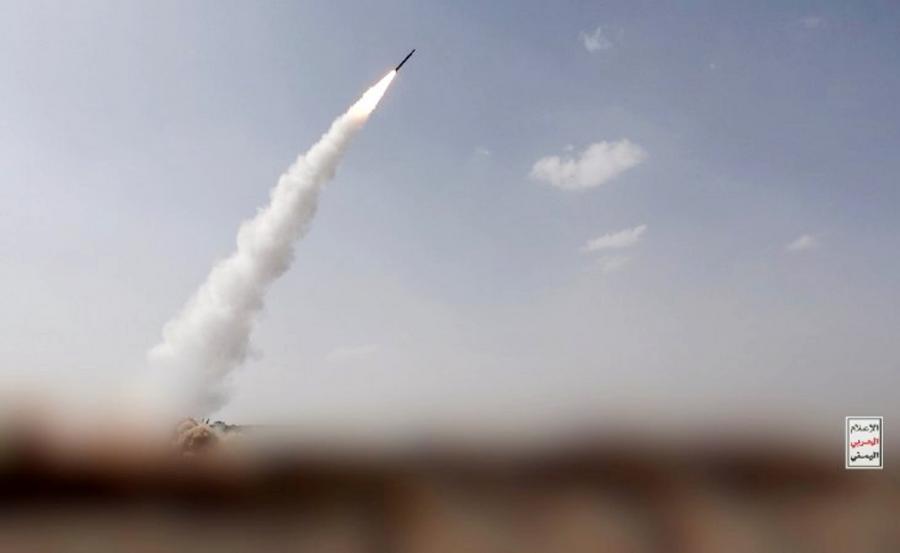
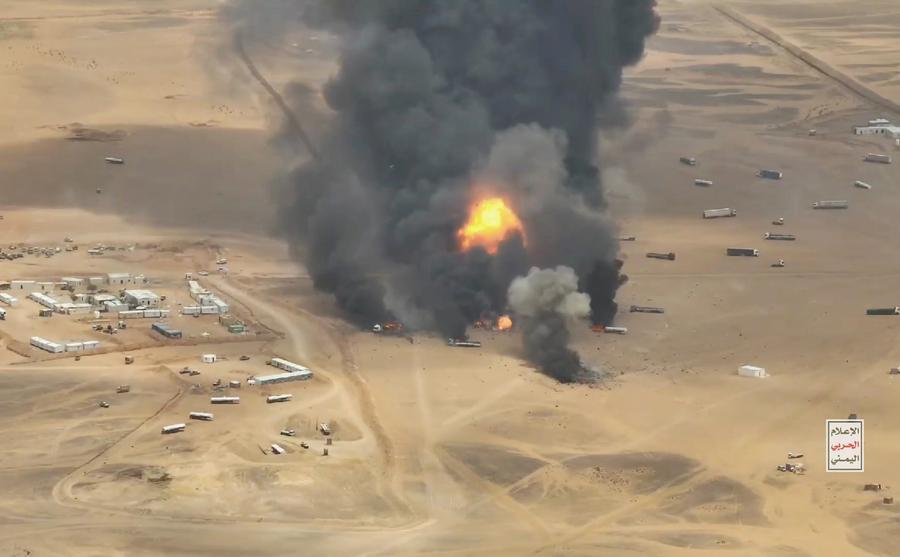
The Houthis, meanwhile, moved to bring the fight back to Saudi territory. Late Monday, the group claimed missile and drone attacks on multiple Saudi targets, including King Khalid International Airport in Riyadh, an Aramco refinery in the western coastal city of Rabigh, and two military sites in the southwest.
Saudi aviation authorities said Tuesday that Jazan and Najran airports in the southwest were targeted on Monday evening, leaving three people slightly injured and causing property damage. The escalation continued on Tuesday, with the Houthis claiming a ballistic missile attack on Abha International Airport, also in southwestern Saudi Arabia.
Saudi Arabia, Alhasani said, is now facing a fundamentally different threat from the one it confronted when it intervened militarily in Yemen in 2015.
The Houthis' "expanded missile and drone arsenal" has raised the economic and security costs of any prolonged confrontation for Riyadh, he said, noting that greater pressure on the battlefield could trigger a stronger Houthi response.
Al-Shuja'a said Riyadh is providing air support, weapons, training and intelligence to Yemeni government forces to fight the Houthis while trying to bridge longstanding divisions within the anti-Houthi camp.
"The weakness of the anti-Houthi camp in Yemen has never been simply a lack of military firepower," he said. "Its deeper problem has been fragmented centers of power and competing political objectives."
CAN RIYADH ALTER THE BALANCE?
Despite battlefield gains by Yemeni government forces in the past days, Houthi attacks on Saudi territory have continued, underscoring a central challenge for Riyadh.
Aden-based Yemeni political analyst Muqbil Naji said the front lines in Yemen remain highly fluid.
"The map can change quickly. Taking territory is one thing; holding it and turning it into a strategic advantage is another," he said.
Naji said Yemeni government forces could make further gains along the exposed Red Sea coastal plain, but the Houthis could use the surrounding highlands to regroup, launch counterattacks, and use their missile and drone capabilities to continue threatening Saudi territory and shipping.
Control of the coast, therefore, does not necessarily translate into the neutralization of the Houthi threat, Naji said, adding that "this distinction goes to the heart of Saudi Arabia's dilemma."
"Battlefield setbacks can weaken the Houthis territorially, but cannot eliminate their capacity to strike Saudi cities, oil infrastructure or shipping," he said.
Cooperation under the Mecca alliance, Al-Shuja'a said, could bolster Saudi air defenses, but would not by itself be enough to eliminate the Houthis as a political and military force or guarantee lasting stability.
The analysts said the conflict is no longer simply a contest over Yemen's territory. Increasingly, it is a test of endurance and deterrence: whether Saudi Arabia can turn military pressure on the battlefield and deeper regional security cooperation into lasting political leverage. That, in turn, could determine whether the latest developments fundamentally alter Yemen's balance of power, or simply usher in another phase of its protracted war of attrition. ■