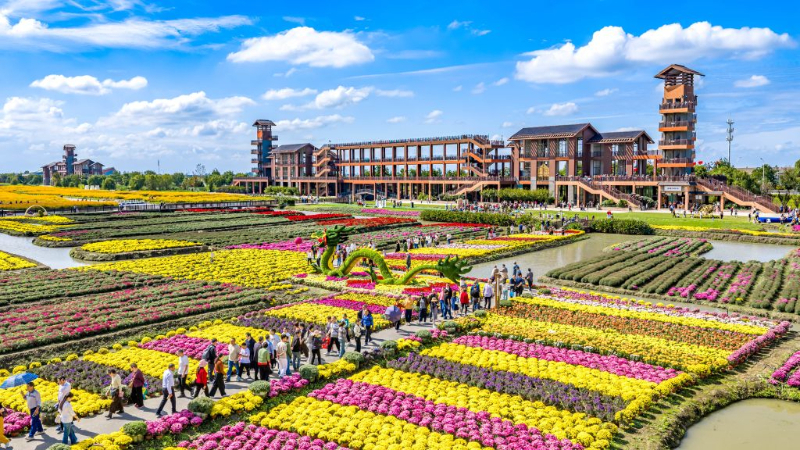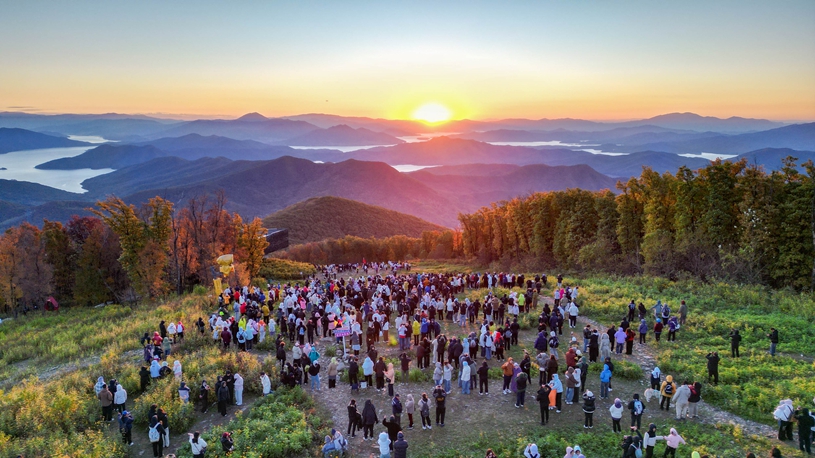
*During this National Day holiday from Oct. 1 to 7, authorities had projected 2.13 billion cross-regional passenger trips, averaging 300 million a day.
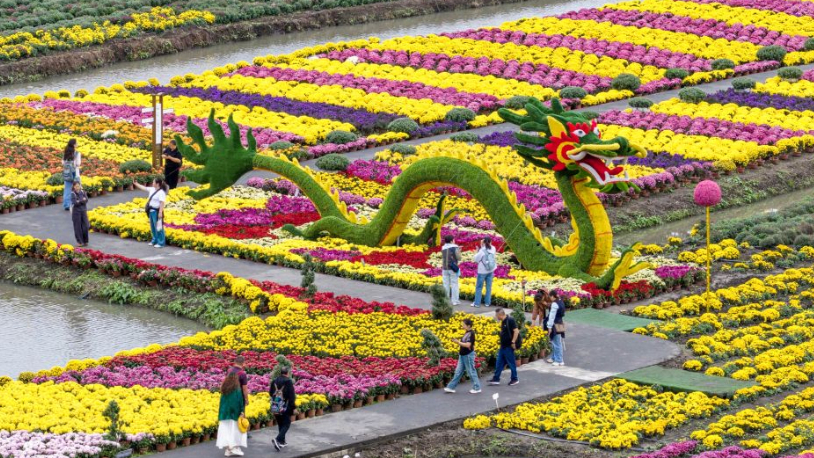
*Cultural and tourism authorities nationwide have introduced a range of creative initiatives to attract visitors, drawing on sports events, cultural IPs, ethnic traditions and distinctive natural landscapes.
*On Sept. 24, the Ministry of Culture and Tourism announced plans to develop more travel experiences that combine traditional culture with modern life during 2026-2030, aimed at helping foreign visitors travel more conveniently, enjoy more comfortable stays and gain a closer view of contemporary China.
BEIJING, Oct. 7 (Xinhua) -- While tourism in China has traditionally been associated with breathtaking landscapes and photo opportunities, Wang Xin (pseudonym) opted for a different kind of National Day holiday this year: watching tennis.
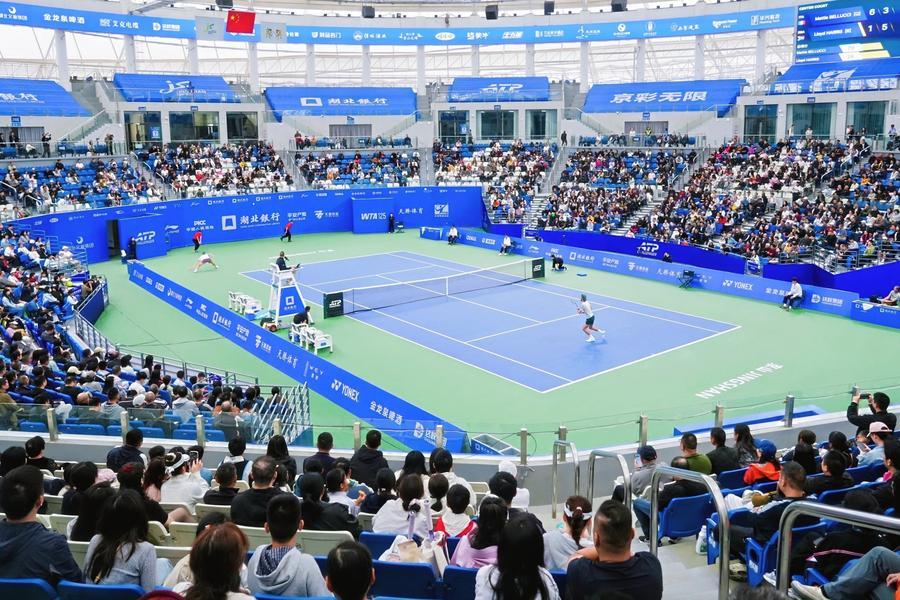
Well before the vacation she had purchased tickets for the Jingshan Tennis Open in central China's Hubei Province.
A resident of Dongguan in Guangdong Province, about 1,000 kilometers away, she first learned about Jingshan because of the tournament. "I want to watch matches featuring several young WTA (Women's Tennis Association) and ATP (Association of Tennis Professionals) players up close," said the tennis enthusiast.
She planned to spend three days watching the matches and the remaining four days exploring the county-level city, taking in its scenic mountains, valleys, and forests.
During this National Day holiday from Oct. 1 to 7, one of China's few annual "golden weeks," authorities had projected 2.13 billion cross-regional passenger trips, averaging 300 million a day.
Data from Meituan, a major services platform, showed homestay bookings for four-to-six-night stays during the holiday rose 24 percent year on year as of Sept. 28, with county-level destinations posting particularly strong growth.
Cultural and tourism authorities nationwide have introduced a range of creative initiatives to attract visitors, drawing on sports events, cultural IPs, ethnic traditions and distinctive natural landscapes.
DESTINATIONS FOR DIVERSE DEMANDS
Jingshan, a county-level city where tennis has been developing for more than 40 years, is known as China's "hometown of tennis."
To boost tourism during the National Day holiday, local authorities announced that during the tournament period, a match ticket would entitle holders to discounts at over 100 local businesses. Merchants have also benefited from the holiday travel surge.
Zuo Meng, a vendor selling knitted products, said she follows the local tennis events closely. "In Jingshan, there are tennis matches almost every week," she said, adding that a tournament can generate 6,000 to 7,000 yuan (about 895 to 1,044 U.S. dollars) in sales. Over the past two years, she has also taught knitting skills to more than 200 women so they, too, could benefit from tourism.
Peng Jufang runs a farm in Wenfeng Village. Noticing tourists' enthusiasm for tennis, he founded his own tennis club in October last year. With more than 16 people coming each day to try their hand at tennis, he was kept busy during this National Day holiday, teaching visitors for over six hours a day.
In 2025, Jingshan hosted 48 domestic and international sports events. The comprehensive output value of its "tennis plus" economy surpassed 3.5 billion yuan, drawing 3.52 million visits for matches and tourism.
While Wang Xin enjoys tennis matches in Jingshan, cultural enthusiasts have meccas of their own to visit.
Wang Yinan, in her 20s, traveled from Beijing to Ruicheng County in north China's Shanxi Province after watching the popular animation "All Wishes Come True." Hometown of the legendary figure behind the film's main protagonist, Lyu Dongbin, Ruicheng is home to the Yongle Palace, which is known for its celebrated murals.
"It is such an exciting trip, and it's incredible to be in Lyu's hometown," said Wang, as she browsed creative products at the Yongle Palace store.
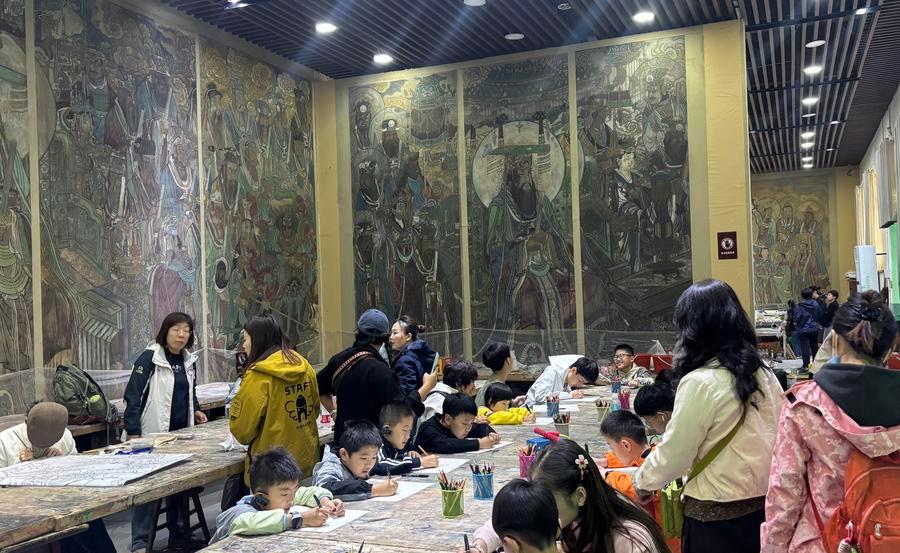
Liu Haibo, chairman of the Yongle Cultural Tourism Investment and Construction Co., Ltd., said the scenic site rolled out customized services to sustain its tourism growth following its viral popularity. Visitors can take photos in dedicated photo zones, guides explain the murals by linking them to scenes from the film, and tourists can attend interactive classes to learn mural copying and line drawing.
The movie has helped raise the profile of Ruicheng, making it a sought-after destination, especially among young people. Statistics showed that between Oct. 1 and 5, Yongle Palace received about 80,000 visits, up more than 50 percent year on year.
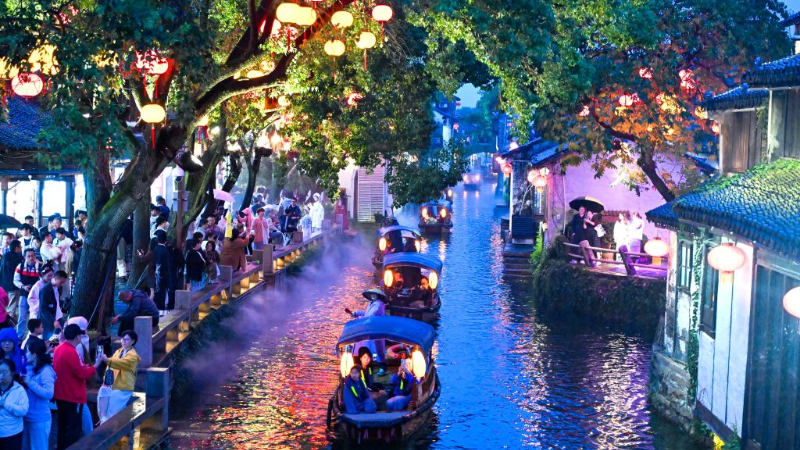
The ancient township of Fenghuang in Xiangxi Tujia and Miao Autonomous Prefecture, central China's Hunan Province, has kept its tourist momentum following the Sept. 25-27 Mid-Autumn Festival holiday.
During the National Day holiday, some visitors seeking to avoid the crowds have ventured beyond the ancient town of Fenghuang into surrounding mountains and villages, exploring rich ethnic cultures, such as Miao welcoming rituals, lantern shows and folk performances.
INTERNATIONAL VISITORS JOINING THE RUSH
The diverse tourism resources in China's counties are also luring international visitors away from metropolises like Beijing and Shanghai and toward niche attractions.
Lucas Martin, 28, from France, visited Fenghuang for the first time after touring major Chinese cities.
"Fenghuang feels entirely different from big cities," he said. "You can slow down here. You can admire the distinctive stilt houses lining the Tuojiang River and observe local residents in their daily lives."
The in-depth county exploration impressed him with the town's authentic living vibe. "This is not merely a tourist attraction. Walking along the river and pausing at street corners makes me feel more than just a passing sightseer."
Emma Wilson, an Australian traveler who is exploring small towns and countryside across China, tried on Miao ceremonial costumes in Fenghuang.
"It is magical to walk into the old streets, dressed like locals," she said. Shop staff carefully helped her get fitted in the ethnic costume.
"A simple landscape photo fades quickly from memory. But putting on traditional clothing, tasting local food and learning the stories behind folk customs create experiences that stay with you far longer," she said.
Since December 2023, when China launched a trial policy granting unilateral visa exemptions to visitors from six countries, it has expanded unilateral visa-free entry to travelers from 50 countries as of September, allowing eligible visitors to stay for up to 30 days.
In a separate move, authorities extended the visa-free transit period for certain countries from 72 or 144 hours to 240 hours in December 2024. So far the number of eligible countries has increased to 57.
Official data revealed that foreign nationals made nearly 61.29 million border crossings in the first eight months of 2026, up 19.5 percent year on year, while one of the leading mobile payment platforms, Weixin Pay, reported that both the value and number of e-wallet transactions made by overseas users rose by more than 80 percent during the same period.
On Sept. 24, China's Ministry of Culture and Tourism announced plans to develop more travel experiences that combine traditional culture with modern life during 2026-2030, aimed at helping foreign visitors travel more conveniently, enjoy more comfortable stays and gain a closer view of contemporary China.

FROM "CITY WALK" TO "COUNTRY WALK"
Yang Han, a researcher at an institute affiliated to the travel platform Qunar, believes that county-level tourism began to accelerate around 2023-2024, as travelers increasingly sought destinations with fewer crowds, a lively atmosphere, opportunities for relaxation and immersive local experiences, as well as greater value for money.
For instance, in Ruicheng of Shanxi, a set meal for one person may cost less than 20 yuan, the price of a cup of bubble tea in Beijing.
Tuo Yanzheng, a professor at the College of Tourism and Service Management, Nankai University, said county areas hold rich agricultural, ecological and cultural resources with untapped consumption potential.
"The key lies in turning these resource strengths into distinctive tourism products and consumption scenarios," she said. "It can not only meet people's increasingly diverse consumption demands, but also inject new vitality into the county economy."
According to Sun Jiashan, a researcher at the Central Institute of Socialism, China's tourism market has evolved from "City Walk" to "Country Walk."
Steadily improving transportation has made county-level destinations more accessible. By the end of 2025, China's total operating railway mileage had reached 165,000 km, including more than 50,000 km of high-speed rail.
Shortly before the National Day holiday, the country opened four major high-speed railway sections, improving transport links across several regions and making travel easier for residents. The high-speed rail network is projected to hit 70,000 km by 2035, with eight north-south vertical lines and eight east-west horizontal lines.
In addition, Sun noted that beyond scenic spots, historical sites and natural landscapes, tourists are increasingly drawn to vibrant scenes of everyday life, such as farmers' markets and bustling streets. "This shift also places higher demands on local cultural and tourism infrastructure and services," he said.
"As overseas tourists venture beyond first-tier cities into central and western regions and county-level areas, they encounter not only the outward face of China's development but also the texture of everyday social life," he said. "This helps break through cognitive filters and information barriers in Western societies and presents a real China to the world."
(Video reporters: Wang Xuetao, Yue Wenwan, Yan Rui, Hu Rong and Zhang Yujie; Video editors: Yang Zeyi, Zhang Mocheng, Zheng Xin)■