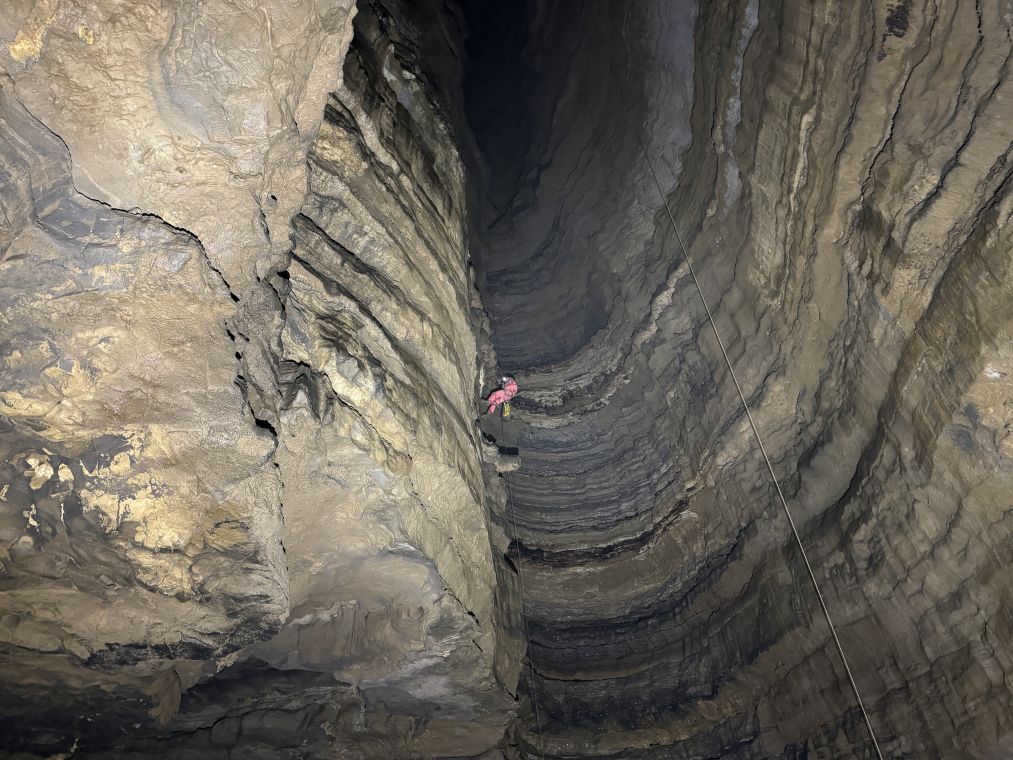
GUIYANG, Oct. 4 (Xinhua) -- For French caver Jean Bottazzi, caves never disappoint. In the vast underground maze of Shuanghe Cave in southwest China's Guizhou Province, even an unfinished mission can lead to an unexpected discovery, opening up whole new horizons.
Bottazzi has spent more than two decades exploring Shuanghe, witnessing its 25-year journey of international exploration. Situated in Suiyang County, it is the world's third-longest cave system and Asia's longest.
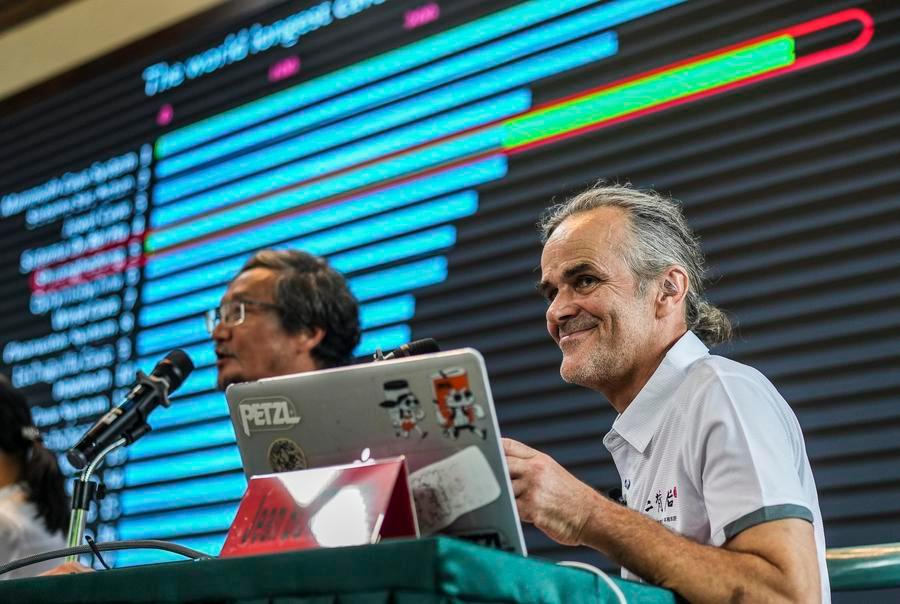
Since the first China-France joint exploration in 2001, the mapped cave system has expanded from several dozen kilometers of known passages to more than 480 kilometers.
The latest findings from the 25th international cave scientific expedition were announced last month in Suiyang. Another 41.8 kilometers were added to the mapped passages.
With the newly added length, the cave system now stretches 481.5 kilometers and reaches a vertical depth of 912 meters. It has 124 interconnected entrances.
For Bottazzi, as well as the scientists and explorers who have worked alongside him, the significance of Shuanghe Cave cannot be measured by its length alone.
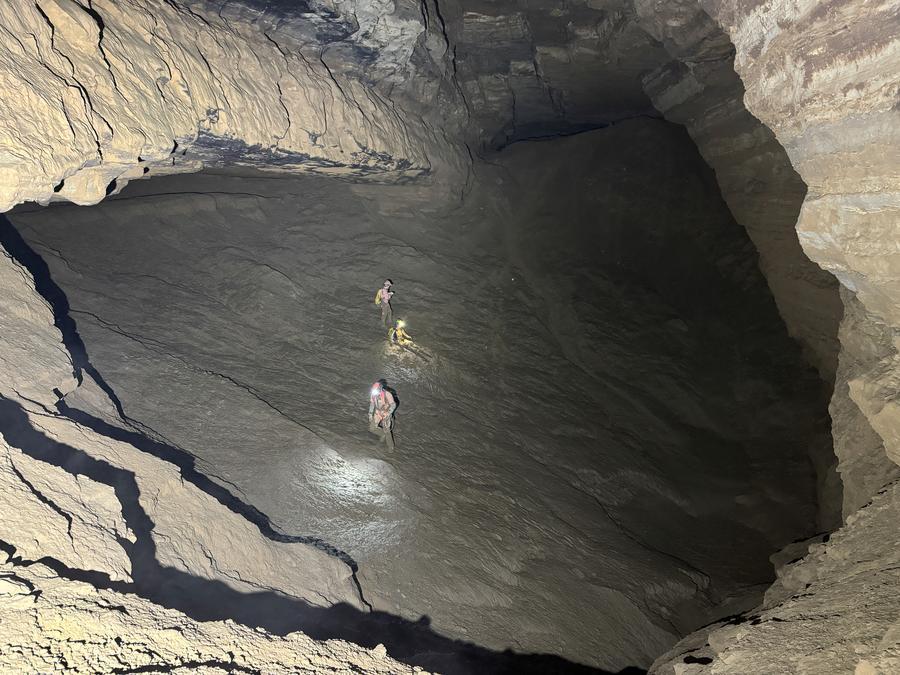
It is also a vast natural archive that preserves clues to the evolution of species, the changing climate and the geological history of southwest China.
Researchers found nine additional individual giant panda fossils, mostly in newly explored passages, during the 25th international expedition this year, bringing the total number of individual giant panda fossils discovered in Shuanghe Cave to 61.
They also found two sites bearing clear giant panda claw marks. Wang Deyuan, an associate research fellow at the Guizhou Academy of Sciences' Institute of Mountain Resources, said the marks and the structure of the cave passages offer clues to how some of the animals may have died.
The pandas apparently entered the cave and moved more than 10 meters inward before falling into a vertical shaft. They survived the initial fall and left claw marks as they tried to move on, but eventually fell into a deeper shaft and became trapped, Wang said.
The latest expedition also uncovered fossils of ancient animals. Among them, fossils of a giant tapir and a clouded leopard were found in Shuanghe Cave for the first time.
For Bottazzi, however, the fascination of cave exploration lies not only in what researchers find, but also in what they do not expect to find.
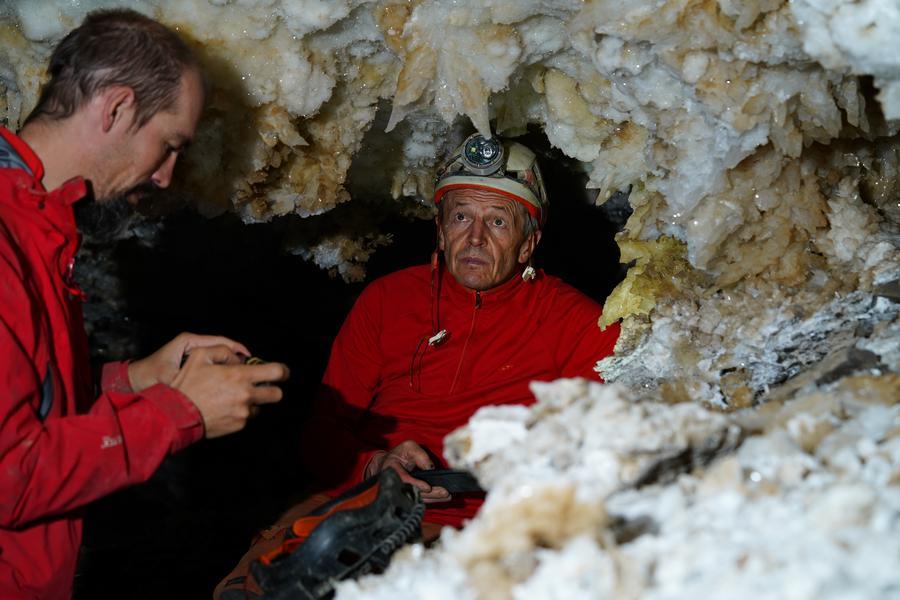
A recent expedition experience reminded Bottazzi once again why he fell in love with caves in the first place. The team had set out to connect several caves at the northern end of the Shuanghe Cave system, but the goal remained elusive.
However, the story didn't end there. As they groped their way forward, something entirely unexpected appeared before them -- an entire magnificent wall of gypsum crystals.
"Curiosity instantly rekindled a new thrill of exploration and unexpectedly opened up a new direction," Bottazzi recalled. "If we had focused only on our planned goal, we would never have met this surprise. Half disappointment, half satisfaction -- that is the true charm of cave exploration," he said.
The Shuanghe Cave also serves as an archive with hidden clues to ancient climate. Researchers have been conducting uranium-series dating of calcite deposits inside the cave, according to Bottazzi.
"As long as we can find calcite samples of different ages and combine them with isotope analysis, we can obtain a record of climate evolution from the present day all the way back a million years," Bottazzi said. "It is an extremely precious archive of paleoclimate."
The line of research made a breakthrough this year. Using the new uranium-lead isotope dating technique, the research team determined that some secondary carbonate deposits inside the cave are more than five million years old.
The finding significantly extends the chronological framework for the development of Shuanghe Cave and other large caves in the karst regions of southwest China.
The vast underground maze of Shuanghe Cave has not only yielded a string of discoveries that have captivated the scientific world, but also become a vivid example of international cooperation in cave research.
Asked how Chinese and foreign researchers share exploration data and cave maps, Bottazzi was unequivocal: "We work for science. All the data and cave maps are shared."
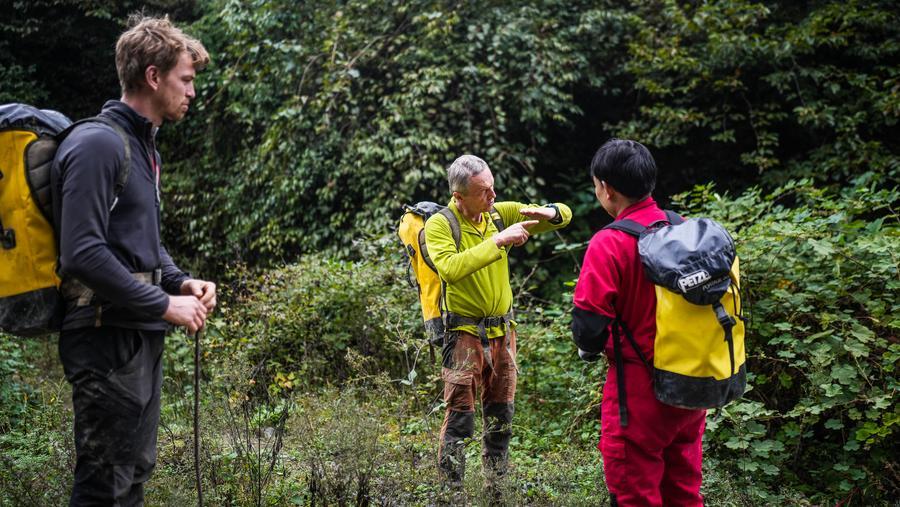
For Bottazzi, the cave has continued to captivate him so deeply that in recent years he settled in Shuanghe Village in Wenquan Township, Suiyang. Over the years, he has become such a familiar face in the village that locals affectionately call him "Lao Rang," or "Old Jean."
To Bottazzi, there are few better places than Shuanghe to explore the Earth's hidden treasures. The cave is a world of diverse landscapes, from underground rivers and vast chambers draped with waterfalls to completely dry fossil galleries.
"We are exploring as if inside a maze; you can never guess where the passage leads, and you have to keep thinking. For cave exploration, this is a wonderfully fascinating place," Bottazzi said. ■