BEIJING, Sept. 30 (Xinhua) -- A grinning "boy" in sleek VR goggles stretches out his arm, pointing a finger forward. The plant sculpture in central Beijing has become a popular photo spot, with visitors striking the same pose as the "boy" for the camera.
The sculpture is one of 10 themed floral displays installed along a roughly 6-km stretch of Chang'an Avenue, Beijing's main east-west thoroughfare, ahead of the National Day holiday, which begins on Oct. 1. It continues a tradition that has lasted more than four decades.
Remarkably, some of this year's installations have captured young visitors' attention, sparking lively discussion on social media. "It's so, so cute, especially considering he's entirely green," one Rednote user commented on the plant-sculpted "boy" wearing VR goggles and sporting a distinctly cheerful expression.
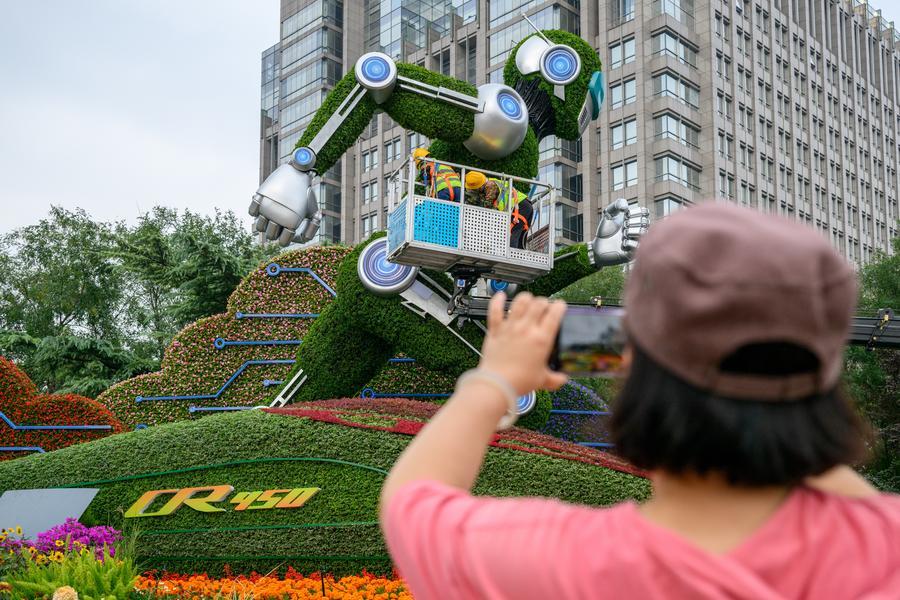
Echoing this animated and geek-chic sculpture is a running humanoid robot with a green-grass body and metallic "joints," installed at another major intersection along Chang'an Avenue. "This year's National Day plant sculptures are so funny," wrote another on Rednote. "Is it because the post-2000 generation has taken over?"
"The displays were designed to appeal to people of all ages," said Lan Hailang, chief designer of this year's National Day floral displays. However, efforts to engage younger generations are perhaps most evident in the fluffy, grass-covered "cats" installed across the capital ahead of the National Day holiday.
People have been sharing photos of them and guides to their locations. Among them, a 3.5-meter-tall kitten, outside Chang'an Avenue, stands out for its lifelike appearance. Designers used buffalo grass to recreate its long, fluffy fur, said Li Mengyu, a member of the design team.
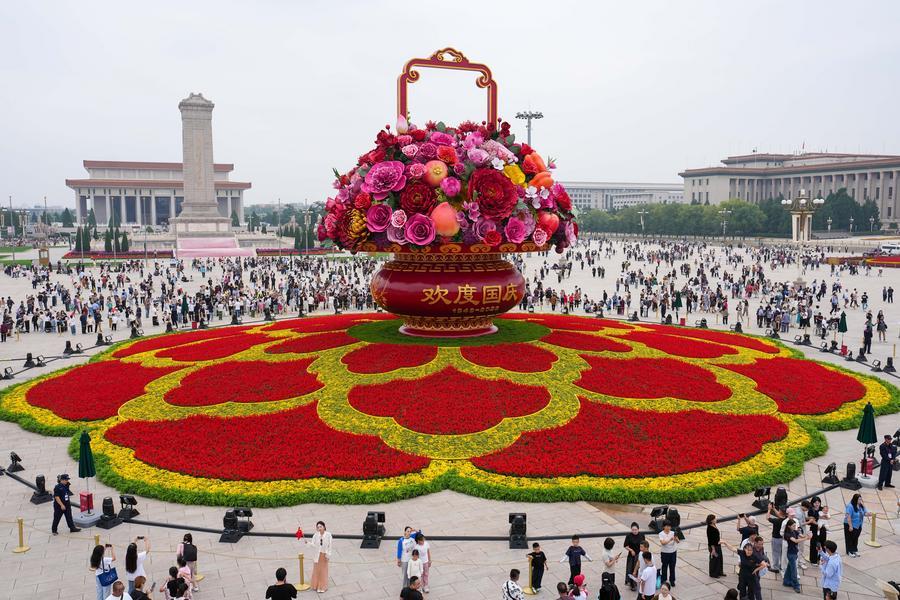
Beyond their appeal to youngsters, the 10 floral installations along Chang'an Avenue, alongside the centerpiece of a giant flower basket at Tian'anmen Square, tell stories of the country's revolutionary history, showcase its technological progress and aspirations for the future, and offer glimpses into the everyday lives of its people.
The displays feature themes ranging from new quality productive forces and harmony between people and nature, to urban renewal and the beautiful countryside.
"In earlier years, the floral displays were mainly about creating a festive atmosphere and giving people something to enjoy," said Lan. "In recent years, they have also become a window into the country's development and people's lives."
Starting from Jianguomen, visitors first encounter a display themed "Carrying Forward the Long March Spirit." This year marks the 90th anniversary of the victory of the Long March.
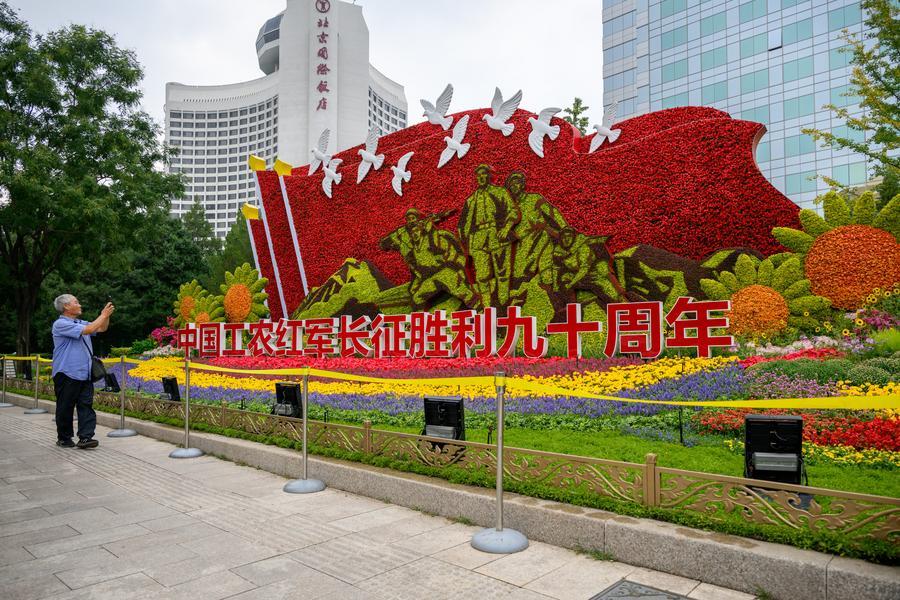
The Long March was an epic military trek from 1934 to 1936, during which the Communist Party of China-led Red Army broke through encirclement by the Kuomintang forces. Red Army soldiers braved raging rivers, snow-covered mountains and treacherous grasslands, with some marching as far as 12,500 kilometers. The maneuver helped lay the foundation for the eventual victory of the Chinese revolution.
Ninety years on, the spirit of the Long March remains a source of inspiration for many Chinese, reminding them to tackle difficulties head-on.
"Compared with the formidable obstacles Red Army soldiers encountered during the Long March, many of the challenges we face in everyday life seem no big deal," said Zhang Caimeng, who traveled from Tianjin to Beijing ahead of the National Day.
Standing before the display, she tried to inspire her son, who is preparing for next year's college entrance examination.
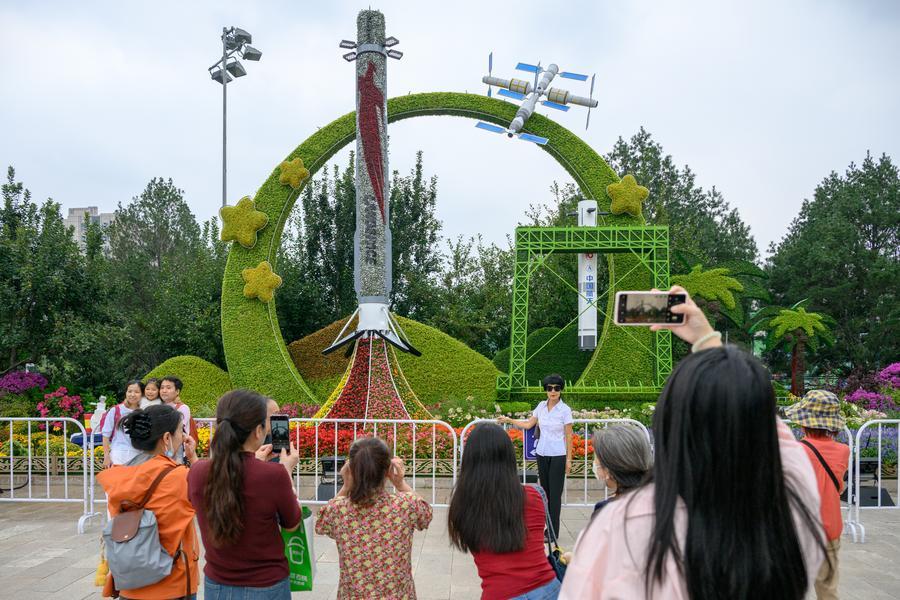
Farther west, at the bustling commercial hub of Dongdan, the displays at four corners of the intersection feature technological achievements, including the Tiangong space station, a reusable rocket, a sprinting humanoid robot and a CR450 high-speed train.
For more than 40 years, floral displays have been a prominent feature of National Day celebrations along Tian'anmen Square and Chang'an Avenue.
The first flower display appeared in Tian'anmen Square in 1984. More than four decades later, the simpler flower arrangements of the early years have evolved into large-scale three-dimensional installations. The varieties of plants used have grown tremendously.
Some of the displays are so exquisitely crafted that they too have become social media hits. One features a garland-wearing girl playing the violin, surrounded by black storks, red-crowned cranes and milu deer, creating a vivid scene of harmony between people and nature.
The hem of the girl's floor-length gown is made up of brightly colored flowers. Her posture, the position of her bow and even the placement of her fingers on the strings are rendered with striking precision. A musical staff woven into the display spells out the beloved melody of "My Motherland and I," adding an unexpected touch that has delighted visitors and social media users alike.
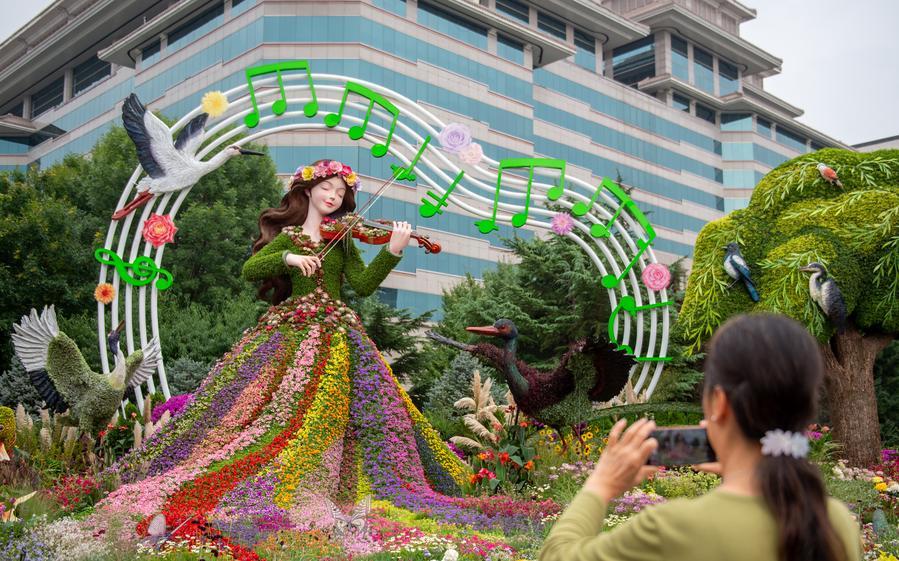
The display is more than a visual spectacle. At scheduled times, a recording of the violin solo "My Motherland and I" fills the air, drawing visitors to stop, film the scene and take in the experience.
Li Lifang, an executive of the Beijing urban construction, landscaping and horticulture company, has been involved in building National Day floral displays for more than two decades.
She said that while floral sculptures once depended heavily on the skill of artisans and craftsmen, technologies such as 3D modeling and simulation have made it possible to achieve greater precision and realism.
For 29-year-old resident Hou Yueru, the displays depict scenes that feel close to home. Cycling along Chang'an Avenue, she was struck by the variety of scenes, from a kitten nestled in a rural setting and people paddleboarding along a waterfront, to community gardens and digital cultural and tourism experiences.
"There are cutting-edge innovations that reach into the sky and deep underground, but there are also scenes that reflect the everyday lives of ordinary people," she said.
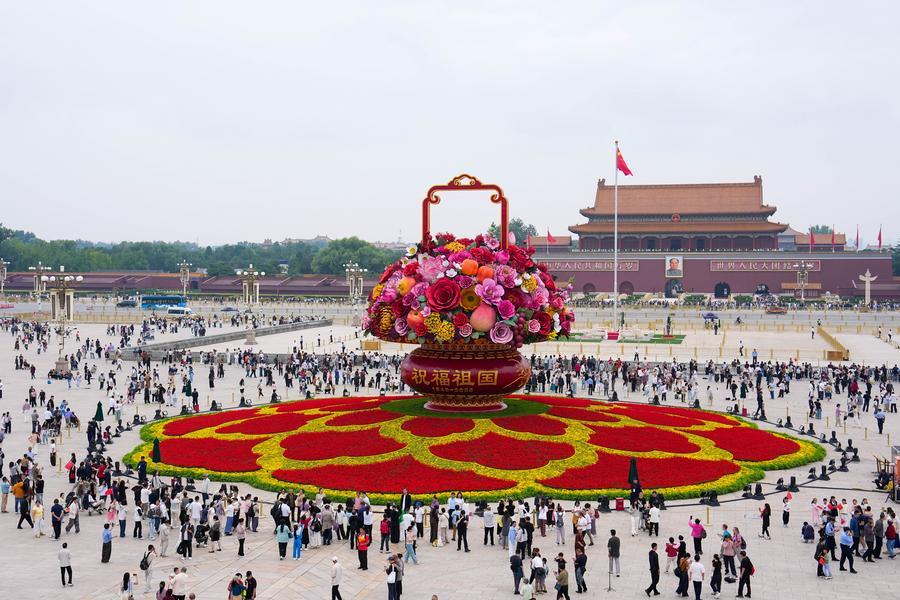
Future aspirations are also woven into the plant sculptures. This year marks the beginning of the 15th Five-Year Plan period (2026-2030). The 18-meter-tall flower basket at Tian'anmen Square contains 15 types of plant-assembled "flowers" and five types of "fruit," symbolizing hopes for abundant blossoms and fruitful results during the five years.
At Fuxingmen, the display titled "Forge Ahead" features galloping horses above the words "Strive ahead in the 15th Five-Year Plan period, work hard to open up new horizons," symbolizing a vigorous start to the new five-year period and the determination to pursue high-quality development through hard work. ■