
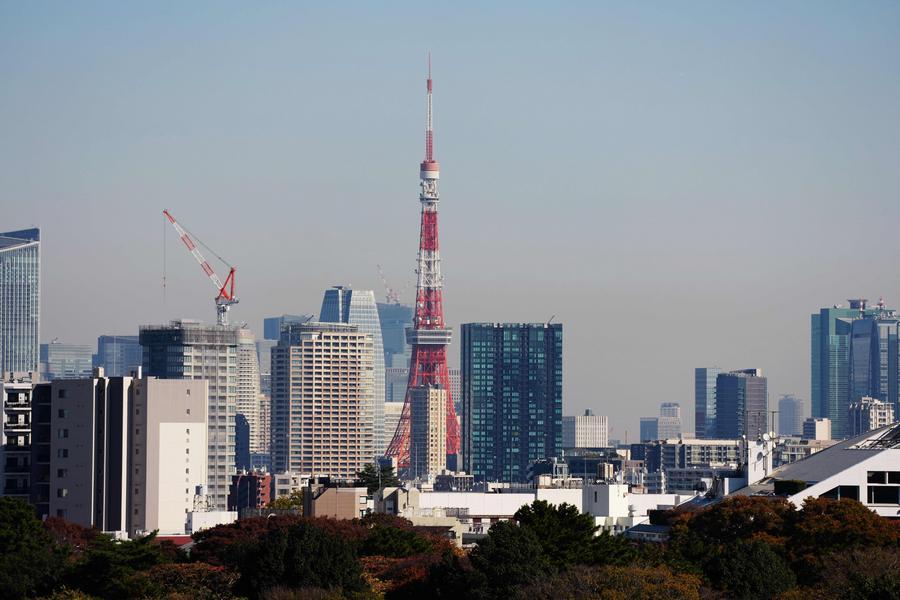
TOKYO, Oct. 4 (Xinhua) -- At a chain store in Tokyo, the Japanese capital, a notice announcing price adjustments on selected items is hard to miss.
These days, price hikes not only rank among the most talked-about topics in Japanese media but are also keenly felt in daily life, from household goods to food and from supermarkets to restaurants.

RISING PRICES, WEAK CONSUMPTION
According to a survey released by Japanese research firm Teikoku Databank Ltd., more than 3,000 food and beverage items in the country are set to go up in price in October, with the full-year tally for 2026 expected to top 20,000.
Data recently released by the Bank of Japan (BOJ) showed that the consumer price index excluding fresh food and institutional factors rose 2.6 percent year on year in August, overshooting the central bank's 2 percent price stability target.
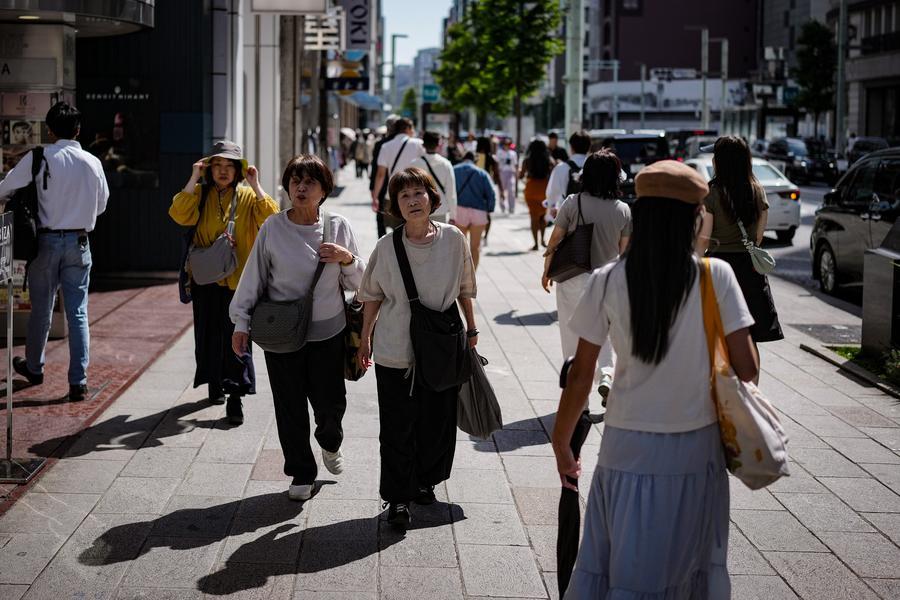
With prices climbing across the board, spending is showing signs of slowing.
Private consumption, which accounts for more than half of Japan's economy, was essentially flat in the second quarter.
As of July, inflation-adjusted household spending had declined year on year for eight consecutive months.
"Rising prices are eroding real purchasing power, and private consumption is likely to stagnate further going forward," said Taro Saito, an economist at NLI Research Institute.
Weak consumer demand is also weighing on corporate earnings. Shingo Ide, chief equity strategist at NLI Research Institute, noted that with costs broadly on the rise, companies that cannot pass them on to customers through higher prices will face sustained pressure on their profit margins, putting their businesses under considerable strain.
Large Japanese companies with strong pricing power still have some room to offset rising costs through price increases, but for the country's large number of small and medium-sized businesses, raising prices is far from easy.
Take ramen shops, a staple of Japan's dining scene. According to Tokyo Shoko Research, bankruptcies among ramen shops jumped 44.4 percent year on year in the first half of 2026, pushing the number of failures to a record high for the period.
Persistently rising costs for ingredients and utilities have forced many ramen shop owners to raise prices, yet with consumers growing more cautious about spending, higher prices risk driving customers away.
For many small restaurant operators in Japan, striking a balance between covering elevated costs and keeping customers coming through the door has become a headache.
LIMITED POLICY TOOLKIT
With rising prices eating into household purchasing power and business costs continuing to climb, Japan's economic policymakers face an increasingly stark dilemma.
On monetary policy, the BOJ finds itself in a bind. The risk that a weaker yen and inflated import costs will push prices up further has not gone away, giving the central bank reason to continue with its tightening cycle.
At the same time, with signs of softening consumption already emerging, raising interest rates too quickly could dampen economic activity.
Recent movements in the yen have added complexity to the BOJ's policy calculus. Even after joint intervention by Japan and the United States in the currency market, the yen has continued to face selling pressure.
A recent Reuters poll found that more than two-thirds of economists surveyed believe the joint intervention has had only a limited effect, merely postponing rather than resolving the deeper problems facing the yen. Against this backdrop, market expectations of a BOJ rate hike have gained noticeable momentum.
At its September policy meeting, the central bank raised its key interest rate to 1.25 percent. However, because the U.S. Federal Reserve also hiked its target federal funds rate, the interest rate gap between Japan and the United States narrowed only modestly, and the yen failed to sustain a meaningful rebound.
According to multiple Japanese media reports, U.S. President Donald Trump recently voiced concerns about the yen's weakness.
The BOJ, for its part, is keeping a close eye on the inflationary impact of a weaker currency.
"If the yen weakens further and economic indicators point to mounting price pressures, the likelihood of a BOJ rate hike in October will increase," said Eiji Maeda, president of Chibagin Research Institute and a former BOJ executive director.
Kyohei Morita, chief economist at Nomura Securities, said the fiscal policy of Prime Minister Sanae Takaichi's government has pushed up inflation expectations, deepening market concerns that the BOJ is falling behind the curve.
On the fiscal side, the Takaichi government's strategy of "responsible and proactive" public finances is running up against the hard reality of limited fiscal space.

A Reuters poll found that 89 percent of economists surveyed expect the government's fiscal policy to drive the yen lower, with markets particularly focused on how measures such as a food tax cut and expanded investment will be funded.
Amid growing concerns over fiscal sustainability, the yield on the benchmark 10-year Japanese government bond, a barometer of long-term interest rates, rose to as high as 3.115 percent at one stage on Sept. 25, its highest level since August 1996.
Japan's government debt has long been high relative to GDP, and as interest rates climb, that debt load is turning into a more immediate interest burden.
According to the Nikkei newspaper, the Ministry of Finance's budget request for fiscal 2027, which runs from April 2027 to March 2028, puts debt-servicing costs at 36.64 trillion yen (about 232 billion U.S. dollars), including 16.59 trillion yen in interest payments, both record highs.
Ultimately, Japan's current economic troubles go beyond a simple rise in prices. They stem from the interplay of shrinking household purchasing power, rising business costs and mounting fiscal pressure, each pulling against the others. When it comes to reconciling price stability, growth and debt control, Japan's policymakers have limited room to maneuver.■