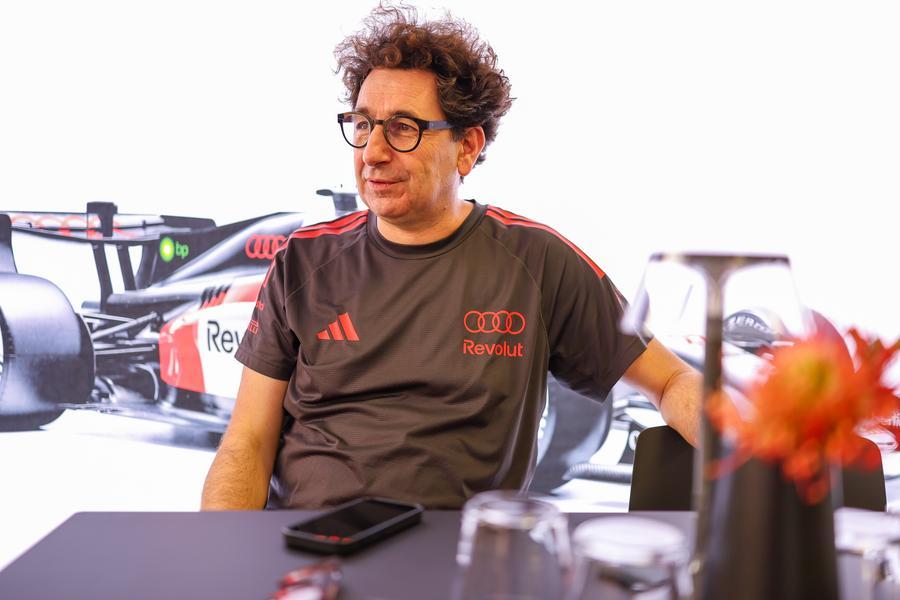
Audi's first Formula 1 season has brought progress but also exposed areas where it remains well behind the front-runners. Xinhua sat down with team principal and CEO Mattia Binotto to discuss the squad's evolution, its power-unit deficit and the long road towards becoming a championship contender.
by F1 correspondent Michael Butterworth
BEIJING, Oct. 1 (Xinhua) -- Mattia Binotto does not know where Audi sits in the Formula 1 constructors' championship.
Nor, apparently, does the man in charge of the German manufacturer's F1 project spend much time keeping track of how many points his team has scored.
"If you would have asked me where we are in the standings, I would not know," Binotto tells Xinhua during the Azerbaijan Grand Prix weekend. "And how much are we scoring? I'm not sure."
The answer is that Audi lies eighth in the constructors' standings in its first season as a works F1 team, with an improving run of results having brought seventh-placed Haas within reach.
But while Binotto welcomes the progress, he insists neither Audi's final championship position nor its points total will determine whether its first year has been a success.
"The objective for us was more becoming competitive, which is not tangible," he says. "It's not the number of points at the end of the season in the championship. It's not about a standing position.
"It's more an attitude. It's more about creating solid foundations, giving a clear perception to the media, the fans in general, our partners, that we are building a solid and credible team for the future."
For Binotto, the more meaningful verdict will come from whether those elsewhere in the paddock believe Audi is developing into a genuine force.
"I would be very happy if, by the end of the season, everyone would share our view that Audi is here to become a strong competitor in the future."
CLOSING THE GAP
There remains plenty of work to do. Audi entered Formula 1 this year with its own power unit, developed at Neuburg in Germany, and Binotto acknowledges that the engine remains the biggest contributor to the team's performance deficit.
The FIA has assessed the relative performance of the new power units, he says, leaving Audi with a clear picture of where it stands.
"I can confirm that the biggest gap in performance is down to the power unit," Binotto says.
Audi has made only a relatively minor change to its turbo during the season, which Binotto says was aimed more at improving drivability than outright performance.
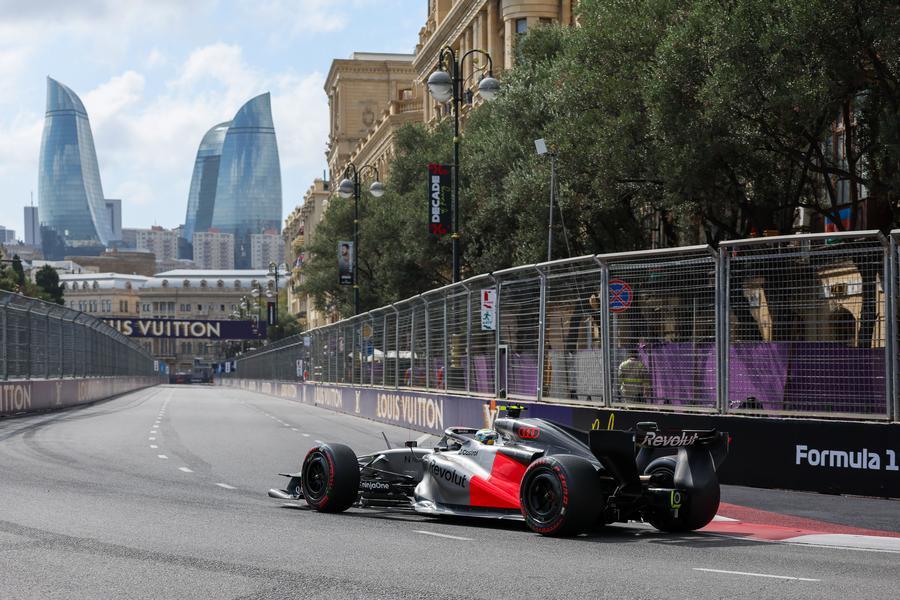
More significantly, he does not expect the deficit to disappear quickly.
"It's clear that it will take several months, or maybe a couple of seasons, before recovering completely," he says.
Binotto hopes Audi will have closed most of that gap by 2028, underlining the long-term nature of a project whose stated ambition is to be challenging for the Formula 1 world championship by 2030.
That does not mean Audi can simply wait for its engine department to find more performance. Binotto stresses that the power unit is only one area in which the team must improve, with development of the chassis continuing in parallel.
BUILDING A TEAM ACROSS BORDERS
Audi's power units are developed in Neuburg, Germany, while its chassis is built in Hinwil, Switzerland. Most of its F1 rivals, meanwhile, draw heavily from a concentrated pool of experienced personnel clustered around southern England, in so-called Motorsport Valley.
Binotto does not regard either issue as the structural disadvantage it might appear.
He points to other F1 teams whose chassis and engine operations have been separated by considerably greater distances. The physical gap matters less, he argues, in an era when engineers in different countries and regions can work together continuously through digital communication.
"What counts the most, especially today with the virtual world where you are connecting with video calls, is making sure the processes are properly in place," he says.
"It's not the proximity of a person which counts, but it's more clarifying where the responsibilities are, where the processes and priorities are.
"I don't think that's location-related. It's organizational."
The same applies to recruitment. Many of the obvious candidates with existing F1 experience are based in England, where switching teams might not even require them to move house. Convincing them to uproot their lives for Switzerland is a different proposition.
Audi has already had some experience of that challenge. Its previous team principal, Jonathan Wheatley, left in April after little more than a year in the role, with the team citing personal reasons for his departure.
Binotto, however, argues that Audi should look beyond the traditional F1 talent pool.
"Worldwide, the talents are everywhere," he says.
Switzerland, in his view, can be an attraction rather than an impediment. He points to its universities and says the team's recent recruitment has encompassed 19 different nationalities.
"Is it a problem for us to attract in Switzerland? No," he says. "I think it's a competitive advantage."
LEARNING TO LET GO OF THE DETAILS
For someone who spent much of his career in engineering, including at Ferrari when Michael Schumacher won five championships in a row, his description of his own technical abilities is surprisingly modest.
"I've never been a good engineer," he says.
Rather than involving himself deeply in individual technical details, Binotto says his task is to ensure the specialists beneath him have what they need to perform.
"My role is more, instead, supporting the team, making sure that everyone has got what's required to deliver to the best. Orchestrating, maybe, an organization.
"I don't like to play the single song. I'd rather prefer to orchestrate the overall team."
Such an approach perhaps explains his apparent lack of interest in Audi's precise championship position. Overtaking Haas would be another sign that the team is moving in the right direction, but Binotto is looking beyond where Audi finishes in 2026.
Whether the foundations being laid this year are strong enough to turn the team into a genuine championship contender will only become clear when the results he currently regards as secondary start to matter rather more. ■