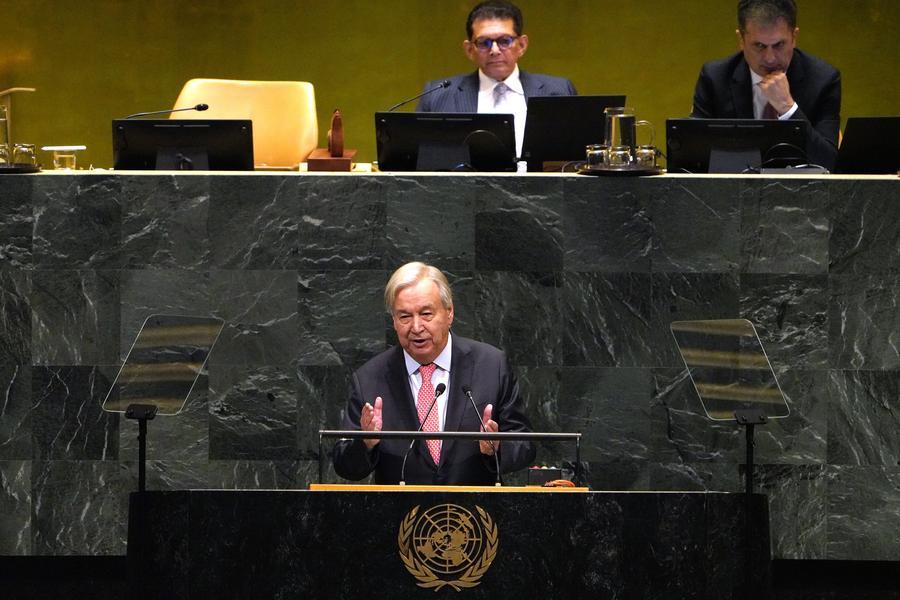
UNITED NATIONS, Sept. 22 (Xinhua) -- UN Secretary-General Antonio Guterres on Tuesday called for a networked multipolar world, instead of one of fragmentation and transactionalism.
"We are clearly moving towards a multipolar world. And that movement is irreversible. But there are different ways that multipolarity can take shape," he told the UN General Assembly before the opening of this year's general debate.
"One possibility is a world of fragmentation and transactionalism. A world of rising tensions and deepening mistrust. Of fractured markets and weakened institutions. Of shrinking cooperation and zero-sum calculations. In many respects, that is the trajectory we are on today," said Guterres.
But there is another path -- a path toward networked multipolarity. A world built on interdependence, and sustained by a dense web of economic, political, social and technological connections; a world in which multiple centers of influence coexist within a common framework of international law and shared rules, said the UN chief.
"Such a world can help us avoid hegemonic tendencies and also what I have called the Great Fracture: the division of the world into two rival blocs with separate economic, technological and security systems," he said. "A networked world recognizes that no power can solve today's challenges alone."
Competition will remain a permanent feature of international relations, but competition does not mean confrontation. Healthy competition can drive innovation, strengthen resilience, and expand opportunity. But only when it operates within frameworks that preserve stability and enable cooperation where cooperation is indispensable, said Guterres.
Building such a future begins with a recognition, especially by superpowers, that their power is not so super, that their power has limits. The events of recent years have made that unmistakably clear. Military power alone cannot secure peace. Economic power alone cannot command stability. And technological power alone cannot guarantee security, he said.
A networked multipolar world can create the conditions for more balanced and representative global problem-solving, but it requires a multilateral system centered in the United Nations that is balanced and representative -- strong, effective institutions that reflect the realities and the progressively changing relative weight of countries and economies in today's world, not the power arrangements of 80 years ago, said the UN chief.
"Fortunately, we are not starting from scratch. We already have a binding foundation: the Charter of the United Nations. And the principles that give it life. The primacy of international law. Upholding human dignity. And the pursuit of justice in all its dimensions. These are the backbone for the effective, legitimate and responsible exercise of power in the 21st century," he said.
"It comes down to this: will we act to ensure that power is governed by law or by force? By cooperation or coercion? By responsibility to young people and future generations or indifference to their fate? Because the defining challenges of our age are not separate from the question of power. They are expressions of it. And they will determine whether we drift deeper into division and instability -- or move toward cooperation, justice and collective security," said Guterres.
Looking ahead, the world's future will be shaped by how to address four great tests of power: the power over war and peace, the power that concentrates wealth and drives inequality, the power fueling climate chaos and the war on nature, and the power unleashed by artificial intelligence, he said. ■