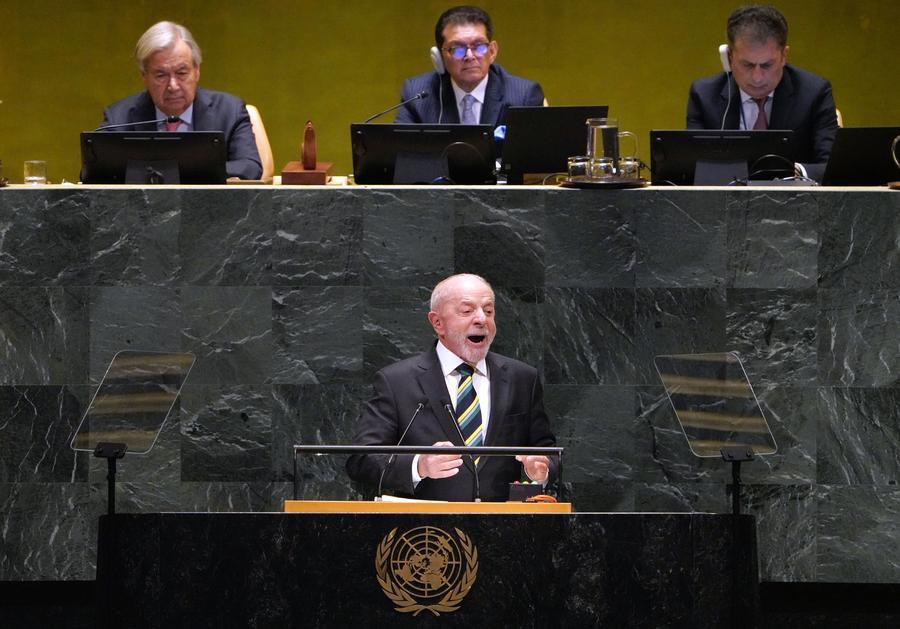
UNITED NATIONS, Sept. 22 (Xinhua) -- Brazilian President Luiz Inacio Lula da Silva on Tuesday opened the general debate of the United Nations General Assembly (UNGA) for the 10th time, calling for multilateralism, dialogue and respect for national sovereignty amid rising geopolitical tensions and armed conflicts.
"The UN is failing in one of its most important missions: to rid humanity of the scourge of war. Its credibility has never been lower. Its ability to protect the most vulnerable, those who have no army or arsenals, has never been so weak," Lula said in his opening speech at the 81st session of the UNGA.
Calling the current situation "the most critical moment for the United Nations," Lula said geopolitical tensions threaten to transform regional conflicts into "a conflagration of global proportions."
"We are all held hostage by the inaction of the Security Council for failing to fulfill its role," he said. "I'm no stranger to the realities of power, but concessions to the law of the stronger have surpassed all limits."
"War is not the continuation of politics by other means. It's the complete breakdown of politics in an interdependent world," he said, adding that leadership means reconciling national interests with those of humanity.
Lula said the international community faces choices between "multilateralism or unilateralism, democracy or extremism, sovereignty or subordination".
On the Ukraine crisis, the Brazilian president called for a diplomatic solution, saying that "there will be no winners on the battlefield." "Diplomacy is the only option," he said.
The Group of Friends for Peace, an initiative launched by China and Brazil, shows that "there are forces in the international community willing to work towards dialogue," Lula said.
Turning to Latin America and the Caribbean, Lula called for respect for the sovereignty of countries in the region and opposed dividing the world into spheres of influence.
"Brazil does not fit in anyone's backyard," he said. "We need partners with a positive agenda that fosters development. Ideological differences should not hinder greater integration among neighbors."
Lula said the Venezuelan people "deserve to define their own destiny". He also called for political participation by the opposition in Nicaragua. On Cuba, Lula said the economic and energy embargo on the country is a "collective punishment" imposed on 10 million people.
On the situation in the Middle East, Lula reiterated support for a two-state solution to the Palestinian-Israeli conflict, saying that illegal settlements in the West Bank are making such a solution increasingly unviable.
He also said that the Strait of Hormuz "has become a battleground, when it should have remained a vital passage for international trade," warning that families are paying for the rising prices for fuel, fertilizers and food around the world.
Lula also called for strengthened international cooperation in fighting organized crime, addressing climate change and managing emerging technologies, including artificial intelligence (AI).
On climate change, he said Brazil will continue to reduce deforestation and advance the decarbonization of its economy, while stressing that the country's natural resources should benefit the Brazilian people.
"Our natural wealth belongs to the Brazilian people, and it is for their benefit that it will be exploited," Lula said.
He also called for regulation of Big Tech and AI, warning against the development of technologies without rules, transparency or ethical boundaries. ■