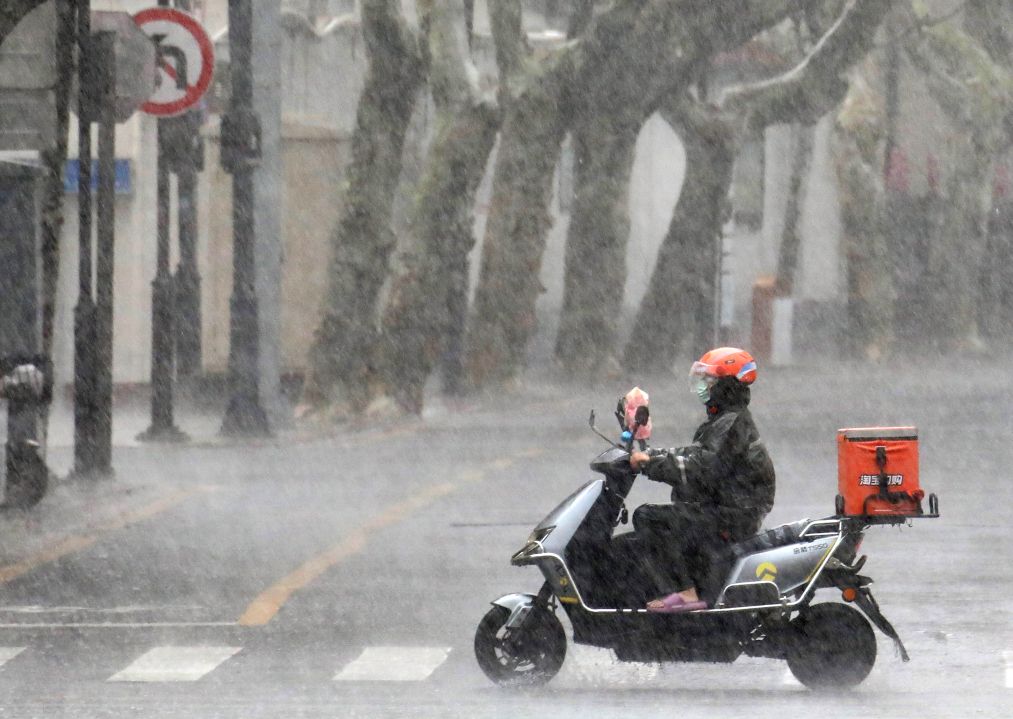
BEIJING, Sept. 22 (Xinhua) -- When a heavy rain flooded streets in north China's Tianjin Municipality in early August, food-delivery rider Zhai Zhongguo found his electric scooter struggling to get through the water. Some residential compounds ended up so waterlogged that he even had to get off and walk to take orders inside.
"In this kind of weather, I just hope customers won't place an order unless they really need to," he said.
In China, the clock starts ticking the moment a food delivery order is placed. Riders are given a set amount of time to deliver each order, a system designed by food delivery platforms to ensure prompt service. Under pressure from the countdown, some riders may resort to speeding or running red lights to save time, putting their own safety and that of pedestrians at risk. When bad weather strikes, however, making the deadline can become even more difficult.
To ease pressure on delivery riders, especially during bad weather, food delivery platforms and local authorities have rolled out human-centered measures, such as more flexible delivery deadlines and "red-light pauses."
When Typhoon Dolphin hit Suzhou in east China's Jiangsu Province early last month, local authorities urged major delivery platforms to waive penalties and deductions for weather-related delays, while delivery services were temporarily suspended in some areas.
In Beijing in north China, Meituan, Taobao Flash Shopping and JD Food Delivery said on Aug. 13 that they would introduce a "red-light pause" system in the city. Time spent waiting at traffic lights would be added back to riders' delivery windows instead of counting against them. These companies also said riders would get more time to complete deliveries in severe weather or when faced with difficult road conditions.
Zhai said he has noticed delivery rules being adjusted when bad weather hits. During a spell of heavy rain, for example, orders that normally came with a 30-minute delivery window were given about 50 minutes instead.
"You just have to ride more slowly when it rains. Safety comes first," said Liu Xingwei, a Taobao Flash Shopping delivery rider in Tianjin's Binhai New Area. "If you explain the delay to customers beforehand, most of them understand."
Platforms are also giving riders a broader safety net, from weather allowances and insurance to protective gear. Meituan said it has covered riders' heat-related medical expenses at its own expense since June 1, while providing per-order subsidies during high temperatures. Taobao Flash Shopping has offered active riders free heatstroke insurance and additional payments based on temperature and rainfall. JD Food Delivery has introduced a monthly high-temperature allowance of 300 yuan (about 44.5 U.S. dollars) for some riders, while offering others additional payments for orders delivered during heavy rain.
In Nanchang, capital of east China's Jiangxi Province, Meituan rider Zhou Zhenbo said he does not receive a high-temperature allowance, but can earn extra pay during peak delivery periods and receive shopping coupons for heat-relief items such as cooling sleeves. At Zhai's station in Tianjin, there is no cash allowance for hot or rainy days, he said, but riders are provided with heat-relief supplies.
Beyond easing the pressure of delivery deadlines, Chinese authorities are also paying greater attention to the health and well-being of delivery workers. Rules issued in 2024 require platforms to prompt riders to take breaks when they reach limits on continuous order-taking or daily working hours, and to stop sending them orders for a set period.
But for riders on the road, finding time and place to rest can still be a challenge.
For Zhai, who typically logs on at 8 a.m., takes a lunch break around 1 p.m., returns at 3:30 p.m. and finishes around 8 p.m., his working hours and order volume remain largely unchanged, even in extreme weather. At times, back-to-back orders leave him with little opportunity to find a rest station.
To enable delivery riders and other outdoor workers can get drinking water, charge their phones or escape the heat and rain, more Chinese cities are expanding rest stations for them. Tianjin, where Zhai works, now has more than 5,700 union-run stations, with the municipal trade union moving more of them closer to logistics hubs and delivery sites to make them easier for riders to reach. In Nanchang, 80 standardized rider rest stations had been built by June, while community service centers across the city have also opened their doors to workers.
At a rider rest station in Nanchang's Xihu District, the midday heat sent delivery workers through the door for a brief break. They filled large bottles with ice water before heading back out to their next orders. A few minutes in the shade and a bottle of cold water could not ease the physical demands of the job, but they offered riders a much-needed pause from the heat and the road. ■