
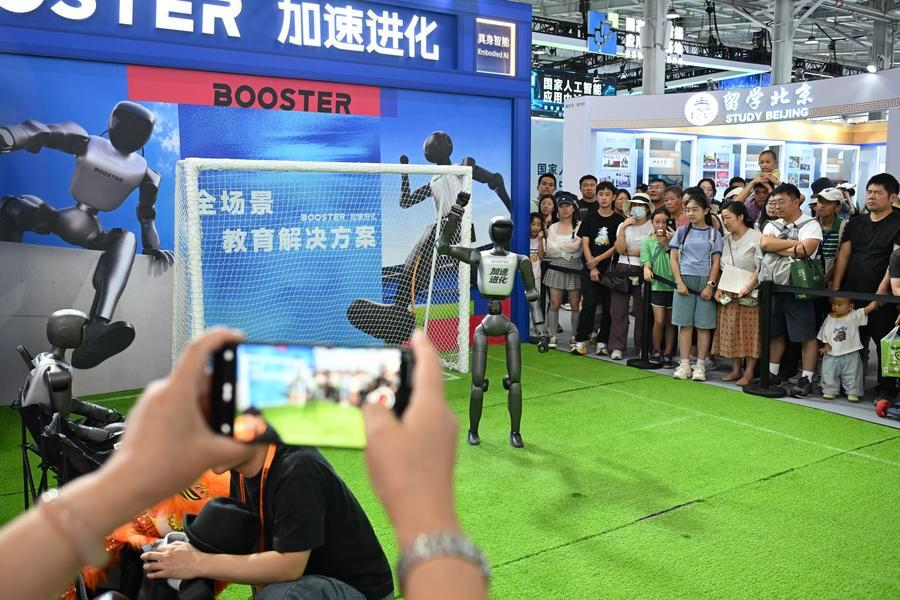
by Xinhua writer Chen Wangqi
BEIJING, Sept. 14 (Xinhua) -- Watching humanoid robots do backflips is surely impressive. But after the sense of novelty wears off, I always find myself wondering: Is it ever going to help me fold my laundry?
Henning Kristoffersen, commercial counselor at the Norwegian Embassy in China, asked me a similar question on the sidelines of the just-concluded 2026 China International Fair for Trade in Services (CIFTIS).
Calling China's humanoid robots "hugely exciting" and "super impressive," Kristoffersen said a part of him thinks, "Oh my gosh, this is changing the world. And another part of me is saying: Oops, in what way is this changing?"
So I put that to the exhibitors on the showroom floor.
WHY HUMANOID?
A robot vacuum cleaner can effortlessly slide under a sofa that requires a human to drop to their hands and knees, making it hard to see what a humanoid robot would add.
"Specialized robots may outperform at one specific job, but humanoids are designed to tackle all sorts of tasks, offering general-purpose capabilities," said Hu Zheqi, vice president of Yue Quan Bionics Ltd., a developer of bionic humanoid robots.
"A robot vacuum can only vacuum. You need another machine to cook, and yet another to do the laundry. A humanoid rolls them all into one, so it's the best choice," Hu said. "Our world is designed entirely for people, from our size to the way we use tools. Building a robot that fits into those existing spaces keeps costs and challenges down, rather than having to redesign the environments from scratch for task-specific machines."
However, Mo Yilin, a tenured associate professor at Tsinghua University's Department of Automation and chief scientist at LingYu Robotics, offered a different perspective.
As the global robotics industry is still in its infancy, it is difficult to envision what form a truly general-purpose machine should take, Mo told Xinhua. "Thus, many people's default reaction is: Well, humans can do a bit of everything, so let's just make it look like a person -- at least we're locked in general versatility."
"But a robot can't be tightening bolts in a factory today and rescuing hikers on Mount Tai tomorrow," he said. "Once a product's actual use case is clear, its physical design will naturally diverge ... After all, the more specialized the roles, the higher the efficiency."
Mo noted that currently, it is nearly impossible to balance the ideal "triangle" of generalizability, performance and autonomy. "Things evolve in stages. You can't expect a robot to morph into the Terminator overnight."
Though the sector is still nascent, China has already secured a massive edge in robotics, Mo said.
Driven by its robust supply chains, vast data and rich real-world scenarios, China has what it takes to pull off hardware, data, models and applications all at once, he noted.
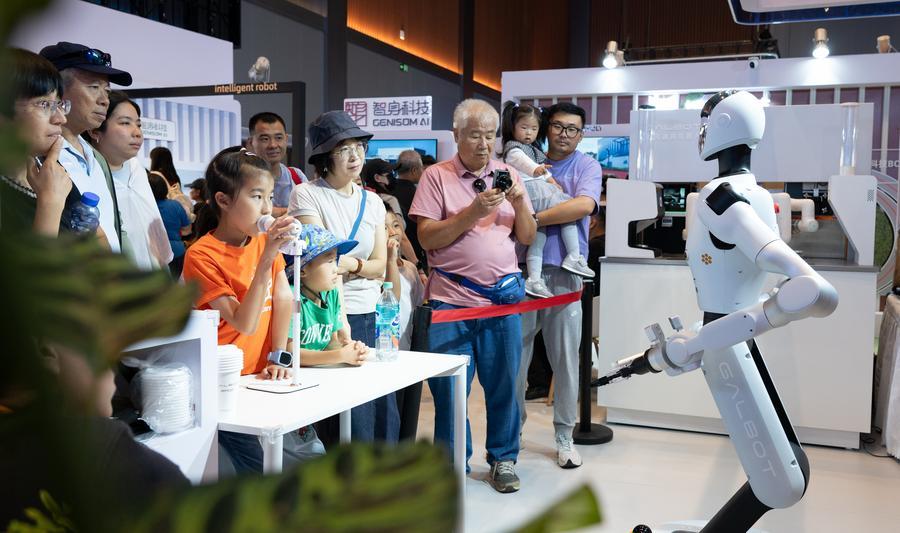
BRAIN, BODY AND BUSINESS USE
In a corner of the CIFTIS exhibition hall, visitors were crowding around, playing rock-paper-scissors with a robotic hand.
The hand can also catch haphazardly tossed objects of any size, shape or material, picking them up and stowing them away in a box without a scratch, said Sun Jia, co-founder and CTO of CasiaHand Robotics, which has won several international awards for innovation.
What controls hand movements is the CasiaHand Brain Si 0.5 -- an algorithm that merges the strengths of the vision-language-action model and the world model, both key model types in embodied AI. While the "big brain" handles comprehension, task planning and analysis, the "little brain" oversees low-level control, Sun told Xinhua.
"When a user says, 'Hand me that bottle,' the big brain translates natural language into robotic commands, maps out which hand to extend, how far to move forward, and the exact grip pressure needed to lift the bottle. Meanwhile, the little brain orchestrates the five digits to pick up the bottle smoothly, ensuring it does not spill," she said.
From tightening screws to brewing coffee, these robotic hands have already found applications in nuclear power inspections and emergency explosive disposal, she noted.
Building a smarter brain requires massive amounts of data. Leju Robotics gathers data through VR teleoperation, with human operators wearing headsets and controllers to map their physical data directly onto the robots.
Fed with real-world data capturing variables like friction and lighting, the robot handles unseen scenarios with ease, adapting seamlessly to changes in object angles and the position of light, said Sun Dong, general manager for the northern China region at Leju.
What makes all this possible is the robot's body. Yue Quan Bionics has developed highly biomimetic humanoid robots featuring what Vice President Hu Zheqi described as the world's smallest chassis. Moving beyond basic tasks like hauling workshop cartons, its compact size allows it to navigate and work in narrow spaces that other robots find hard to enter.
And these humanoid robots are already walking out of the factory into our daily lives.
Mo Yilin said LingYu Robotics' humanoids are now employed in JD Supermarket, navigating dense crowds and unpredictable traffic, reliably handing out food samples, restocking shelves, and guiding customers through the racks.
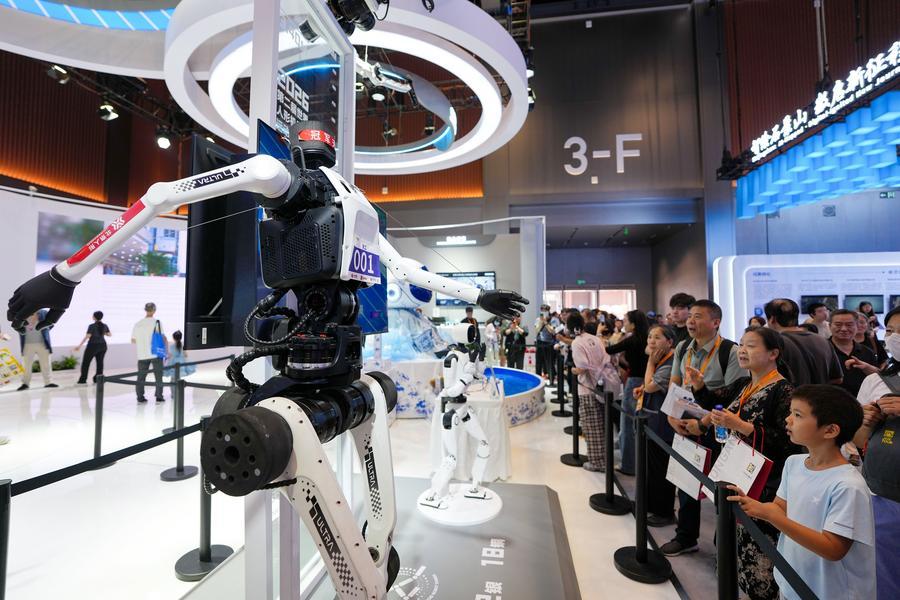
INTERNATIONAL COOPERATION
Building on partnerships with European manufacturing giants like Schaeffler and Hutchinson, Leju sealed deals at the recent World Robot Conference to establish strategic hubs in Britain and the Netherlands for research and manufacturing, Sun Dong told Xinhua.
"This is a deep strategic partnership, not just a hardware sale," said Sun Dong. "Leju will provide algorithms and services, while our partners bring their industry expertise, leveraging each other's strengths to drive the development of this technology."
As the guest country of honor of this year's CIFTIS, Norway saw a record number of companies visiting China to build and expand partnerships, said Vebjorn Dysvik, the Norwegian ambassador to China.
Ole J. Rugset, CEO of Kristiansund and Nordmore Business Association, told Xinhua that the Norwegian delegation visited several humanoid robot companies ahead of CIFTIS.
"We are here to learn, especially about artificial intelligence," he said, adding that he hopes to bring those connections back to Norway and looks forward to future collaboration.
Ambassador Dysvik told Xinhua he believes humanoid robotics will be a key growth area, saying there remains immense potential for collaboration.
"China is far ahead on a lot of this, but we are also quite advanced, especially when it comes to autonomous vehicles in the sea that can withstand harsh conditions," he said. "I think a lot of Norwegian companies that are advanced in this sector will be looking to China to see where they can cooperate, where that is possible."
Impressed by China's robots after experiencing hotel-delivery bots firsthand, Nanno Mulder, chief of the International Trade Unit at the Economic Commission for Latin America and the Caribbean, expressed optimism for the industry's future, stressing that robots should only take over mundane tasks to free humans for more productivity-enhancing roles.
Grounding this frontier technology in human-centric progress, CIFTIS offers "tremendous opportunities" for international companies to deepen cooperation not only in robotics, but also across a wide spectrum of service sectors, Mulder said. ■