by Xinhua writer Zhao Weihong
RAMALLAH, Sept. 7 (Xinhua) -- One summer evening, I went for a stroll down Issa Ziada Street in the old city of Ramallah. The rich aroma of coffee, the herbal scent of handmade soap, and the smell of freshly baked bread filled the air.
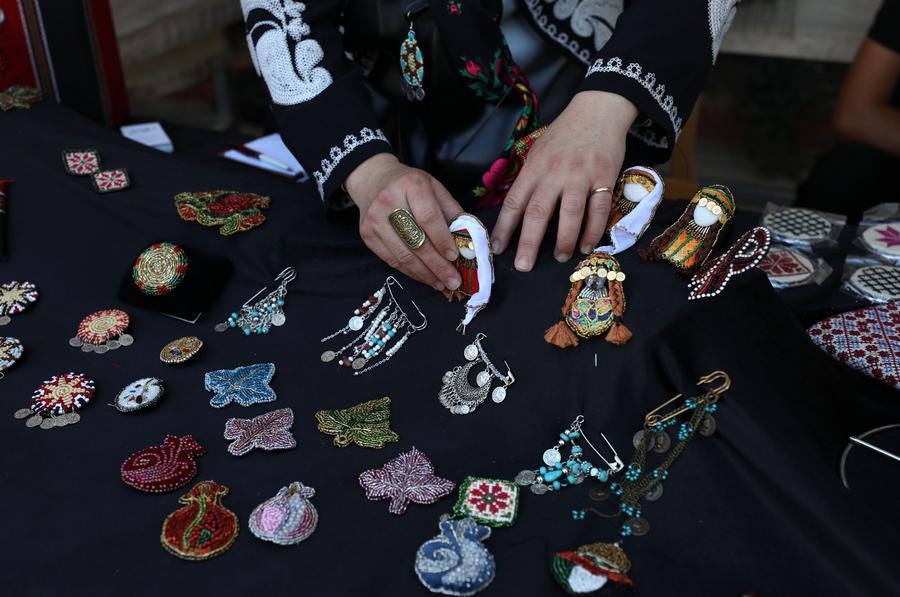
Yet it was not those inviting aromas that stopped me, but some crimson and indigo threads -- fine as veins, dense as memory, stitched into cloth by hands that refused to forget.
Ayyam Tamimi, a 50-year-old embroiderer from East Jerusalem, picked up a panel of fabric and gently ran her fingers over the stitches.
"This is Tatreez," Tamimi said softly.
Tatreez, the traditional Palestinian art of cross-stitch embroidery, gained international recognition in 2021, when the UN Educational, Scientific and Cultural Organization inscribed it on its Representative List of the Intangible Cultural Heritage of Humanity.
Tamimi told me that she had spent over 20 years mastering the craft, first as a seamstress, then as a shop owner, and finally as the founder of her own brand.
"This is the heritage passed down from our ancestors," she said, her eyes tracing the patterns as if reading a landscape she could no longer return to.
"We Palestinian women stitched the landscapes of our occupied villages into cloth," she said. "The villages did not survive. The cloth did. We may not be able to inherit our ancestors' land, but every time I see Tatreez, in homes, at weddings, in shops, I remember where our roots lie."
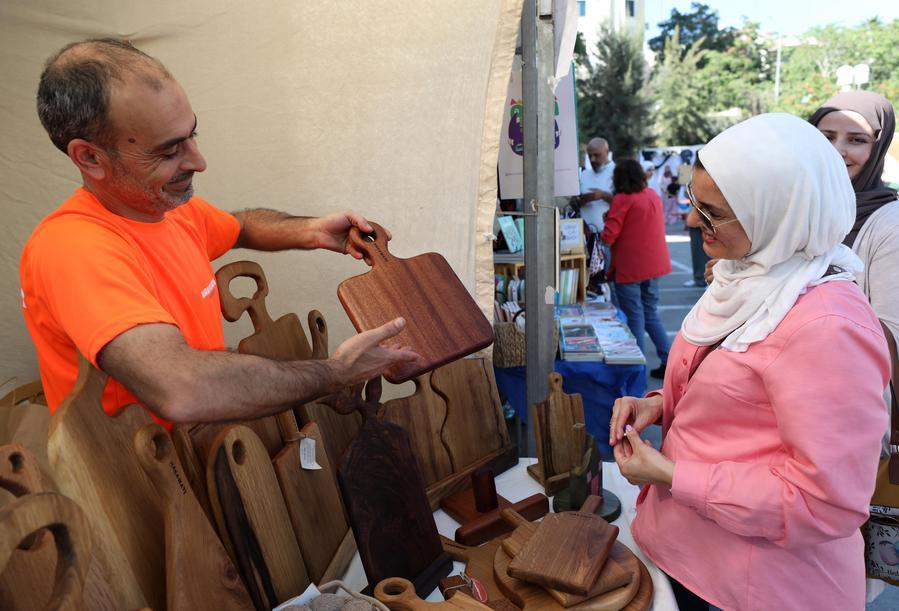
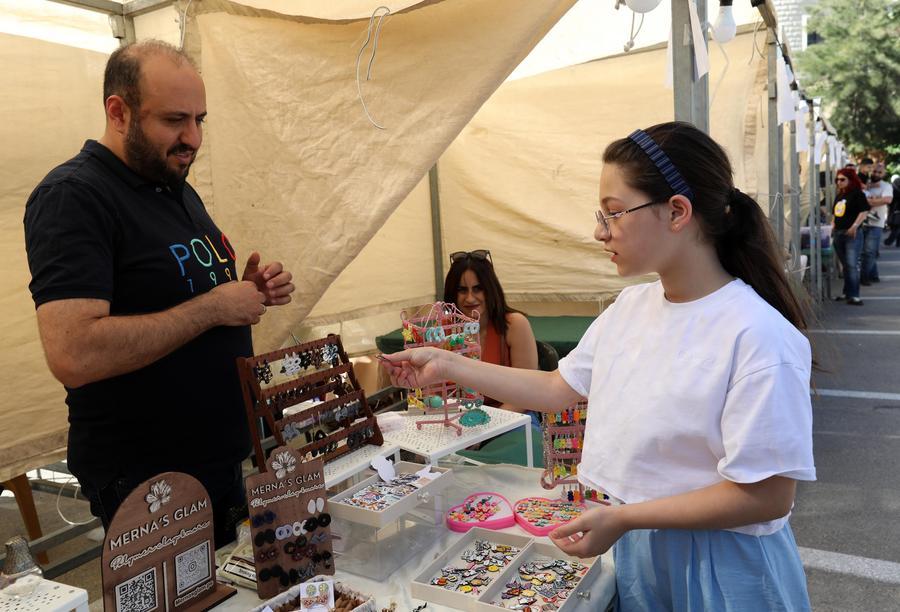
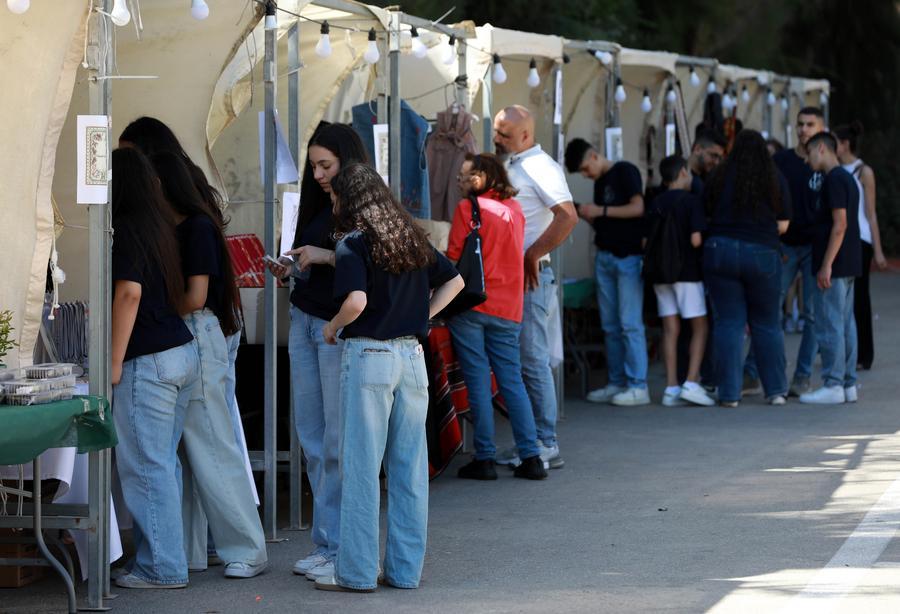
Beyond Tamimi's stall, the street opens onto a parking lot transformed into four rows of booths. They were part of the Harjeh Market, which reopened this summer after a two-year suspension following the outbreak of the latest Israel-Hamas war in October 2023.
The seasonal market, intended to support Palestinian artisans and small businesses, ran on Fridays during summer and usually hosted about 100 stalls. Here, memory lives on -- stitched into cloth, carried by place names and carved into olive wood.
At a nearby booth, Sameh Abdullah bent down to pick up a placard reading "Jaffa" in both Arabic and English. His grandparents had been forced to flee that city to the West Bank city of al-Bireh in 1948.
Beside him, 30-year-old Mohammad Omar politely asked me not to film him, saying he wanted "to avoid unnecessary trouble."
Omar had driven more than four hours from Tulkarm in the northern West Bank, navigating multiple Israeli military checkpoints that turned what would normally be a 40-minute journey into a half-day trip.
"My goods are often detained at Israeli checkpoints," he said quietly.
For the past 10 years, Omar has sold placards bearing Palestinian place names. Whenever he travels to other cities, he sends them ahead with supply trucks.
"They are afraid," he said, lowering his voice. "Afraid that we will remember the name of every occupied city, every hill, every river."
Violence has continued to escalate across the West Bank. The UN Office for the Coordination of Humanitarian Affairs documented more than 1,300 settler attacks causing casualties or property damage in the first seven months of the year, the highest pace on record.
Thousands of olive trees have been burned, cut down, or otherwise vandalised. For Palestinians, these trees are far more than a crop cultivated for millennia and a vital source of livelihood; they are symbols -- quiet and enduring -- of resistance and of home.
At another booth at the Harjeh Market, Aida Al-Shawa arranged gleaming refrigerator magnets carved from olive wood in the afternoon sun.
"Israeli soldiers and settlers are cutting down and burning olive trees across the West Bank," she said. "So we hold tightly to every trunk and pour our hearts into our work. We want the world to see that this land belongs to us."
Her words echoed what an elderly Palestinian farmer once told me: bulldozers may split an olive trunk, but as long as the roots remain, the tree will grow again.
In Al-Shawa's hands, those roots were transformed into everyday reminders. She told me that she carves the names of places that she believes are being erased and turns them into objects for daily life.
"That way," she said with a smile, "every morning when people open the fridge to get some milk, they catch a glimpse of the homeland they may never return to." ■