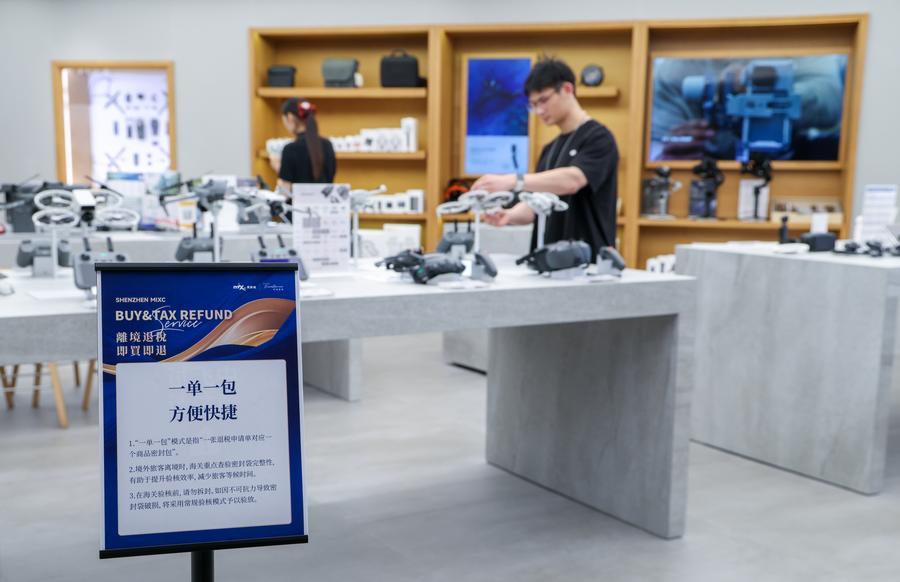
SHENZHEN, Sept. 8 (Xinhua) -- Inside a flagship store of Chinese drone maker DJI in the city of Shenzhen, south China's Guangdong Province, British visitor Annabel Grainger was busy taking photos of products to share with her friends back home.
"My friends wouldn't have seen anything like that before," she said.
A thriving tech hub, Shenzhen has emerged as a magnet for global tech aficionados. The city's wide range of high-tech products, including artificial intelligence (AI) glasses, AI 3D printers, AI robots, drones, and handheld gimbal cameras, have generated considerable buzz on international social media platforms such as Instagram and TikTok.
An average of nearly 8,000 foreign buyers visit Huaqiangbei, Shenzhen's mega electronics marketplace, each day this year. From January through July, sales of AI products surged more than 55 percent from a year earlier in this area. Sales of AI glasses doubled, while sales of drones and robots climbed by 60 to 70 percent during the same period.
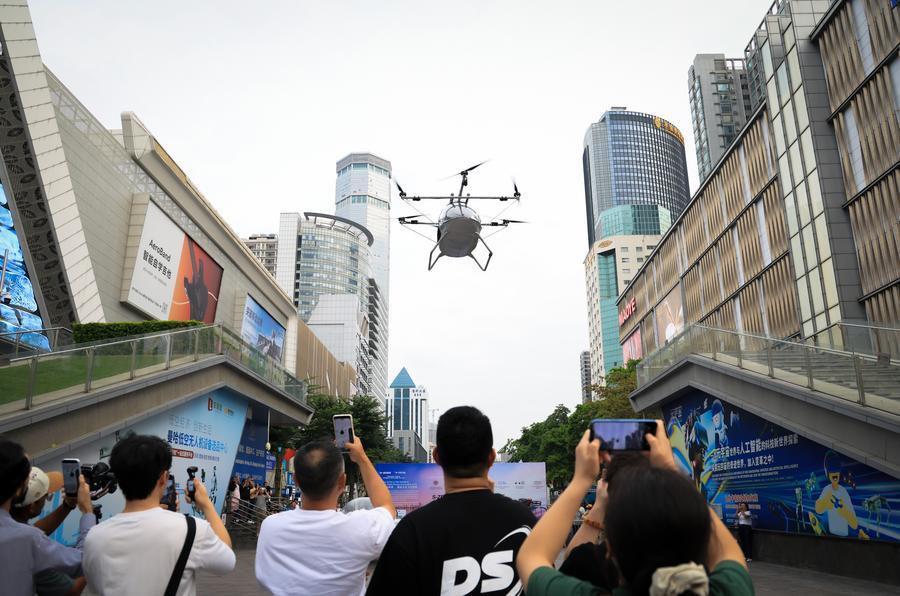
Industry insiders noted that a complete industrial chain and high-density industrial clusters have taken shape in Huaqiangbei's AI sector, covering the full spectrum from AI chip solutions and agent development to on-device model deployment and scenario testing.
These advantages, they said, have facilitated the deep integration of AI technologies into hardware products, while boosting production efficiency and significantly lowering costs.
"It takes several weeks to make a prototype in Europe, but it can be done in half a day in Shenzhen," Dutch engineer Henk Werner said.
"In Shenzhen, if you need to upgrade a product, you can pull together all your suppliers within a day and have a cooperation agreement inked by the evening," said Leng Xiaokun, founder of Leju Robotics, highlighting the city's core advantage in having a complete industrial chain.
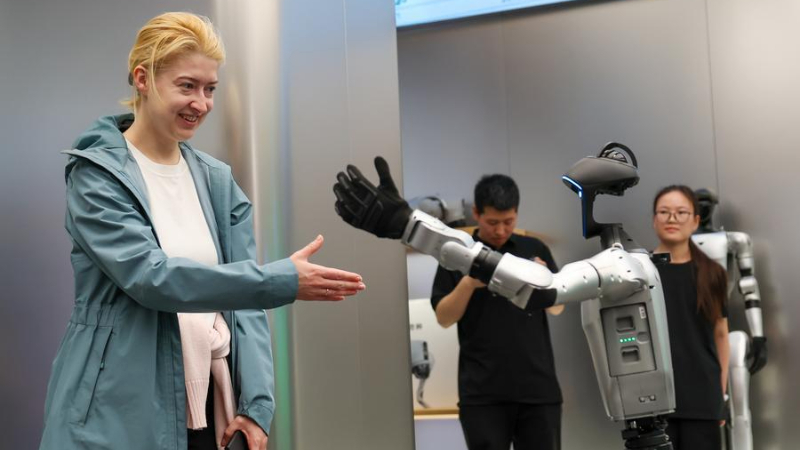
The company's Kuafu line of humanoid robots has, notably, achieved a domestic sourcing rate of 95 percent for its core components, which has significantly reduced costs and enabled rapid market launch.
In a bid to incentivize enterprises to double down on fundamental core technologies over the long haul, Nanshan District in the city, home to a vibrant tech ecosystem, has set up a seed fund and an angel fund totaling 500 million yuan (approximately 73.7 million U.S. dollars), aimed at offering lead investment support to early-stage ventures.
"Though the research and development of the fundamental components and algorithms of humanoid robots often yields no direct returns for several years, Shenzhen's patient capital provides a guarantee for technological breakthroughs," Leng noted.
Leveraging an international cooperation center based in the city's Longhua District, a host of advanced technology firms have successfully introduced their AI-powered intelligent computing terminals and other smart products and solutions to markets across North America and Southeast Asia.
Shenzhen has also jointly built cooperation platforms with ASEAN member states. The Shenzhen-Singapore cross-border data verification platform, now in trial operation, is designed to address challenges related to secure data flows in AI and other industries.
Adjacent to Hong Kong, Shenzhen was one of China's first special economic zones and has since evolved, over four decades, into a global hub for innovation and advanced manufacturing.
The number of AI enterprises in China had surpassed 6,000 last year, while the output value of the core AI industry was projected to exceed 1.2 trillion yuan during the same period, representing a year-on-year increase of almost 30 percent.
Moreover, China was home to more than 140 humanoid robot developers in 2025, with shipments reaching 14,400 units -- accounting for 84.7 percent of the global market, an industry research report said. ■