by Mahmoud Fouly
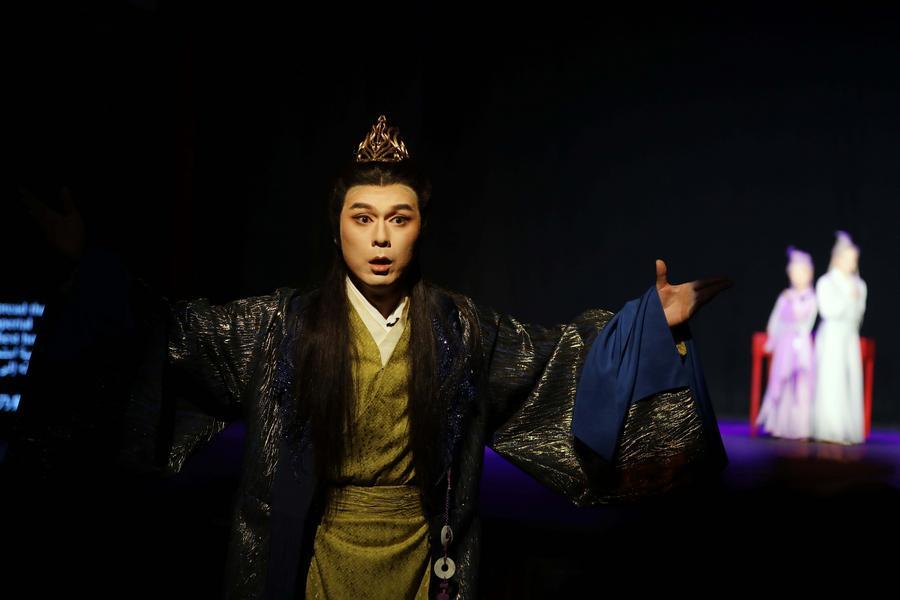
CAIRO, Sept. 6 (Xinhua) -- With a spotlight on him, a Chinese actor slowly descended from the stage and made his way through the aisles of a packed Cairo theatre, delivering an anguished soliloquy amid warm applause.
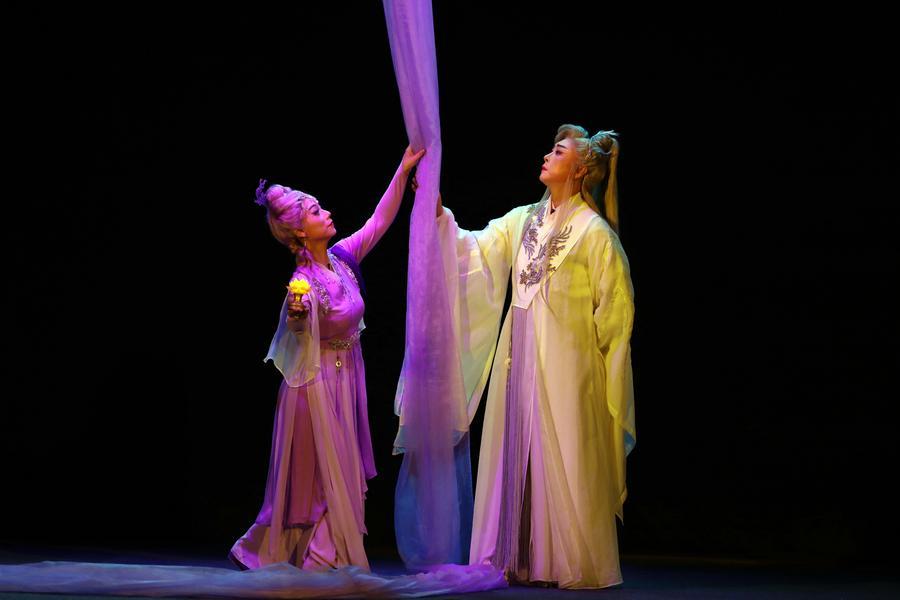
It was one of several moments when performers of "Liaozhai: Purple Tail," an experimental Chinese Xiju production, moved beyond the stage and into the audience during their performance at the 33rd Cairo International Festival for Experimental Theatre (CIFET).
The Chinese production, presented by Wuxi Xiju Theatre, brought to life a story weaving together the human and supernatural worlds.
"For moments, we felt we had been transported from Cairo to China," Hamada Shousha, an Egyptian actor, director and theatre professor at Heliopolis University, told Xinhua.
"We did not just see and hear the story; we lived its atmosphere," he said, noting "the costumes, music and presentation all carried a distinctly Chinese character."
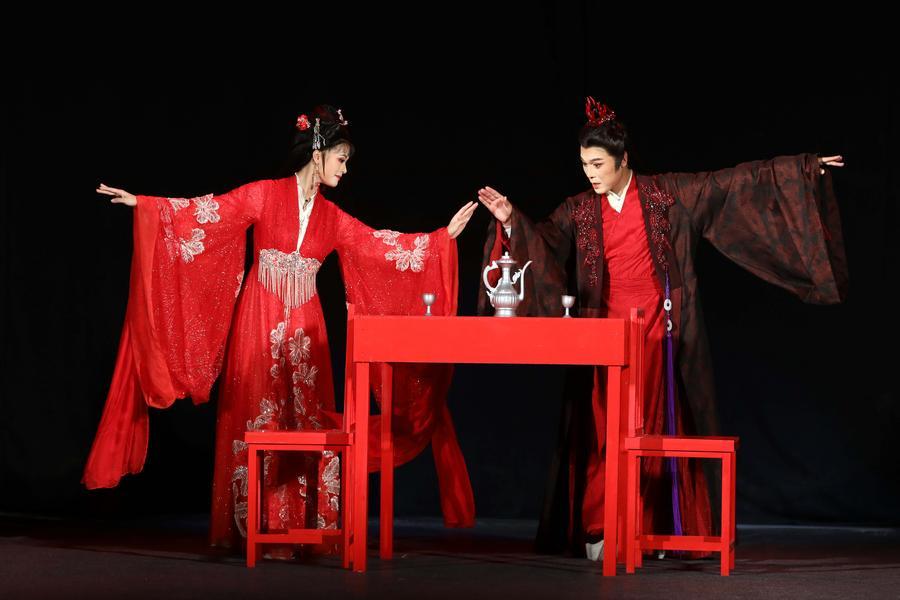
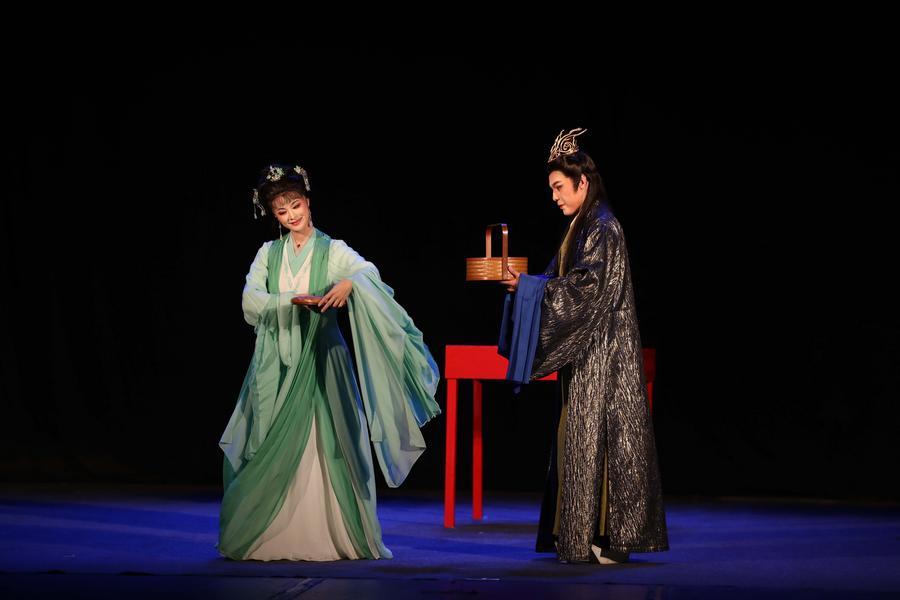
The play follows Qiao Sheng, a kind and honest scholar who unexpectedly saves a fox maiden. In gratitude, she gives him a magical fox tail capable of granting any wish. Armed with this power, Qiao Sheng gradually succumbs to his desires, exposing the darker side of human nature.
The play is adapted from Liaozhai, or Strange Tales from a Chinese Studio, a classic collection of Chinese ghost stories and supernatural folk tales written over a period of 40 years from the late 1600s to the early 1700s.
Though performed in Chinese, English, Arabic and Chinese surtitles were displayed on a monitor to the left of the stage, allowing Egyptian and international spectators to follow the story without diverting their attention from the action.
Hui Haifeng, who plays Qiao Sheng, said the response of the Egyptian audience had left a deep impression on him.
"Although we speak different languages, I could tell from their eyes, expressions and reactions that they were following the story attentively and were deeply immersed in it," Hui said.
"Art knows no borders, and neither does emotional communication," he said. "Language may present a barrier, but emotions are shared, and body language and stage expression can also communicate across cultures."
Founded in 1951, Wuxi Xiju Theatre has spent over seven decades preserving and developing xiju, a form of traditional Chinese opera, while taking its productions to audiences abroad.
Li Mengheng, a lead performer, said audiences could feel the story and its emotions through the stylized movements and body language of traditional Chinese opera even without prior familiarity with the form.
"I feel that Egyptian audiences understand the rhythm of our performance particularly well. They know when to applaud and when to give the performers some encouragement," Li said.
The Chinese play is one of 15 productions from 13 countries in the festival's official competition, including entries from Egypt, Saudi Arabia, Britain, Spain, Germany, and Russia, spanning dramatic and physical theatre, contemporary dance, puppetry, visual theatre and multimedia performances.
Sabine Liebherr from Germany described the production as "absolutely magical," saying it carried "something of a general truth about human existence."
"You have to be careful what you wish for," she said, referring to a theme of the play. "If your wish does not come from a good heart, the result can be disastrous."
She was also struck by the performers' movements. "The way they moved was so graceful -- they were almost floating."
Running from Sept. 1 to 8, this year's CIFET brings together Egyptian, Arab and international theatre practitioners for performances, workshops and discussions centered on experimentation and new approaches to theatrical expression.
For Malak Mahmoud, a fourth-year Chinese-language student at Cairo University, the performance offered a chance to experience Chinese culture firsthand rather than through a screen.
"The show was breathtaking. I could see how engaged the Egyptian spectators were, and I could hear people behind me reacting with surprise as they followed the performance," Mahmoud said.
"Through such performances, we can learn more about Chinese culture, the way people think and their beliefs," she added.■