by Hummam Sheikh Ali
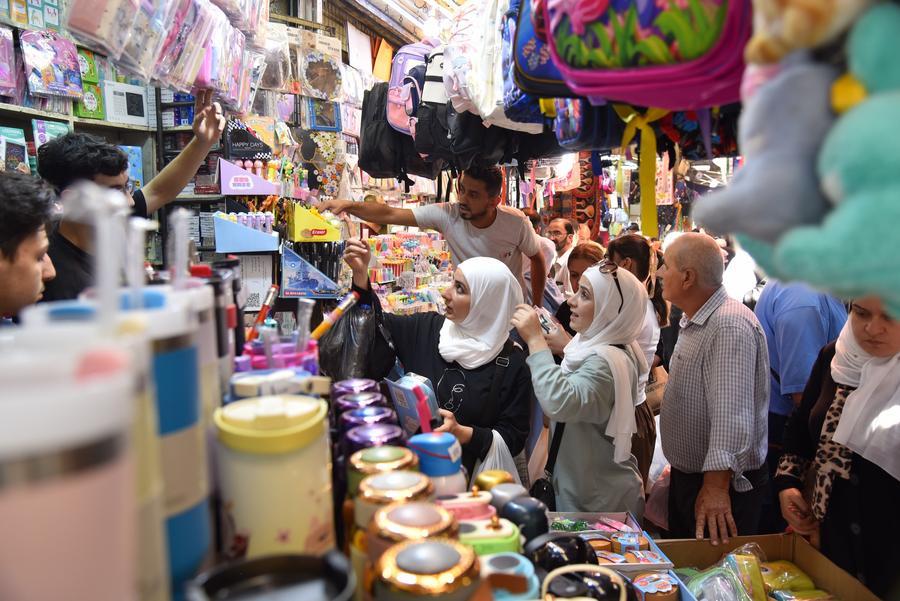
DAMASCUS, Sept. 5 (Xinhua) -- In the narrow lanes of Damascus' old markets, parents moved from shop to shop on Saturday, comparing prices for pens, notebooks, and school bags and making the final preparations for the 2026/2027 school year.
At al-Asrounieh market, a traditional stationery hub in Old Damascus, Abu Masa was shopping for his two daughters ahead of Syria's school reopening on Sunday, Sept. 6.
"We are here to buy school supplies. I have two daughters," Masa told Xinhua. "Everything is expensive, and people don't have enough money to buy what they need. There are shoppers, but prices are very high."
To save money, his family is passing supplies down among the children.
"We give the older sister's school bag to her younger sister and buy only one new bag," he added.
At nearby al-Khaja market, Fadi, another Damascus resident, was shopping for a school bag but said his family could not afford to purchase everything the children need at once.
"Prices have no connection to people's actual incomes. They are very high, and most people are looking rather than buying," he told Xinhua.
Saturday's local market estimates put a basic stationery set for a primary-school student at 100,000-250,000 old Syrian pounds, or about 8-19 U.S. dollars, varying with item count and quality. A notebook costs around 3,000-10,000 old pounds, while a pen 700-3,000.
Adding clothing, shoes and a school bag pushes the bill higher. Primary-school clothing can cost roughly 4-10 dollars, while a school bag or pair of shoes can cost around 5-15 dollars each. Altogether, basic supplies and clothing for one child can easily reach several dozen dollars.
Those expenses take on added weight when measured against incomes. The country's minimum monthly wage now stands at 12,560 new Syrian pounds, or about 105 dollars. The Finance Ministry notes this isn't the average salary, though no current official nationwide figure exists.
Against that benchmark, even basic preparations for one child eat a large slice of monthly earnings. A stationery set, a school bag, shoes, clothing, and other essentials could together amount to roughly one-fifth to over half of the minimum monthly wage.
"We only buy what is immediately necessary. We don't purchase all the school supplies at once because we simply cannot afford to do that," Fadi added.
The pressure is also visible from behind shop counters.
Mohammad Khair Jaqmaqji, who owns a stationery shop in Old Damascus, said customers are buying much more selectively than they did a year ago.
"To be frank about the economic situation, business this year is slower than last year," Jaqmaqji told Xinhua. "Last year, customers would come and buy complete sets and large quantities. This year, people are forced to buy only what they actually need."
The restrained spending comes despite signs of broader economic stabilization. The World Bank said inflation in Syria dropped to an estimated 11.5 percent in 2025, down significantly from 72.1 percent in 2024. Still, high living costs, a weak labor market and reconstruction needs weigh on households in the country.
Meanwhile, Syria's education system is still recovering from years of conflict, displacement and destruction.
The Education Ministry said Saturday that 1,370 schools had been rehabilitated or restored during 2026, following 2,017 in 2025, while more than 6,000 schools still need rehabilitation and maintenance.
More than 500,000 Syrian children have returned from abroad, adding pressure on the education system to absorb students with varied backgrounds. About 2.45 million children remain out of school, according to figures from the UN Children's Fund cited by the ministry.
For families walking through Damascus' markets on the eve of the new academic year, however, the immediate concern is simpler: getting kids back to school without breaking already stretched budgets.
On Sunday morning, Syrian children will once again head to classrooms. For parents such as Abu Masa and Fadi, getting them there has meant carefully weighing what can be bought now, what can be reused and what will have to wait. ■