by Xinhua writers Zhou Xinyi, Yu Junjie and Zhang Yunlong
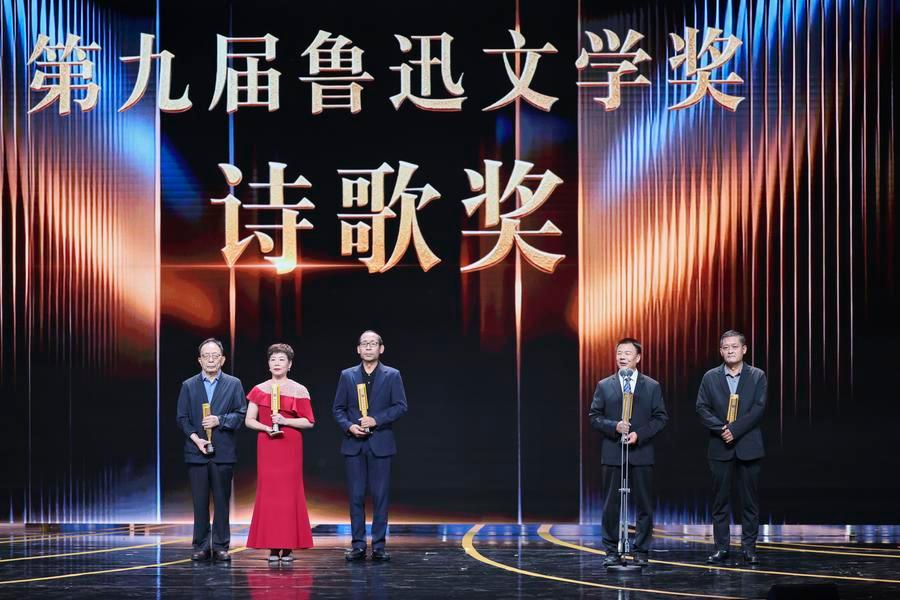
SHANGHAI, Sept. 4 (Xinhua) -- For eight years, Wang Jibing threaded through streets and alleys on his electric scooter, delivering meals, breakfast, lunch or dinner. Last week, he took a very different path, stepping onto the stage at the ceremony for one of China's top literary honors.
There, Wang's poetry collection "Low Flight" won him the Lu Xun Literature Prize, making him the first takeout rider-turned-laureate. His works are now stocked at Beijing's prominent bookshops, and have appeared in The Baffler, a literary journal published in New York.
Beside him on stage was Zhang Ergun, a former geological driller whose poems draw on years spent working in remote mountains and mining regions.
The moment highlighted a broader shift: individuals whose lives have long been subjects of literary works are now picking up the pen, by and for themselves.
According to Yuewen Group, one of China's largest online literature platforms, more than 6,100 delivery riders and over 4,000 truck drivers and ride-hailing drivers are among its creators. Beyond those figures are security guards, cleaners, domestic helpers, farmers, rural teachers and others who write about their lives outside established literary institutions.
One of Wang's best-known poems sprang from a routine delivery stop. While collecting an order from an eatery one afternoon, he noticed the owner asleep on a sofa with her child in her arms.
The scene inspired his poem "Three O'Clock in the Afternoon," in which he wrote: "One dream was holding another dream inside a dream." Trying not to wake them, he quietly picked up the order and left, comparing himself in the poem to a "thief of time" who stole away, if only briefly, part of the hardships carried by the mother and child.
In plainspoken language, Wang captures the rhythms, challenges and moments of warmth that mark the lives of delivery riders: slippery roads during storms, brief exchanges between couriers and customers, and solitary journeys beneath streetlights late at night.
"An excellent writer should move from writing for oneself toward giving voice to others," Wang said at a recent public event in Shanghai. "Life gives you material, and you respond with your work."
Zhang's poetry, however, emerges from a different landscape. His verses portray windswept northern plains, mountain roads, stonemasons and travelers making their way through difficult terrain.
The success of Wang and Zhang offers two examples of the rising "new popular literature and art," a term used to describe creative work rooted in the lived experiences of ordinary people.
Earlier this year, 35 representatives of this literary trend gathered at the National Museum of Modern Chinese Literature in Beijing.
One participant, Li Wenli from northwest China's Gansu Province, worked in Beijing as a domestic helper before writing and publishing a memoir. "I am just an ordinary rural woman," she said. "I never imagined I would write a book."
In Xihaigu, a once-impoverished area of northwest China's Ningxia Hui Autonomous Region, some farmers tend crops by day and craft stories at night. As one local writer put it, "The crops grown from the soil sustain the body. The words grown from the pen sustain the soul."
Bai Ye, honorary president of the Chinese Association of Contemporary Literature, sees "new popular literature and art" as a vivid expression of the nation's creative vitality, saying the trend could encourage more literature lovers to take part in literary creation.
This year's Lu Xun prize for literary theory and criticism went to "Workers Sing of Their Lives: New Popular Literature & Art and the Reconstruction of Literary Spirit," a study examining how new forms of grassroots writing are reshaping literary expression in the digital era.
Its author, Zhuo Jin, poses a pointed question: When ordinary workers pick up the pen to express their own voices, should the boundaries of literature be reconsidered?
What began as individual acts of writing is drawing recognition from literary institutions and scholars alike.
Qiu Huadong, vice chairman of the China Writers Association, said these creators from all walks of life and their new literary and artistic practices are among the clearest signs of a new cultural landscape in China.
"Not every pair of wings can soar high," Wang said after receiving the award. "Flying close to the ground is still a kind of flight." ■