BEIJING, Sept. 4 (Xinhua) -- A 72-year-old man suffering a heart attack recently received life-saving treatment at a rural health center in central China's Hubei Province -- a procedure that, until a few years ago, was beyond the expertise of most grassroots medical institutions.
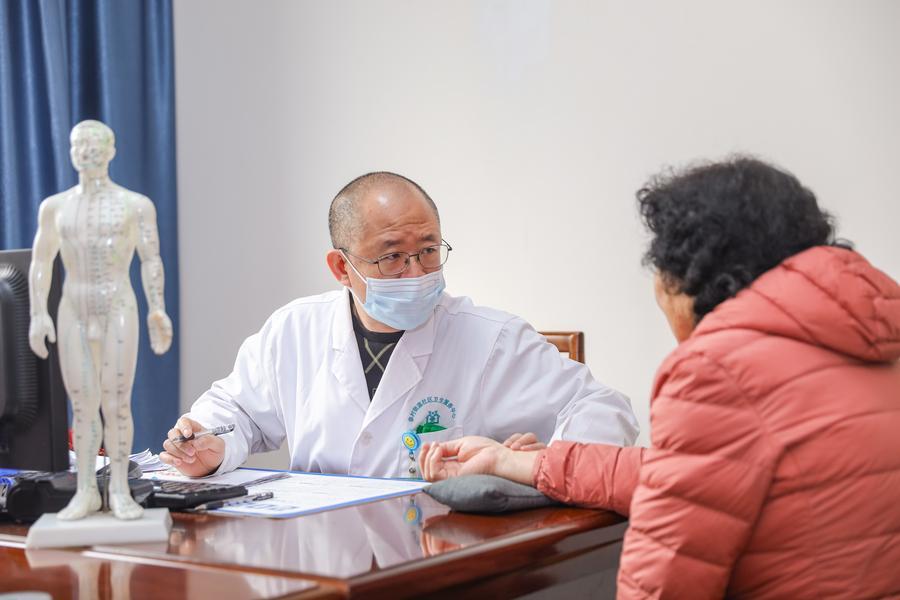
When the man was brought to Wuli Township health center in mountainous Hefeng County, Enshi Tujia and Miao Autonomous Prefecture, doctors quickly diagnosed an acute myocardial infarction and administered intravenous thrombolysis. After his vital signs stabilized, he was transferred to a higher-level hospital for further care.
"This was the fourth emergency thrombolysis procedure since our health center set up a chest pain treatment unit," said Tian Jianbing, head of the health center.
"Cardiovascular diseases can progress rapidly and require timely intervention, making it essential to bring lifesaving capabilities to the grassroots level," said Huang Kai, a senior executive at Renmin Hospital of Wuhan University.
In remote rural or mountainous areas, where residents may live far from hospitals equipped to handle emergencies, many township medical centers previously lacked the expertise and experience to perform thrombolysis. They would often refer patients to higher-level hospitals, sometimes at the cost of precious treatment time.
To address this challenge, Hubei has in recent years established standardized chest pain treatment units at grassroots medical institutions, bringing emergency expertise, treatment protocols and quality medical resources closer to patients' homes.
Over the past five years, the province has set up 1,404 such units. A total of 320 grassroots health centers have performed nearly 3,000 thrombolysis procedures for heart attack patients. The province's mortality rate from cardiovascular and cerebrovascular diseases fell from 240.4 per 100,000 people in 2020 to 190.7 in 2025.
Hubei's experience is part of a broader national push to strengthen primary healthcare. In 2021, the National Health Commission (NHC) launched pilot areas for improving grassroots medical services, focusing on tasks such as bolstering the primary care workforce and enhancing service capacity. To date, 12 national pilot areas have been established, and 20 provinces have launched 186 provincial-level pilot areas.
One of the national pilots, Suixi County in east China's Anhui Province, has in recent years focused on building a more coordinated grassroots emergency response network.
The county has integrated its emergency dispatch center with two sub-centers run by county-level medical consortia and 14 grassroots emergency stations, creating a three-tier emergency network covering the county, towns and villages.
In 2025, the network handled 18,000 emergency transfers, with ambulances dispatched within three minutes in 99 percent of cases. The average response time was about 12 minutes.
Suixi County People's Hospital has established five specialized emergency and critical care centers covering chest pain, stroke, trauma, critically ill pregnant women, and critically ill children and newborns. In 2025, the hospital handled 8,991 cases involving emergency and critical care patients.
The hospital has also strengthened coordination between pre-hospital and in-hospital emergency care. When a patient is transferred from a grassroots facility, medical information is transmitted in real time to the hospital's emergency center via a pre-hospital emergency platform.
Doctors at the center can provide remote video guidance to grassroots staff as they treat the patient in the ambulance, while an emergency "green channel" is activated at the hospital, ensuring the patient is admitted and treated without delay.
As grassroots emergency networks are strengthened, localities are also turning to technology to improve response efficiency. In Zhangjiajie, a mountainous tourist city in central China's Hunan Province, a unified emergency medical command and dispatch system integrates Beidou satellite positioning, electronic mapping, vehicle monitoring and real-time information on hospital emergency resources.
The system automatically identifies callers' locations and helps dispatchers assign the nearest available ambulance based on real-time traffic conditions and hospital capacity. Ambulance routes and patients' vital signs can be transmitted to receiving hospitals, allowing medical teams to prepare in advance and linking pre-hospital with in-hospital care.
"Dispatching now relies on data, making it faster and more accurate," said an official with the municipal health authority.
These efforts reflect China's broader push to strengthen primary healthcare. Official data show that primary-level medical institutions -- including township health centers and village clinics in rural areas, as well as community health centers and stations in urban areas -- grew from 882,000 in 2009 to nearly 1.06 million in 2025, accounting for more than 95 percent of all medical institutions nationwide.
By 2025, compact county-level medical consortia had been established in 2,199 counties, with more than 70,000 county-level hospital staff deployed to grassroots institutions. Remote diagnostic centers for medical imaging and electrocardiography had been set up in more than 90 percent of counties.
The push will continue under a three-year action plan (2026-2028) launched by the NHC, which calls for improving the quality of primary care services, including strengthening emergency and critical care capacity, upgrading facilities and equipment, improving early identification and initial treatment of critically ill patients, and enhancing coordination with higher-level hospitals. ■