

* Air China now serves 27 European destinations with nearly 260 weekly flights between the two continents, with the Beijing-Bucharest-Zagreb route adding another thread to this growing network.
* For Croatia, where tourism accounts for about one-fifth of GDP, the direct flight is a long-awaited gateway to the world's largest outbound tourism market. For Romania, it restores a connection that has been absent since 2003. And for Chinese travelers, it offers a new, hassle-free entry point to the wider Balkan region.
by Xinhua writers Yao Yulin, Ma Zhen and Li Xuejun
BUCHAREST/ZAGREB, Sept. 4 (Xinhua) -- Air China launched its maiden Beijing-Bucharest-Zagreb flight on Friday, restoring direct passenger links between China and Romania after more than two decades and inaugurating the first-ever scheduled passenger service between China and Croatia.
Operating three times a week, the new route comes as Central and Eastern Europe -- known for its Adriatic coastline, medieval towns and rich cultural heritage -- is attracting growing interest from Chinese travelers. Travel has become more convenient than ever following China's unilateral visa-free policy for ordinary citizens of both Romania and Croatia.
For Croatia, where tourism accounts for about one-fifth of GDP, the direct flight is a long-awaited gateway to the world's largest outbound tourism market. For Romania, it restores a connection that has been absent since 2003. And for Chinese travelers, it offers a new, hassle-free entry point to the wider Balkan region.
VISA-FREE BENEFITS
China and Romania once enjoyed direct air links, with Air China operating the route until 1994 and Romania's TAROM taking over until its suspension in 2003. For the next 23 years, travelers had to transit through third countries, turning a straightforward journey into a half-day ordeal. The new Beijing-Bucharest-Zagreb route has finally restored that missing link.
The timing is no coincidence. In November 2024, China expanded its unilateral visa-free policy to include Romania and Croatia, along with seven other countries. Ordinary passport holders from both nations can now stay in China for up to 30 days without a visa for tourism, business, family visits or transit.
The results have been striking. Around 35,000 Romanian citizens traveled to China in 2024, twice the figure recorded a year earlier. In the first seven months of 2025 alone, nearly 36,000 Romanians visited China, up 78 percent year-on-year, according to the National Association of Travel Agencies in Romania.

Dan-Horia Maxim, Romania's ambassador to China, described the restored direct flights as "a major diplomatic and economic success aimed at bringing our communities closer together" in a press release.
Chen Feng, China's ambassador to Romania, told Xinhua that the resumption of regular direct passenger flights has been a shared aspiration of the Chinese and Romanian peoples and reflects sustained joint efforts on both sides.
"It is expected to help further strengthen bilateral economic and trade cooperation, deepen cultural and people-to-people exchanges, promote mutual understanding, and inject fresh momentum into the sustained and healthy development of China-Romania relations," Chen added.
For Croatia, the numbers tell a story of promise still waiting to be fulfilled. In 2024, the country welcomed over 250,475 Chinese tourist arrivals, up more than 41 percent from the previous year. Yet that figure remains barely half of the pre-pandemic peak of some 490,000. Industry insiders view the new air link as a key step toward unlocking further growth.
Qi Qianjin, China's ambassador to Croatia, called the route "the first direct flight in the history of the two countries and the latest achievement in deepening bilateral relations," adding that it would "significantly reduce travel time and costs, further unleash cooperation potential, and promote exchanges in trade, tourism, culture, sports and people-to-people ties."
For China, the route fits into a broader pattern of deepening air connectivity with Central and Eastern Europe. Air China now serves 27 European destinations with nearly 260 weekly flights between the two continents, with the Beijing-Bucharest-Zagreb route adding another thread to this growing network.
BALKAN HUB
Kristjan Stanicic, director of the Croatian National Tourist Board (CNTB), described the air link as "an important step forward" that "opens up additional opportunities for Croatian tourism to position itself more strongly on the large and promising Chinese market."
He said Croatia is reaching out to Chinese visitors "through its exceptional diversity, but also through an authentic experience of our country, the local way of life, tradition and values."
The CNTB, through its Shanghai office, plans to continue working with Chinese partners to "enable Chinese guests to get to know our homeland, its heritage and people in a quality and deeper way," Stanicic added.
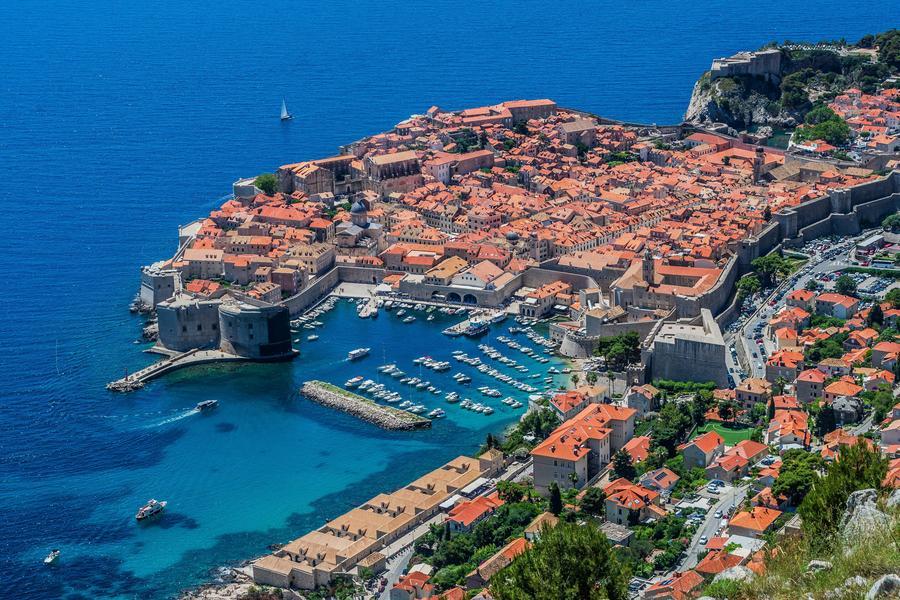
Dubrovnik, Split, Zadar and the capital Zagreb remain among the most popular Croatian destinations for Chinese tourists, but industry observers believe the new route could broaden that map.
Leon Jiang, president of the Balkan Chinese Tourism Association and the Croatian Chinese Tourists Guide Association, said that direct access eliminates the inconvenience of transfers, making travel easier for both Chinese tourists heading to the Adriatic and Croatians interested in visiting China.
Romania, too, stands to benefit significantly from the restored air link as the new route responds to long-standing calls from the tourism industry and provides infrastructure to meet growing two-way travel demand.
In the first half of 2025 alone, Romania welcomed 21,682 Chinese tourists, the highest number of Asian visitors on record. With direct flights now in operation, the bottleneck that once held back the market's full potential is being removed.
Romania has been actively positioning itself to capture a larger share of the Chinese outbound market. In May, Romania made its debut at ITB China in Shanghai, one of the most important B2B travel trade events dedicated to the Chinese market. The delegation promoted destinations including Bucharest, Transylvania and the monasteries of Bucovina.

Earlier in October 2025, the China Tourism Fair was held at the Chinese Cultural Center in Bucharest, bringing together over 100 representatives from the tourism, culture and education sectors of both countries.
Zagreb's strategic location also gives the route broader regional significance. Ljubo Jurcic, professor of economics and former Croatian minister of economy, pointed out that Chinese travelers arriving in Zagreb can easily continue to Italy and Austria, while the Adriatic coast is only a short journey away.
Jurcic added that the route also signals Chinese interest in expanding cooperation with Croatia beyond tourism.
"Croatian business people have long considered China an interesting market, because China is today the largest and most influential country in the world when it comes to business," he said. "Unfortunately, Croatian business people were not turned to China in time, but today that is changing." ■