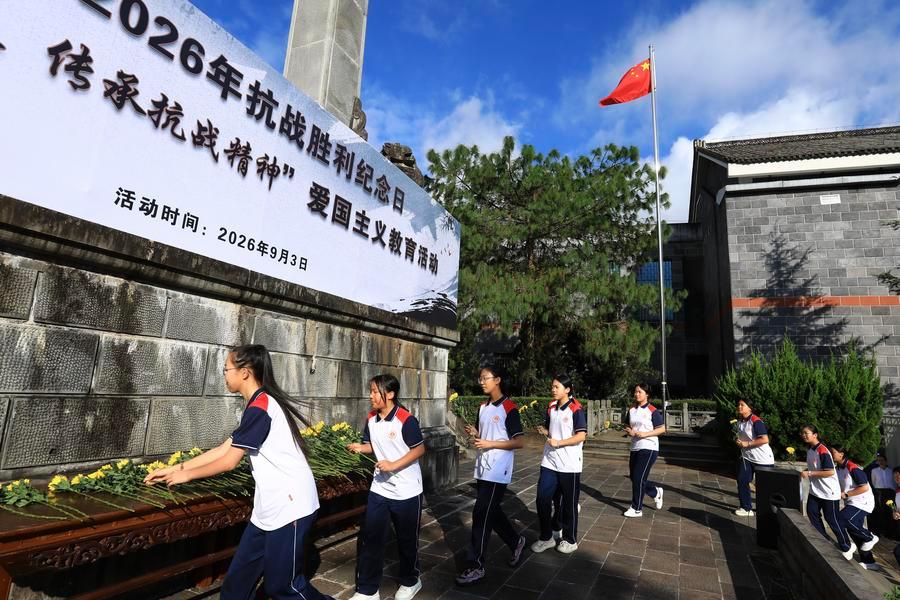
BEIJING, Sept. 3 (Xinhua) -- People across China held commemorative activities on Thursday to mark the 81st anniversary of the victory in the Chinese People's War of Resistance Against Japanese Aggression and the World Anti-Fascist War.
The Chinese People's War of Resistance Against Japanese Aggression (1931-1945) was the first to break out and lasted the longest in the World Anti-Fascist War. Over 14 years, some 35 million Chinese were killed or wounded. Japan officially surrendered on Sept. 2, 1945, by signing the Instrument of Surrender.
The war marked China's first complete victory against foreign aggression in modern times. Through immense sacrifice, the Chinese people made a major contribution to the salvation of human civilization and the defense of world peace.
In 2014, China's national legislature designated Sept. 3 as Victory Day of its War of Resistance. Last year, China held grand commemorative events in Beijing on Sept. 3 to mark the 80th anniversary of the victory, including a military parade in Tian'anmen Square.
On Thursday, a symposium was held in Beijing to commemorate the 81st anniversary. Li Shulei, a member of the Political Bureau of the Communist Party of China (CPC) Central Committee and head of the Publicity Department of the CPC Central Committee, attended the event.
About 200 people took part in the symposium, including veterans of the war, relatives of wartime commanders and fallen soldiers, and international friends who contributed to China's victory, as well as representatives of their families.
Officials, young military personnel, and student representatives spoke at the event, vowing to remember history, honor fallen heroes, cherish peace, and build a better future.
In Harbin, capital of northeast China's Heilongjiang Province, a series of activities commemorating the hard-won victory 81 years ago was held at the Northeast China Revolutionary Martyrs' Memorial Hall.
Representatives from government agencies, businesses, military units, schools and social organizations attended a memorial event and paid silent tribute to those who fell in the War of Resistance.
They also visited an exhibition featuring wartime relics to learn more about the historical significance and contemporary relevance of the spirit of the Northeast Anti-Japanese United Army (NAJUA).
For 14 years, the soldiers of NAJUA fought in extreme conditions, suffering severe food and clothing shortages while facing overwhelming enemy superiority. Yet they still inflicted heavy losses on Japanese forces, making an indelible contribution to the World Anti-Fascist War.
"We commemorate the victory so that we do not forget history," said Tong Guobo, head of the memorial hall. "The NAJUA spirit -- of unwavering faith, deep patriotism, and dauntless courage -- has taken deep root in northeast China, inspiring generations to forge ahead."
At the Memorial Hall of the Victims in Nanjing Massacre by Japanese Invaders in east China's Jiangsu Province, people took part in poetry readings and historical reenactments, bringing to life the harrowing stories of that dark chapter for the audience.
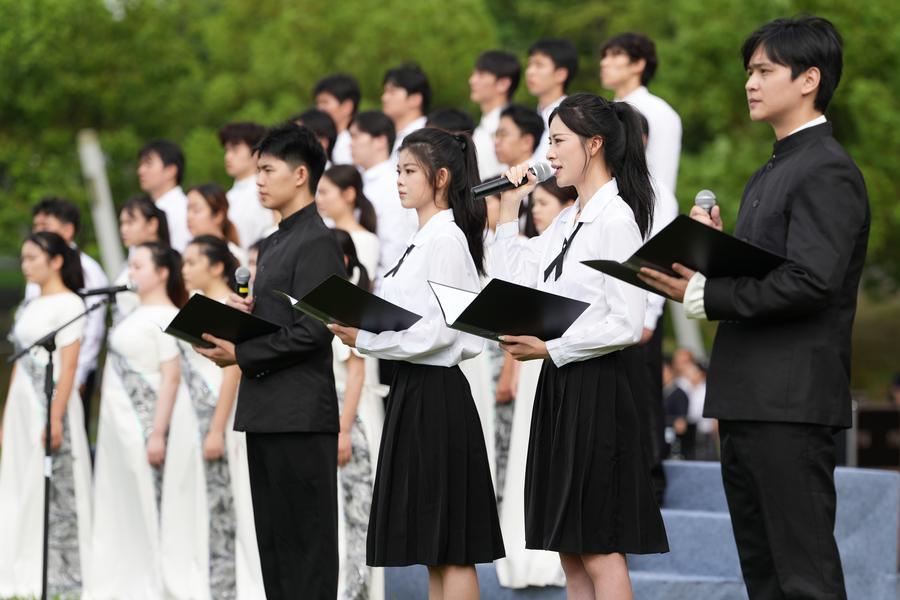
"Both my parents were survivors of the Nanjing Massacre, and we lost six family members to the Japanese forces in 1937," said Cao Yuli, who was participating in the event.
"We should always remember the past and value the peace we enjoy today," said Zhang Xinjue, a student choir member during the commemorations.
In east China's Shandong Province, more than 3,000 artifacts that bear witness to the Japanese atrocities are exhibited at a private museum in Pingyin County. Among them are military postcards and letters and soldiers' diaries, as well as photographs, combat maps, and other items such as swords, helmets, and gas masks.
Han Guangyou, the 65-year-old curator of the museum, has spent more than four decades amassing these artifacts from across China. "These exhibits stand as undeniable proof of the war crimes committed by imperial Japan," he said.
The museum now receives more than 20,000 visitors annually. Han is currently collaborating with several universities to catalog, digitize and research the collection. "These stark exhibits serve as a sobering reminder for young people to remember the lessons of history and strive to build a stronger China," Han said.
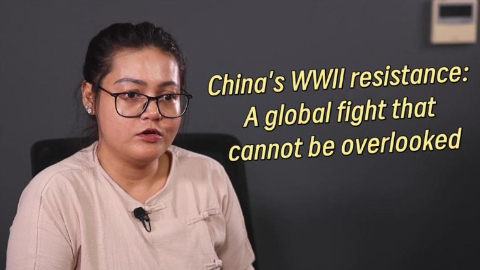
"Today's world is far from peaceful," said Zhang Shaoduo, an associate researcher at Shanghai International Studies University. "These commemorative events remind people across the globe that a stronger China remains a pillar of world peace."
Also on Thursday, Chinese Foreign Ministry spokesperson Guo Jiakun urged Japanese right-wing forces to adhere to the path of peaceful development, in response to Japan's record-high defense budget request for the 2027 fiscal year.
"Our solemn message to Japanese right-wing forces: the right way forward for Japan is to fulfill its international obligations, fully remove the pernicious influence of militarism, and keep to peaceful development," Guo told a regular press briefing in Beijing. ■