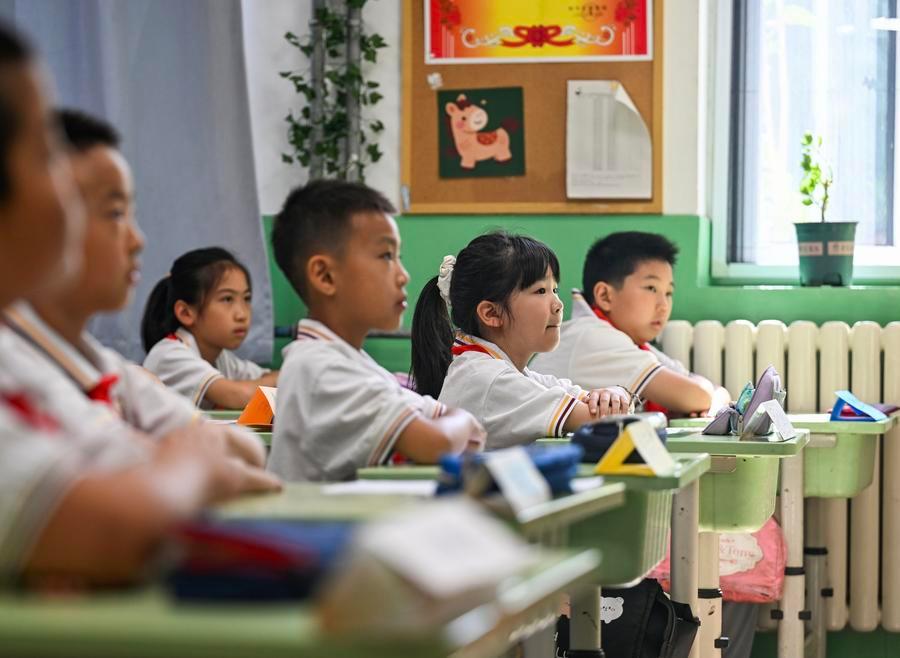
BEIJING, Sept. 3 (Xinhua) -- The overall myopia rate among Chinese students stood at 49.9 percent in 2025, a 3.7 percentage points drop from 2018, the National Administration of Disease Control and Prevention said Thursday.
The figure also marked a continuous decline over the past five years, the administration added.
In 2018, China released measures to curb rising myopia among children and teenagers, urging coordinated action from schools, households, healthcare institutions and government bodies to tackle the issue.
Heavy academic workloads, insufficient outdoor time and excessive screen use had been widely cited as major barriers to curbing rising myopia among young people.
Earlier this year, the Ministry of Education rolled out new guidelines to develop "healthy schools," mandating at least two hours of daily physical activity for primary and secondary students and the extension of class breaks from 10 minutes to 15 minutes.
During this year's "two sessions" -- the annual meetings of China's top legislature and political advisory body, Education Minister Huai Jinpeng called for sustained work to ensure every student acquires at least one sporting skill to benefit them for life.
Huang Hong, a physical education teacher with 37 years' experience at Beijing Bayi School, said middle and high-school students there have seen a clear increase in PE class time in recent years.
The school has introduced over a dozen elective courses, including martial arts, fencing and boxing, ensuring that every student can find a sport they enjoy.
The "healthy school" framework also calls for comprehensive measures to prevent and control myopia, especially during key stages in kindergartens and primary schools, with the goal of accelerating the decline in China's myopia rates.
At a primary school in Pingli County in northwest China's Shaanxi Province, posture-correcting devices, eye-friendly lighting and a dedicated vision-care room have been installed to protect children's eyesight.
These efforts cut the school's student myopia rate by three percentage points from the level recorded five years ago, said Wu Jinpeng, the school's principal. ■